
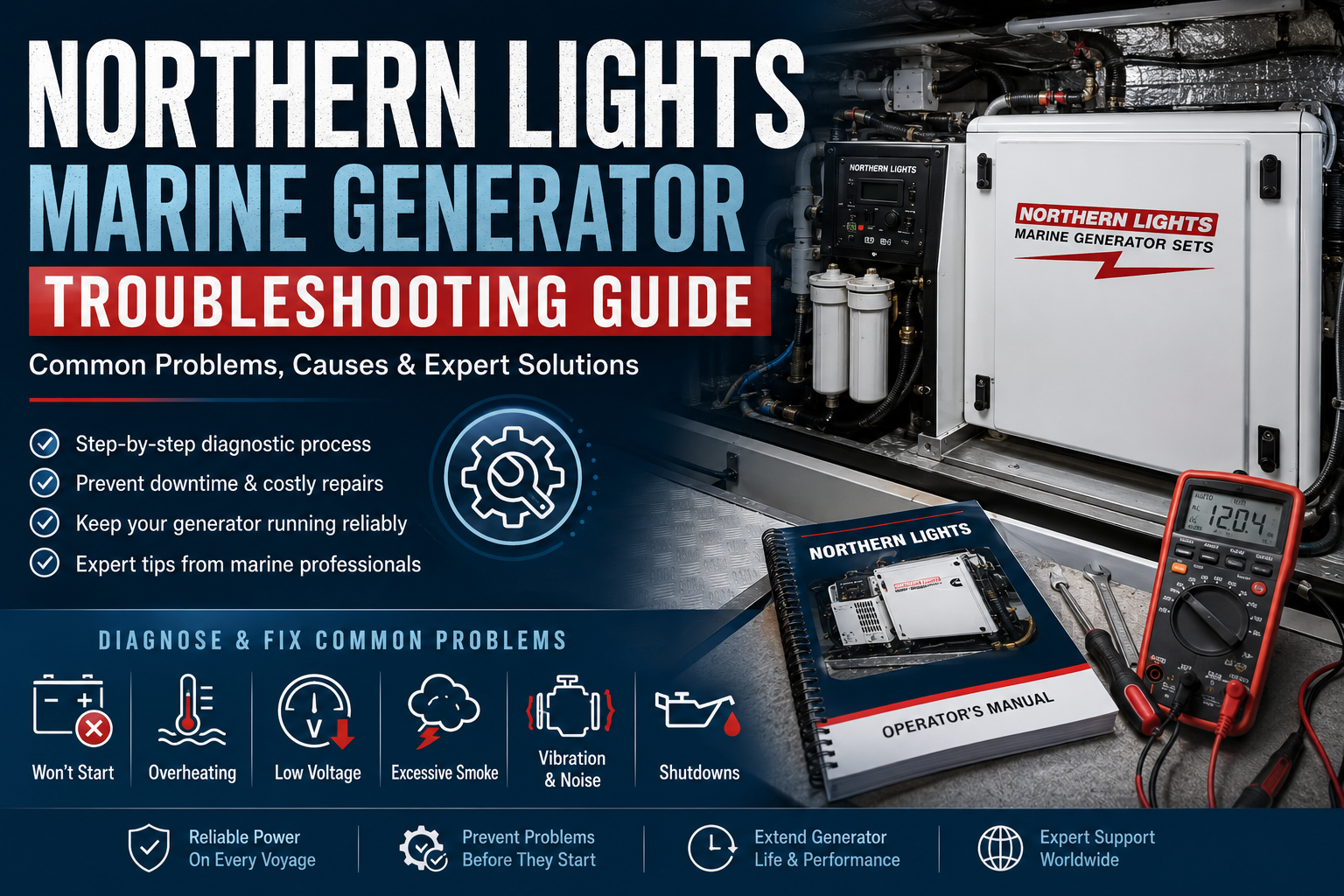
Northern Lights marine generators have earned a reputation for exceptional reliability in some of the world’s most demanding marine environments. From luxury yachts and long-range cruising sailboats to commercial fishing vessels, ferries, tugboats, and offshore workboats, these generators are trusted to provide dependable onboard electrical power day after day.
Like any diesel-powered machine, however, even the most reliable generator requires regular maintenance and systematic troubleshooting to perform at its best. Most generator failures don’t happen suddenly. They often begin as small issues—a partially blocked sea strainer, a worn raw water impeller, contaminated fuel, or a weak battery—that gradually develop into more serious problems if left unaddressed.
At Generator Plus, we regularly advise boat owners and marine professionals that successful troubleshooting is rarely about replacing parts at random. Experienced marine technicians follow a logical diagnostic process, beginning with the simplest inspections before moving on to more advanced testing. This approach saves time, reduces unnecessary repair costs, and often identifies the root cause before significant damage occurs.
Whether you operate a compact Northern Lights Marine Generator Troubleshooting Guide on a sailing yacht or a high-output commercial unit powering critical onboard systems, understanding how to diagnose common faults will help improve reliability, minimise downtime, and extend the service life of your investment.
This guide explains the most common Northern Lights marine generators problem, what typically causes them, and the practical steps experienced marine engineers use to identify and resolve faults safely.
Why Northern Lights Marine Generators Experience Problems
Northern Lights generators are engineered for continuous marine service, but their performance depends heavily on routine maintenance and operating conditions.
One of the biggest misconceptions among boat owners is that because Northern Lights generators are known for durability, they require very little attention. In reality, many service calls involve generators that have simply missed routine maintenance or have been affected by conditions commonly found in the marine environment.
Some of the most frequent causes of generator problems include:
- Contaminated diesel fuel
- Water entering the fuel system through condensation
- Worn raw water impellers
- Blocked sea strainers
- Restricted heat exchangers
- Corroded electrical terminals
- Weak batteries
- Loose drive belts
- Low coolant level
- Extended periods without operation
- Excessive electrical loading
Saltwater, humidity, vibration, and long operating hours all contribute to gradual wear. When small issues are ignored, they often develop into overheating, poor electrical output, difficult starting, or automatic shutdowns.
This applies across the Northern Lights product range, from compact commercial units like the Northern Lights M20CRW3 20/16kW Commercial Marine Generator to larger continuous-duty systems such as the Northern Lights M1064 Series 40–99kW Marine Generator, Northern Lights M116A13L 116kW Marine Generator, Northern Lights M1066 Series 120–185kW Marine Generator, and Northern Lights M1305 Series 185–300kW Marine Generator.
Regardless of generator size, preventative maintenance remains the most effective way to avoid unexpected failures.
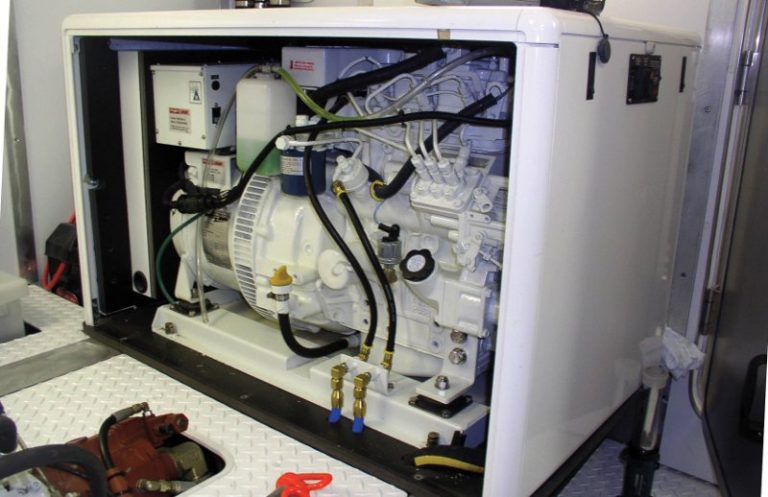
Safety Before Beginning Any Troubleshooting
Before inspecting or servicing a Northern Lights generator, always place safety first.
Marine generators combine diesel fuel, seawater cooling systems, rotating machinery, and high-voltage electrical output. Even routine inspections should be carried out carefully and in accordance with the manufacturer’s recommendations.
Before troubleshooting:
- Shut the generator down completely.
- Allow hot components to cool.
- Turn off connected AC loads.
- Isolate battery power when working on electrical circuits.
- Close the seawater intake if removing raw water components.
- Wear suitable eye and hand protection.
- Never bypass safety shutdown devices.
- Keep loose clothing away from rotating belts and pulleys.
If your generator displays repeated shutdown alarms, produces heavy smoke, suffers severe overheating, or develops fuel leaks, discontinue operation until the fault has been identified.
Generator Plus Technician Tip
One of the most common mistakes we see is owners replacing expensive components before confirming the actual fault. A generator that shuts down because of overheating may simply have a blocked sea strainer or a damaged impeller rather than a failed temperature sensor. Following a structured diagnostic process is almost always faster and less expensive than replacing parts by trial and error.
Northern Lights Generator Troubleshooting Workflow
Professional marine engineers rarely begin with the most complicated diagnosis. Instead, they eliminate the simplest possibilities first before progressing to more advanced inspections.
A typical troubleshooting sequence follows this order:
| Step | Inspection |
|---|---|
| 1 | Confirm the reported symptom. |
| 2 | Check battery voltage and electrical supply. |
| 3 | Verify fuel level and fuel quality. |
| 4 | Inspect engine oil and coolant levels. |
| 5 | Check raw water flow and sea strainer. |
| 6 | Review warning lights or shutdown alarms. |
| 7 | Inspect belts, hoses, and visible leaks. |
| 8 | Test generator under electrical load if safe to do so. |
Working methodically helps identify the true cause of the problem while avoiding unnecessary repairs.
Quick Troubleshooting Reference
| Problem | Most Likely Cause | First Inspection |
|---|---|---|
| Generator won’t start | Weak battery or poor fuel supply | Battery voltage and fuel filters |
| Cranks but won’t fire | Air in fuel system | Fuel filter and fuel lines |
| Starts then shuts down | Low oil pressure or overheating | Oil level and warning alarms |
| High temperature alarm | Cooling restriction | Sea strainer and impeller |
| Low AC voltage | Engine speed or electrical issue | Generator load and RPM |
| Black smoke | Overloading or restricted air intake | Reduce load and inspect air filter |
| Excessive vibration | Loose mounts or alignment | Engine mounts and mounting bolts |
Problem 1: Northern Lights Generator Will Not Start
A generator that refuses to start can be frustrating, especially when preparing for a voyage. Fortunately, the underlying cause is often straightforward.
Experienced marine technicians usually begin by determining whether the generator fails to crank or cranks but does not start, as these symptoms point to different systems.
If the Generator Does Not Crank
Begin with the electrical system.
Inspect:
- Battery voltage
- Battery switch position
- Battery terminals
- Ground connections
- Starter motor wiring
- Main fuses
- Emergency stop switch
Even a battery that powers the control panel may not have sufficient capacity to crank the engine under load.
Corroded terminals, particularly in saltwater environments, are another common cause of poor starting performance.
If the Generator Cranks but Does Not Start
Attention should then shift to the fuel system.
Inspect:
- Fuel tank level
- Fuel shut-off valve
- Fuel filters
- Water separator
- Fuel lift pump
- Air leaks in fuel lines
- Contaminated diesel fuel
Fuel contamination remains one of the most common causes of difficult starting after vessels have been laid up for extended periods.
Generator Plus Technician Tip
Before replacing fuel injectors or electrical components, always replace clogged fuel filters if their service history is unknown. We’ve found that many hard-starting generators return to normal operation after restoring unrestricted fuel flow.
Whether your vessel is equipped with a Northern Lights M20CRW3 20/16kW Commercial Marine Generator or a Northern Lights M150A13 150kW Marine Generator, beginning with these basic inspections often identifies the fault quickly and avoids unnecessary repair costs.
Problem 2: Generator Starts but Shuts Down
A Northern Lights generator that starts normally before shutting down a few seconds or minutes later is usually responding to one of its built-in protection systems.
These safety systems are designed to prevent serious engine damage by automatically stopping operation if critical conditions are detected.
Common causes include:
- Low engine oil pressure
- High coolant temperature
- Restricted raw water flow
- Fuel starvation
- Air entering the fuel system
- Faulty shutdown sensor
- Electrical control fault
Begin by checking the control panel for warning lights or fault indications.
Next, inspect:
- Engine oil level
- Coolant level
- Raw water discharge
- Fuel supply
- Sea strainer
- Fuel filters
If cooling water is not flowing normally from the exhaust outlet, shut the generator down immediately and investigate the raw water circuit before attempting another restart.
Repeated restart attempts without identifying the cause can transform a minor cooling issue into a major engine repair.
Generator Plus Technician Tip
If a generator repeatedly shuts down under heavy electrical load but runs normally at idle, don’t immediately assume an electrical fault. Cooling system restrictions often become apparent only when the engine is working harder. Testing the generator under a controlled load while monitoring coolant temperature, oil pressure, charging voltage, and cooling water discharge provides a far more accurate diagnosis than simply observing idle operation.
Problem 3: Northern Lights Generator Overheats
Overheating is one of the most serious issues a marine generator can experience. Fortunately, it’s also one of the most preventable. In our experience, the majority of overheating problems are not caused by major engine failures but by restricted cooling water flow or overdue maintenance.
Northern Lights generators rely on a carefully balanced cooling system to maintain safe operating temperatures while producing continuous electrical power. If cooling efficiency is reduced, engine temperatures can rise quickly, particularly when the generator is operating under heavy load.
The most common causes of overheating include:
- Blocked sea strainer
- Worn raw water impeller
- Closed or partially closed seawater seacock
- Restricted heat exchanger
- Low coolant level
- Damaged raw water pump
- Air trapped in the cooling circuit
- Collapsed cooling hose
Begin troubleshooting by confirming that cooling water is being discharged normally from the exhaust outlet. A weak or intermittent discharge often indicates restricted raw water flow.
Next inspect:
- Sea strainer
- Raw water intake
- Raw water pump
- Impeller condition
- Heat exchanger
- Coolant reservoir
- Hose clamps
- Raw water hoses
Generator Plus Technician Tip
One of the first components we inspect during overheating complaints is the raw water impeller. Even when an impeller appears visually acceptable, rubber vanes can harden or remain permanently compressed after long periods without operation. We’ve seen generators overheat within minutes simply because an ageing impeller failed shortly after reaching operating temperature.
For many commercial operators, replacing the impeller annually is inexpensive insurance compared with the cost of repairing an overheated diesel engine.
Cooling system inspections are especially important for larger continuous-duty generators, including the Northern Lights M1064 Series 40–99kW Marine Generator, Northern Lights M116A13L 116kW Marine Generator, Northern Lights M120C13 Series 116kW Commercial Marine Generator, and those where extended operating hours place significant demand on the cooling system.
Problem 4: Low Voltage or Poor Electrical Output
A generator may run smoothly while still producing unstable or insufficient electrical power.
If lights flicker, voltage fluctuates, or onboard equipment struggles to operate correctly, the fault may lie within either the engine or the electrical generating system.
Common causes include:
- Generator overload
- Incorrect engine RPM
- Voltage regulator malfunction
- Loose electrical connections
- Alternator problems
- Fuel restriction affecting engine speed
- Poor battery charging
- Damaged wiring
Begin by reducing the electrical load.
Disconnect non-essential equipment and observe whether voltage stabilises. If normal voltage returns after reducing demand, the generator may simply be overloaded.
Next inspect:
- Generator frequency
- Engine speed
- Alternator wiring
- Control panel
- Circuit breakers
- Battery charging voltage
Generator Plus Technician Tip
Electrical problems are often misdiagnosed as alternator failures. Before replacing expensive electrical components, confirm that the engine is maintaining its correct operating speed under load. Even a small drop in engine RPM can affect voltage and frequency.
Commercial installations using models such as the Northern Lights M150C13 Series 150kW Commercial Marine Generator or the Northern Lights M1066 Series 120–185kW Marine Generator should always be tested under realistic operating loads to verify stable voltage before returning the vessel to service.
Problem 5: Excessive Exhaust Smoke
The colour of exhaust smoke provides valuable information about engine condition.
Rather than ignoring smoke, experienced marine technicians use it as one of the first diagnostic clues.
Black Smoke
Black smoke usually indicates incomplete combustion.
Possible causes include:
- Generator overload
- Dirty air filter
- Restricted air intake
- Injector wear
- Poor fuel atomisation
If black smoke appears only when heavy electrical equipment is operating, temporarily reduce the load and monitor whether the smoke clears.
White Smoke
White smoke may indicate:
- Cold engine
- Water contamination in diesel fuel
- Injector issues
- Low compression
- Poor combustion
A small amount of white smoke immediately after startup can be normal, particularly in cooler weather. However, persistent white smoke after the engine reaches operating temperature should be investigated.
Blue Smoke
Blue smoke generally indicates engine oil entering the combustion chamber.
Possible causes include:
- Worn piston rings
- Valve guide wear
- Turbocharger wear (where fitted)
- Excessive engine oil level
Persistent blue smoke should never be ignored because it often indicates internal engine wear requiring professional inspection.
Generator Plus Technician Tip
Avoid diagnosing engine problems based solely on exhaust smoke colour. Smoke should always be assessed alongside engine temperature, operating hours, fuel consumption, warning alarms, and recent maintenance history. Looking at the complete operating picture usually leads to a more accurate diagnosis.
Problem 6: Excessive Vibration or Unusual Noise
Marine generators naturally produce some vibration, but noticeable increases in vibration or unfamiliar mechanical noises should always be investigated.
Ignoring abnormal vibration can eventually damage:
- Fuel lines
- Cooling hoses
- Electrical wiring
- Engine mounts
- Exhaust components
Begin by inspecting:
- Engine mounting bolts
- Flexible engine mounts
- Generator alignment
- Belt condition
- Couplings
- Loose panels
- Exhaust supports
If vibration has increased gradually over time, deteriorated engine mounts are often responsible.
If vibration appears suddenly, shut the generator down immediately and inspect for loose components before restarting. Your Ultimate Guide to Northern Lights Marine Generators
Generator Plus Technician Tip
Many vibration complaints are eventually traced to mounting systems rather than internal engine faults. During routine servicing, inspect each mounting point for compression, cracking, corrosion, or movement. Replacing worn mounts early can prevent unnecessary stress on the generator and surrounding equipment.
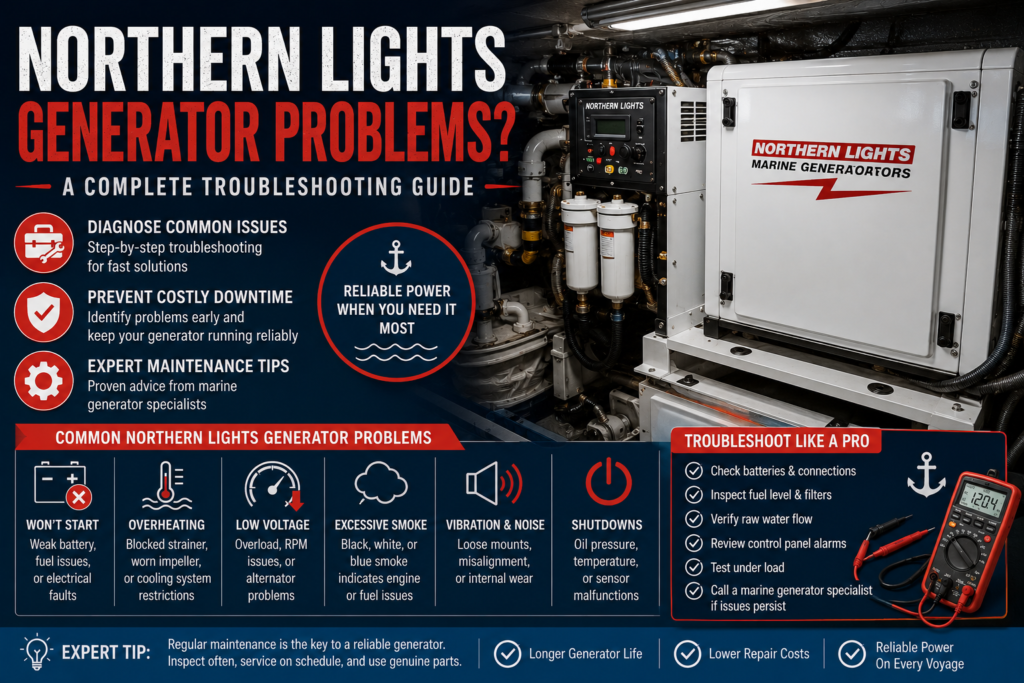
Preventative Maintenance Is the Best Troubleshooting Strategy
One of the biggest differences between recreational owners and experienced commercial operators is that commercial operators rarely wait for equipment to fail before taking action.
Instead, they follow planned maintenance schedules that identify wear before it develops into unexpected downtime.
Routine preventative maintenance helps:
- Improve generator reliability
- Extend engine life
- Reduce fuel consumption
- Maintain stable electrical output
- Prevent overheating
- Reduce emergency repair costs
Whether you’re operating a compact Northern Lights M20CRW3 20/16kW Commercial Marine Generator, a Northern Lights M20C13R Series 106kW Radiator-Cooled Marine Generator, or a larger commercial installation, following the manufacturer’s maintenance schedule remains the single most effective way to maximise generator lifespan.
Generator Plus Recommendation
Don’t wait for a warning alarm before servicing your generator.
Routine inspections of the fuel system, cooling circuit, belts, batteries, electrical connections, and exhaust components often identify small issues long before they interrupt a voyage. Preventative maintenance is almost always more economical than emergency repairs, particularly for commercial vessels where generator downtime can affect operations.
Recommended Northern Lights Marine Generator Maintenance Schedule
The best troubleshooting strategy is preventing problems before they occur. A structured maintenance schedule helps identify worn components early, improves reliability, and reduces the likelihood of costly repairs during the boating season.
While service intervals vary between models and operating conditions, the following maintenance schedule provides a useful guide. Always refer to the official Northern Lights service manual for your specific generator model.
| Maintenance Item | Recommended Interval |
|---|---|
| Check engine oil level | Before every trip |
| Inspect coolant level | Before every trip |
| Check sea strainer | Before every trip |
| Inspect raw water discharge | Every startup |
| Inspect belts and hoses | Monthly |
| Test battery voltage | Monthly |
| Clean battery terminals | Every 3–6 months |
| Replace engine oil and oil filter | According to Northern Lights service schedule |
| Replace fuel filters | According to service interval or if contaminated |
| Inspect raw water impeller | Annually or every 200–300 hours (whichever comes first) |
| Inspect heat exchanger | Annually |
| Inspect exhaust system | Annually |
| Perform full generator load test | Annually before peak boating season |
Generator Plus Technician Tip
One habit shared by experienced commercial operators is maintaining a detailed service log. Recording maintenance dates, operating hours, replaced parts, and any warning alarms makes future troubleshooting far easier and helps identify recurring issues before they become serious failures.
When Should You Repair or Replace Your Northern Lights Generator?
Not every generator fault requires replacement. In many cases, replacing service items such as filters, belts, impellers, hoses, or sensors is all that’s needed to restore reliable performance.
However, replacement may become the more economical option if:
- Major engine damage has occurred.
- Repair costs approach the value of the generator.
- The generator has accumulated very high operating hours.
- Electrical output no longer meets your vessel’s requirements.
- Parts availability has become limited.
- Fuel consumption has increased significantly.
- Reliability is affecting vessel operations.
If your vessel has grown in electrical demand due to additional air conditioning, navigation electronics, refrigeration, or other onboard systems, upgrading to a higher-capacity generator may also improve long-term performance and efficiency.
Generator Plus supplies genuine Northern Lights marine generators for both recreational and commercial applications, including:
- Northern Lights M20CRW3 20/16kW Commercial Marine Generator – A dependable solution for smaller commercial vessels, fishing boats, and auxiliary onboard power.
- Northern Lights M1064 Series 40–99kW Marine Generator – Suitable for larger yachts, passenger vessels, and commercial marine applications requiring medium-capacity continuous power.
- Northern Lights M116A13L 116kW Marine Generator – Designed for demanding commercial operations where reliable electrical output is essential.
- Northern Lights M120C13 Series 116kW Commercial Marine Generator – Built for continuous-duty marine environments with consistent onboard power requirements.
- Northern Lights M20C13R Series 106kW Radiator-Cooled Marine Generator – An ideal option where radiator-cooled configurations are preferred.
- Northern Lights M150A13 150kW Marine Generator – Well suited to large commercial vessels and heavy-duty marine applications.
- Northern Lights M150C13 Series 150kW Commercial Marine Generator – Designed for vessels operating extended hours under substantial electrical loads.
- Northern Lights M1066 Series 120–185kW Marine Generator – A versatile solution for larger yachts, ferries, offshore vessels, and commercial fleets.
- Northern Lights M1305 Series 185–300kW Marine Generator – Engineered for high-capacity commercial and offshore operations where uninterrupted power is critical.
Our technical team can help you compare these models based on your vessel’s electrical demand, available installation space, duty cycle, and future operational requirements. Safe Harbour | Northern Lights Cooling System Maintenance.
When Should You Contact a Marine Generator Specialist?
Many routine inspections can be carried out by experienced boat owners. However, some faults require specialist diagnostic equipment and marine engineering expertise.
Professional assistance is recommended if your Northern Lights generator experiences:
- Repeated shutdowns despite normal fluid levels.
- Persistent overheating after impeller replacement.
- Low or unstable AC voltage.
- Frequent circuit breaker trips.
- Continuous warning alarms.
- Excessive black, white, or blue exhaust smoke.
- Significant vibration or knocking noises.
- Fuel injection or governor faults.
- Alternator or automatic voltage regulator (AVR) issues.
- Electronic control panel faults.
Modern Northern Lights generators incorporate sophisticated monitoring and protection systems. Correct diagnosis often requires more than simply replacing parts—it involves understanding how the engine, alternator, cooling system, and electrical controls interact under load.
Generator Plus Technician Tip
If the same fault returns after replacing a component, stop replacing parts and start looking for the root cause. For example, repeatedly changing an impeller will not solve an overheating issue caused by a blocked heat exchanger or restricted seawater intake. A systematic diagnostic approach almost always produces faster and more cost-effective repairs.
Frequently Asked Questions
Why won’t my Northern Lights marine generator start?
The most common causes include a weak battery, contaminated diesel fuel, clogged fuel filters, loose electrical connections, air in the fuel system, or an activated safety shutdown. Always begin with the simplest inspections before assuming a major mechanical failure.
Why does my generator start and then shut down?
Automatic shutdowns are usually triggered by low oil pressure, overheating, restricted fuel supply, or sensor-related faults. Review the control panel for warning indicators and inspect the oil level, coolant level, and raw water flow before restarting the generator.
What causes a Northern Lights generator to overheat?
The most common causes are blocked sea strainers, worn raw water impellers, restricted heat exchangers, low coolant levels, closed seawater seacocks, or damaged cooling hoses. Any overheating issue should be resolved immediately to avoid internal engine damage.
How often should the raw water impeller be replaced?
Although replacement intervals vary by operating conditions, many experienced marine engineers inspect the impeller annually and replace it if there is any uncertainty regarding its condition or service history. Preventative replacement is considerably less expensive than repairing an overheated engine.
Can contaminated diesel fuel cause generator shutdowns?
Yes. Water contamination or microbial growth can restrict fuel flow, clog filters, reduce injector performance, and cause difficult starting or unexpected shutdowns. Maintaining clean fuel and replacing filters at the recommended intervals is essential.
Why does my generator produce black smoke under load?
Black smoke usually indicates incomplete combustion caused by excessive electrical loading, restricted airflow, dirty air filters, or fuel system issues. Reducing the load and inspecting the air intake and fuel system are good starting points.
Can I troubleshoot electrical problems myself?
Basic inspections such as checking battery terminals, loose wiring, and visible connections can often be performed safely. However, alternator faults, AVR problems, control panel diagnostics, and AC electrical testing should normally be carried out by qualified marine technicians. A Buyer’s Guide to Choosing the Right Marine Generator.
Final Thoughts
Northern Lights marine generators have earned their reputation for reliability because they are engineered for demanding marine environments. However, even the most dependable generator relies on proper maintenance, quality fuel, an efficient cooling system, and timely servicing to deliver years of trouble-free operation.
When problems occur, avoid replacing parts based on guesswork. A structured troubleshooting process—starting with the battery, fuel system, cooling circuit, and warning indicators—will often identify the root cause far more quickly while reducing unnecessary repair costs.
Whether you’re maintaining a compact Northern Lights M20CRW3 20/16kW Commercial Marine Generator, upgrading to a Northern Lights M1066 Series 120–185kW Marine Generator, or specifying a Northern Lights M1305 Series 185–300kW Marine Generator for continuous commercial operation, preventative maintenance remains the most effective way to maximise reliability and protect your investment.
At Generator Plus, we support boat owners, shipyards, marine engineers, and commercial operators with expert product advice, genuine Northern Lights marine generators, technical guidance, and worldwide shipping. If you’re troubleshooting an existing generator, planning a replacement, or selecting a generator for a new vessel, our team is ready to help you find the right solution.
