


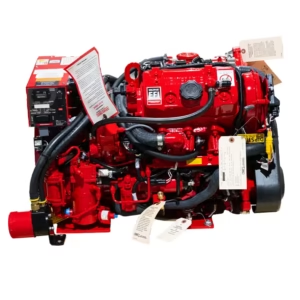


5.0 MCGB-614 Westerbeke 5.0 kW Multiport EFI – 60 Hz – 1800 RPM
€11.888,00
5.0 MCGB-614 Westerbeke 5.0 kW Multiport EFI – 60 Hz – 1800 RPM
€11.888,00
- Description
- Reviews (0)
Description
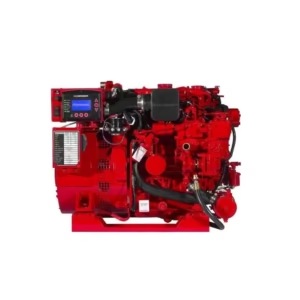
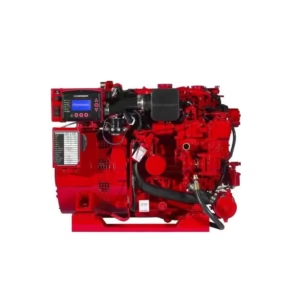
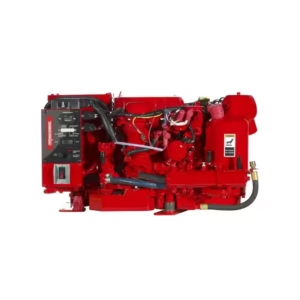
New Westerbeke 5.0 MCGB-614 5.0 kW 60 Hz Multiport EFI Marine Gasoline Generator For Sale
Compact Low-Speed Marine Power for Yachts and Recreational Vessels
The New Westerbeke 5.0 MCGB-614 5.0 kW 60 Hz Multiport EFI Marine Gasoline Generator is a compact, low-profile marine gasoline generator set engineered to provide dependable onboard electricity for motor yachts, express cruisers, sport-fishing boats, cabin cruisers, and other gasoline-powered recreational vessels.
Designed for compatible 120V, 60 Hz marine electrical systems, the Westerbeke 5.0 MCGB-614 delivers 5.0 kW of single-phase electrical power while operating at a low 1800 RPM. Its smooth three-cylinder industrial gasoline engine, sequential multiport electronic fuel injection, electronic governing, water-cooled returnless fuel system, brushless four-pole alternator, freshwater cooling, one-touch controls, and automatic safety shutdowns support reliable onboard operation.
The standard configuration supplies 120V AC power at approximately 41.6 amps, using a single-phase, four-wire arrangement with a power factor of 1.0. Its 5.0 kW capacity may support compatible marine air-conditioning systems, refrigeration, battery chargers, freshwater pumps, lighting, entertainment systems, water heaters, electrical outlets, and selected galley appliances, subject to a proper vessel electrical-load assessment.
The generator measures approximately 26.4 inches long, 18.4 inches wide, and 17.9 inches high. Westerbeke’s current product page lists a dry weight of approximately 343 lb., while the current advanced specification sheet lists 344 lb. The difference is minor, but installers should use the applicable serial-number-specific installation drawing when calculating vessel loading and mounting requirements.
Customers looking for the Westerbeke 5.0 MCGB-614 for sale should confirm the vessel’s voltage, frequency, continuous electrical demand, compressor-starting requirements, machinery-space dimensions, raw-water supply, exhaust arrangement, fuel-system compatibility, optional enclosure, and installation accessories before ordering.
Purpose-Built Westerbeke Marine Generator Engineering
The Westerbeke 5.0 MCGB generator is developed specifically for onboard marine electricity generation. Unlike portable household generators or general-purpose industrial units adapted for vessel use, it integrates marine cooling, a water-injected exhaust arrangement, electronic fuel management, gasoline ignition protection, vibration isolation, automatic safety monitoring, and vessel-compatible remote controls.
The generator is engineered for operating conditions that may include:
- Continuous vessel movement and vibration
- Salt-laden marine air
- High machinery-space humidity
- Elevated compartment temperatures
- Restricted installation space
- Changing electrical demand
- Extended operation away from shore power
- Vessel movement and inclination
Westerbeke describes the 5.0 MCGB as one of the most compact low-speed gasoline marine generators available. Its marine design combines a heavy-duty industrial engine with an installation footprint comparable to many higher-speed generator sets.
The lower operating speed of the 5.0 MCGB, combined with its industrial base engine, is intended to provide a longer-lasting and more dependable generator package than many compact high-speed alternatives.
The generator meets applicable United States Coast Guard requirements and is listed as meeting CARB and United States EPA regulations. Westerbeke also identifies the model as CE certified. Installation must still comply with the marine safety, electrical, ventilation, fuel, and exhaust requirements applicable to the vessel and country of operation.
The 5.0 MCGB remains listed in Westerbeke’s current-production Multiport EFI generator range and is backed by the manufacturer’s five-year limited warranty, subject to the applicable warranty terms, registration requirements, approved installation, and maintenance conditions.
Customers comparing the Westerbeke 5.0 MCGB price should consider more than its 5.0 kW output. Low-speed operation, Multiport EFI, electronic governing, freshwater cooling, low-CO engineering, service accessibility, alternator construction, safety monitoring, warranty coverage, and established parts support all contribute to the generator’s overall value.
Smooth Three-Cylinder Gasoline Engine Performance
The Westerbeke 5.0 MCGB-614 uses a naturally aspirated, three-cylinder, four-cycle gasoline engine arranged vertically inline.
Its published engine characteristics include:
- Three-cylinder vertical inline configuration
- Four-cycle gasoline operation
- Naturally aspirated air intake
- Approximately 48.5 cubic inches or 0.795 litres of displacement
- 2.70-inch bore
- 2.83-inch stroke
- 9.0:1 compression ratio
- Semi-spherical combustion chamber
- Electronic engine governing
- 1800 RPM operation at 60 Hz
- Approximately 13.2 horsepower at 1800 RPM
- Aluminium cylinder head
- Cast-iron cylinder block
- Forged crankshaft supported by four main bearings
- Overhead rotating valves
These specifications are published in Westerbeke’s current advanced specification sheet for the 4.2/5.0 MCGB generator platform.
The three-cylinder industrial engine provides smoother power delivery than many compact single-cylinder and twin-cylinder generator platforms. Its electronically controlled 1800 RPM operating speed also produces a lower mechanical frequency than the 3600 RPM speed commonly used by smaller 60 Hz gasoline generators.
Lower-speed three-cylinder operation may contribute to:
- Reduced mechanical vibration
- Smoother power delivery
- Lower operating noise
- Improved onboard comfort
- Reduced engine-speed variation
- Better suitability for extended operation
- Longer service life when correctly maintained
The generator is rated for a maximum operating inclination of approximately 25 degrees in all directions in Westerbeke’s current advanced specification sheet. The applicable installation and operating limits should always be checked against the generator identification plate and serial-number-specific documentation.
A properly sized marine gasoline generator allows vessel owners to operate essential AC systems while cruising or remaining at anchor without relying continuously on marina shore power.
5.0 kW Single-Phase Electrical Output
The standard Westerbeke 5.0 MCGB-614 configuration provides the following electrical ratings:
| Electrical Specification | Rating |
|---|---|
| Rated Electrical Output | 5.0 kW |
| Voltage | 120V |
| Frequency | 60 Hz |
| Electrical Configuration | Single Phase |
| Number of Wires | Four |
| Power Factor | 1.0 |
| Rated Current | 41.6 Amps |
| Engine Operating Speed | 1800 RPM |
| Starting Method | Remote Electric Start |
| Alternator Type | Brushless, Four Pole |
These electrical ratings are specified by Westerbeke for the MCGB-614 configuration.
The same engine-and-alternator platform is used for the 4.2 MCGB-514, which produces 4.2 kW at 230V and 50 Hz while operating at 1500 RPM. Westerbeke lists the platform as field-convertible between 50 Hz and 60 Hz. However, changing frequency also changes the engine speed, voltage arrangement, amperage, and rated output. Conversion should therefore be performed only by a qualified marine generator technician following Westerbeke’s approved procedures.
The vessel’s continuous electrical demand should remain within the generator’s rated output while preserving sufficient reserve for temporary startup loads.
Electrical systems that may require substantially more current during startup include:
- Marine air-conditioning compressors
- Refrigerators and freezers
- Freshwater pumps
- Seawater pumps
- Battery chargers
- Compact water makers
- Ventilation motors
- Galley appliances
- Electric water heaters
An undersized generator may experience:
- Voltage reduction
- Frequency instability
- Difficulty starting compressors
- Circuit-breaker operation
- Excessive engine loading
- Protective shutdown
- Increased operating temperature
- Reduced generator service life
A professional marine electrical load assessment should consider continuous demand, compressor and motor startup current, simultaneous appliance operation, battery-charger consumption, voltage drop, and a practical operating reserve.
A 5.0 kW generator should not automatically be expected to operate every onboard appliance simultaneously. Sensible load management may be required when starting air-conditioning compressors, water heaters, chargers, pumps, or other high-demand systems.
Multiport Electronic Fuel Injection
One of the principal features of the Westerbeke 5.0 MCGB-614 is its sequential multiport electronic fuel-injection system.
Multiport EFI supplies gasoline through electronically controlled fuel injectors rather than a traditional marine carburettor. Westerbeke states that the system supports optimum fuel efficiency, easier starting, improved reliability, reduced emissions, and advanced diagnostic capability.
The EFI system works with the generator’s electronic control unit, ignition components, engine sensors, electric fuel pumps, and electronic governor.
Potential benefits include:
- Easier cold and warm starting
- Precise fuel delivery
- Improved response to changing electrical loads
- Reduced carburettor-related maintenance
- Electronic fault monitoring
- Improved high-temperature performance
- More consistent engine operation
- Reduced exhaust emissions
The current Westerbeke operator’s manual covering the 5.0 MCGA/B platform specifies fresh unleaded gasoline. It also warns that fuel containing more than 10% ethanol is not approved and may affect warranty coverage.
Fuel quality remains essential. Water contamination, deteriorated gasoline, blocked filters, deposits, damaged fuel hoses, or prolonged storage of unstable fuel may cause difficult starting, poor operation, injector problems, or fuel-system damage.
A suitable marine gasoline water-separating filter should be installed between the vessel’s fuel tank and generator. Fuel hoses, shutoff valves, filters, electrical components, ventilation, and installation practices must comply with applicable marine gasoline-fuel standards.
Water-Cooled Returnless Fuel System
The Westerbeke 5.0 MCGB uses a water-cooled returnless gasoline fuel system designed to improve operation in elevated machinery-space temperatures.
The system helps reduce the risk of vapour lock by controlling fuel temperature before gasoline reaches the electronic injectors. Vapour lock can occur when heated gasoline forms vapour inside the fuel-delivery system, interrupting normal fuel flow and causing difficult starting, power loss, unstable operation, or engine shutdown.
Westerbeke specifically identifies vapour-lock prevention and improved performance in high ambient temperatures as benefits of the water-cooled returnless fuel system.
Published fuel-system characteristics include:
- Sequential Multiport EFI
- Electric fuel-transfer pump
- Water-cooled returnless fuel arrangement
- Electronic fuel and ignition control
- Engine-mounted fuel filtration
- 1/4-inch fuel-supply connection
- Advanced electronic diagnostic capability
The official advanced specification lists a 0.25-inch inside-diameter fuel-supply connection. Fuel hoses, fittings, shutoff valves, and filters should be installed using approved marine gasoline components and protected from heat, abrasion, and possible mechanical damage.
Low-CO Marine Generator Technology
The Westerbeke 5.0 MCGB belongs to the company’s low-carbon-monoxide Multiport EFI gasoline-generator range.
Westerbeke explains that its Multiport EFI marine generators are designed to reduce normal carbon-monoxide output through precise control of the engine’s air-to-fuel ratio and exhaust after-treatment.
Low-CO does not mean CO-free.
Carbon monoxide is colourless, odourless, and potentially fatal. Even a generator designed to produce reduced CO levels can create a dangerous situation if exhaust enters an engine compartment, cabin, cockpit, enclosed canvas area, swim-platform space, or another occupied part of the vessel.
A correctly installed gasoline-generator system should include:
- Functioning marine carbon-monoxide detectors
- Properly designed wet-exhaust routing
- Adequate machinery-space ventilation
- Secure exhaust hoses and clamps
- A correctly sized waterlift muffler
- Suitable exhaust-outlet placement
- Regular exhaust-system inspection
- Catalyst inspection where applicable
- Immediate investigation of every CO alarm
Westerbeke’s current operator’s manual states that the generator should not be operated unless the vessel is fitted with a functioning marine carbon-monoxide detector. It also recommends detectors in vessel living and sleeping areas and requires regular inspection of the exhaust system for leakage.
The operator’s manual additionally warns operators to run compartment blowers, maintain adequate ventilation, and avoid swimming or remaining near the generator exhaust outlet while the generator is operating.
Water intrusion into the exhaust system can damage emissions components and compromise generator operation. Proper exhaust design, correct siphon-break installation where required, and compliance with Westerbeke’s installation instructions are therefore essential.
Electronic Governing for Stable Frequency
The Westerbeke 5.0 MCGB-614 uses an electronic engine governor to maintain consistent engine speed as connected electrical demand changes.
When an air-conditioning compressor, pump, refrigerator, battery charger, or other electrical load starts, the engine experiences an immediate increase in mechanical demand. The electronic governor responds by adjusting throttle and fuel delivery to help maintain the rated 1800 RPM operating speed.
Westerbeke states that electronic speed control maintains constant engine speed, supports precise frequency regulation, and virtually eliminates the “bogging down” that can occur when electrical load is applied.
The published frequency regulation is approximately 0.5 Hz, or 1%, from no load to full load.
Stable frequency can improve the operation of:
- Marine air-conditioning systems
- Refrigeration equipment
- Battery chargers
- Freshwater pumps
- Electric motors
- Lighting circuits
- Entertainment equipment
- Sensitive onboard electronics
Generator stability still depends on correct wiring, proper grounding, suitable cable sizing, effective ventilation, circuit protection, and sensible load management.
Brushless Four-Pole Marine Alternator
The Westerbeke 5.0 MCGB-614 55-0-mcgb-614 uses a brushless four-pole revolving-field alternator designed for dependable onboard electricity generation.
Its published alternator features include:
- Brushless construction
- Four-pole design
- Revolving electrical field
- Capacitor voltage regulation
- Class H insulation
- Approximately ±5% voltage regulation
- Approximately 0.5 Hz frequency regulation
- Direct-connected cast centrifugal cooling blower
- Marine electromagnetic-interference control
These alternator characteristics are published in Westerbeke’s current advanced specification sheet.
The four-pole design enables the generator to produce 60 Hz electricity at 1800 RPM. By comparison, a two-pole 60 Hz generator normally operates at approximately 3600 RPM.
Potential benefits of the four-pole, low-speed arrangement include:
- Lower operating speed
- Reduced mechanical frequency
- Reduced brush-related maintenance
- Stable onboard electrical output
- Improved winding protection
- Better suitability for extended operation
- Lower operating noise than many high-speed alternatives
Westerbeke states that the alternator’s electromagnetic-interference performance exceeds the requirements of most marine radiotelephones and standard televisions. 5.0 MCGB-614 55-0-mcgb-614
Electrical performance depends on the complete vessel installation, including output-cable sizing, circuit breakers, neutral and grounding arrangements, transfer switching, ventilation, and load distribution.
Freshwater Cooling with Marine Heat Exchanger
The Westerbeke 5.0 MCGB-614 55-0-mcgb-614 uses a freshwater cooling system with a marine heat exchanger.
Internal coolant circulates through the engine and freshwater-cooled exhaust manifold. Raw water removes heat through the heat exchanger before being discharged through the generator’s water-injected marine exhaust system.
The cooling arrangement includes:
- Closed freshwater coolant circuit
- Marine heat exchanger
- Freshwater circulation pump
- Belt-driven raw-water pump
- Coolant-recovery tank
- Freshwater-cooled cast-aluminium exhaust manifold
- Water-injected exhaust elbow
- Thermostatic temperature control
The published cooling-system capacity is approximately 3.5 US quarts or 3.31 litres. The generator uses a 0.75-inch outside-diameter raw-water connection and a 2-inch outside-diameter exhaust-elbow connection. 5.0 MCGB-614 55-0-mcgb-614
| Cooling and Exhaust Specification | Rating |
|---|---|
| Cooling-System Capacity | 3.5 qt. / 3.31 L |
| Raw-Water Connection | 0.75 in. OD / 19.1 mm |
| Exhaust Connection | 2.0 in. OD / 50.8 mm |
| Cooling System | Freshwater with Heat Exchanger |
| Exhaust Manifold | Cast Aluminium, Freshwater-Cooled |
| Raw-Water Pump | Belt-Driven |
Routine cooling-system maintenance should include inspection of:
- Coolant level and condition
- Raw-water seacock
- Seawater strainer
- Raw-water pump impeller
- Freshwater circulation pump
- Drive belts
- Heat exchanger
- Cooling hoses and clamps
- Exhaust mixing elbow
- Waterlift muffler
- Wet-exhaust hose
- Siphon-break arrangement
Restricted raw-water flow, a blocked strainer, worn impeller, loose belt, fouled heat exchanger, restricted exhaust elbow, or inadequate machinery-space ventilation may cause overheating.
Fuel Consumption
Westerbeke publishes the following approximate fuel-consumption figures for the 5.0 MCGB-614 55-0-mcgb-614 operating at 1800 RPM:
| Generator Load | Approximate Fuel Consumption |
|---|---|
| 100% Load | 0.77 US gal/hr / 2.91 L/hr |
| 75% Load | 0.63 US gal/hr / 2.40 L/hr |
| 50% Load | 0.53 US gal/hr / 1.99 L/hr |
| 25% Load | 0.40 US gal/hr / 1.52 L/hr |
These are manufacturer-published approximate figures. Actual fuel consumption may vary according to electrical demand, gasoline quality, engine condition, maintenance, installation, machinery-space temperature, and operating environment. 5.0 MCGB-614 55-0-mcgb-614
One-Touch Starting and Automatic Safety Shutdowns
The Westerbeke 5.0 MCGB-614 55-0-mcgb-614 includes a simple one-touch start-and-stop control panel.
The standard control panel incorporates:
- One-touch start-and-stop operation
- Running-hour meter
- Warning-annunciation light strip
- AC circuit breaker
- DC control protection
- Connection provision for optional remote controls
Westerbeke lists the one-touch panel, running-hour meter, warning lights, and AC circuit breaker among the generator’s standard equipment.
Automatic safety systems are designed to warn the operator or stop the generator when potentially damaging conditions are detected.
Published warning and shutdown functions include:
- Engine overspeed
- Engine underspeed
- Low engine-oil pressure
- High exhaust temperature
- High engine-coolant temperature
- Additional electronic-control faults
These protection functions are listed in Westerbeke’s current product literature.
Other standard electrical and control features include:
- 12V electric starting motor
- 1.4 kW starter
- Integral battery-charging system
- 12V negative-ground electrical system
- Approximately 120 amps cranking draw at 70°F
- Electronic ignition and fuel control
- Remote-start capability
The current advanced specification identifies the charging system as 12 amps, while the Westerbeke product overview describes it as a 10-amp charger. Because of this document difference, the installed charging-system rating should be verified using the generator serial number and current parts documentation before quotation or replacement.
Automatic shutdown protection reduces the risk of serious generator damage but does not replace routine inspection. Engine oil, coolant, raw-water flow, fuel supply, exhaust components, belts, electrical connections, and compartment ventilation should be checked regularly.
Quiet 1800 RPM Operation
Noise and vibration are important considerations aboard vessels where the generator may be installed close to cabins, seating areas, or overnight accommodation.
The Westerbeke 5.0 MCGB-614 55-0-mcgb-614 combines:
- Smooth three-cylinder operation
- Electronically controlled 1800 RPM engine speed
- Precise electronic governing
- Heavy-duty industrial base engine
- Flexible vibration isolators
- Freshwater-cooled exhaust manifold
- Water-injected marine exhaust
- Low-profile installation design
Westerbeke describes the 5.0 MCGB-614 55-0-mcgb-614 as extremely smooth and quiet, noting that 3600 RPM generators are generally noisier than comparable 1800 RPM platforms and may require additional sound shielding to reach similar sound levels.
A properly installed quiet marine gasoline generator should also include:
- Correctly sized waterlift muffler
- Proper wet-exhaust routing
- Suitable machinery-space insulation
- Flexible fuel and cooling connections
- Correct vibration-isolator positioning
- Properly supported hoses and cables
- Adequate compartment ventilation
- Sufficient maintenance clearance
Final onboard sound levels depend on the complete installation rather than the generator alone. Hull construction, mounting strength, insulation, exhaust routing, ventilation openings, and structural vibration transfer all influence the result.
Optional Westerbeke Ventilated Enclosure
For installations requiring additional machinery protection and controlled ventilation, the Westerbeke 5.0 MCGB-614 55-0-mcgb-614 may be supplied with an optional factory ventilated enclosure.
Westerbeke states that the enclosure is not sold separately. It should therefore be specified with the generator package when required.
Approximate enclosure specifications are:
| Enclosure Measurement | Specification |
|---|---|
| Length | 30.3 in. / 768 mm |
| Width | 21.6 in. / 550 mm |
| Height | 18.8 in. / 477 mm |
| Enclosure Weight | Approximately 20 lb. / 9 kg |
The enclosure dimensions and weight are published in Westerbeke’s current advanced specification sheet.
The generator can also be ordered with an optional SIDEX water-injected exhaust elbow, allowing an alternative exhaust orientation where required by the vessel installation.
The ventilated enclosure must not be treated as a substitute for proper machinery-space ventilation. The vessel must still provide sufficient airflow for combustion, heat removal, gasoline-vapour evacuation, and safe generator operation.
Installation Dimensions and Weight
The approximate base-generator dimensions are:
| Measurement | Specification |
|---|---|
| Length | 26.4 in. / 671 mm |
| Width | 18.4 in. / 467 mm |
| Height | 17.9 in. / 455 mm |
| Dry Weight | Approximately 343–344 lb. / 156 kg |
| Maximum Operating Inclination | 25° in All Directions |
The dimensions and weight are published on Westerbeke’s current product page and advanced specification sheet.
Before installation, the vessel owner, boat builder, or marine engineer should confirm:
- Machinery-space dimensions
- Mounting-point positions
- Generator lifting and removal route
- Dry and operating weight
- Service clearances
- Machinery-space ventilation
- Ignition-protected electrical installation
- Raw-water inlet position
- Wet-exhaust routing
- Siphon-break requirements
- Fuel-supply connection
- AC output cable route
- Starting-battery cable route
- Remote-control harness route
- Carbon-monoxide detector placement
- Optional enclosure clearance
- Standard or SIDEX exhaust configuration
When replacing an existing marine gasoline generator, matching only its kilowatt output is insufficient. Voltage, frequency, phase, dimensions, weight, mounting centres, cooling, exhaust, fuel supply, ventilation, ignition protection, and control compatibility must also be evaluated. 5.0 MCGB-614 55-0-mcgb-614
Applications of the Westerbeke 5.0 MCGB-614
Motor Yachts
The generator may support compatible marine air conditioning, refrigeration, battery charging, water heating, lighting, freshwater pumps, entertainment equipment, and electrical outlets. Express Cruisers.
Its low-profile design and gasoline fuel system make it suitable for compatible gasoline-powered express cruisers requiring independent 120V electricity away from shore power.
Sport-Fishing Boats
The 5.0 MCGB-614 may provide electricity for refrigeration, bait-well pumps, battery chargers, lighting, marine electronics, and selected onboard appliances.
Cabin Cruisers
The generator may support overnight-comfort systems such as air conditioning, refrigeration, lighting, battery charging, water heating, and electrical outlets.
Day Boats and Weekend Cruisers
Its relatively compact footprint may suit vessels requiring useful auxiliary power without the installation size of a substantially larger generator.
Marine Refit Projects
The generator may be considered when replacing an ageing, unreliable, high-speed, or undersized gasoline generator, provided its mechanical, electrical, cooling, exhaust, fuel, and safety requirements are compatible with the vessel.
Technical Specifications of the Westerbeke 5.0 MCGB-614
| Specification | Details |
|---|---|
| Brand | Westerbeke |
| Model | 5.0 MCGB-614 |
| Generator Category | Multiport EFI Marine Gasoline Generator |
| Rated Electrical Output | 5.0 kW |
| Voltage | 120V |
| Frequency | 60 Hz |
| Electrical Configuration | Single Phase |
| Number of Wires | Four |
| Rated Current | 41.6 Amps |
| Power Factor | 1.0 |
| Engine Operating Speed | 1800 RPM |
| Starting Method | Remote Electric Start |
| Engine Configuration | Three Cylinders, Vertical Inline |
| Engine Cycle | Four-Cycle Gasoline |
| Aspiration | Naturally Aspirated |
| Displacement | 48.5 cu. in. / 0.795 L |
| Bore × Stroke | 2.70 × 2.83 in. |
| Compression Ratio | 9.0:1 |
| Combustion Chamber | Semi-Spherical |
| Engine Output | Approximately 13.2 HP at 1800 RPM |
| Governor | Electronic |
| Fuel System | Sequential Multiport EFI |
| Fuel Type | Unleaded Gasoline |
| Maximum Ethanol Content | E10 / 10% |
| Fuel Arrangement | Water-Cooled Returnless System |
| Fuel-Transfer Pump | Electric |
| Full-Load Fuel Consumption | 0.77 GPH / 2.91 LPH |
| Alternator Type | Brushless, Four Pole |
| Voltage Regulation | Approximately ±5% |
| Frequency Regulation | Approximately 0.5 Hz / 1% |
| Alternator Insulation | NEMA Class H |
| Cooling System | Freshwater with Heat Exchanger |
| Cooling-System Capacity | 3.5 qt. / 3.31 L |
| Raw-Water Connection | 0.75 in. OD |
| Exhaust Connection | 2.0 in. OD |
| Exhaust System | Water-Injected Marine Exhaust |
| Exhaust Manifold | Cast Aluminium, Freshwater-Cooled |
| Lubricating-Oil Capacity | 3.0 qt. / 2.8 L |
| Oil Filter | Full-Flow Spin-On Element |
| Starting System | 12V DC, Negative Ground |
| Starting Motor | 1.4 kW |
| Battery Charger | Verify by Serial Number; Documents List 10–12 Amps |
| Cranking Draw | Approximately 120 Amps at 70°F |
| Remote Start Connection | Standard |
| Optional Enclosure | Ventilated Enclosure |
| Optional Exhaust | SIDEX Water-Injected Elbow |
| Maximum Operating Angle | 25° in All Directions |
| Approximate Dimensions | 26.4 × 18.4 × 17.9 in. |
| Approximate Dry Weight | 343–344 lb. / 156 kg |
| Frequency Conversion | Field-Convertible to 50 Hz |
| Production Status | Current Production |
| Warranty | Five-Year Limited Warranty |
The specifications above are based on Westerbeke’s current product page, February 2026 advanced specification sheet, and January 2026 operator’s manual. Individual configurations may vary according to serial number, installation, optional exhaust arrangement, and later manufacturer revisions. 5.0 MCGB-614 55-0-mcgb-614
Standard Equipment and Available Options
Typical standard equipment includes:
- Three-cylinder Westerbeke gasoline engine
- Sequential Multiport EFI
- Water-cooled returnless fuel system
- Electronic engine governor
- Brushless four-pole alternator
- One-touch start-and-stop control panel
- Running-hour meter
- Warning-annunciation light strip
- Automatic safety warnings and shutdowns
- Freshwater cooling system
- Marine heat exchanger
- Coolant-recovery tank
- Remote lubricating-oil filter
- AC output circuit breaker
- Integral battery-charging system
- Water-injected exhaust elbow
- Belt-driven raw-water pump
- Flexible vibration isolators
- Lubricating-oil drain hose
- Belt guard
- Operator’s manual
- Parts documentation
These standard features are listed by Westerbeke for the current 5.0 MCGB-614 55-0-mcgb-614 generator.
Available options may include:
- Remote start-and-stop panel
- Remote extension harness
- Onboard spare-parts Kit A
- Extended-cruising spare-parts Kit B
- Hydro-Hush muffler and fittings
- Anti-siphon valve with 3/4-inch stainless-steel loop
- Ship-to-shore transfer switch
- Auxiliary DC power adapter
- SIDEX water-injected exhaust elbow
- Factory ventilated enclosure
The ventilated enclosure is identified as an option that is not sold separately. The final package should therefore be confirmed during quotation.
Frequently Asked Questions
What is the Westerbeke 5.0 MCGB-614 price?
The Westerbeke 5.0 MCGB-614 55-0-mcgb-614 price depends on current availability, included controls, optional ventilated enclosure, exhaust configuration, installation accessories, packing requirements, shipping destination, and export documentation.
How much power does the Westerbeke 5.0 MCGB-614 55-0-mcgb-614 provide?
It delivers 5.0 kW at 120V and 60 Hz, with rated single-phase output of approximately 41.6 amps.
Is the Westerbeke 5.0 MCGB-614 55-0-mcgb-614 a diesel generator?
No. It is a marine gasoline generator powered by a naturally aspirated three-cylinder engine with sequential Multiport EFI.
What does Multiport EFI mean?
Multiport EFI uses electronically controlled fuel injectors to supply gasoline precisely to the engine. Westerbeke identifies easier starting, improved fuel efficiency, increased reliability, reduced emissions, and advanced diagnostics among its benefits.
What does low-CO mean?
Low-CO means the generator is engineered to reduce normal carbon-monoxide output through precise electronic fuel control and exhaust treatment. It does not mean that the exhaust is free from carbon monoxide. Proper ventilation, exhaust installation, emissions-system maintenance, and functioning CO detectors remain essential.
How many cylinders does the engine have?
The generator uses a three-cylinder vertical inline gasoline engine with approximately 0.795 litres of displacement.
What speed does the engine operate at?
The 5.0 MCGB-614 operates at an electronically controlled 1800 RPM when producing 60 Hz electricity.
What fuel does it use?
The engine uses fresh unleaded gasoline. Fuel containing more than 10% ethanol is not approved by Westerbeke.
How much fuel does it consume?
Published full-load fuel consumption at 1800 RPM is approximately 0.77 US gallons per hour or 2.91 litres per hour.
Does it include remote starting?
Yes. The generator is configured for remote electric starting, and optional remote start-and-stop panels and extension harnesses are available.
Is the 5.0 MCGB-614 55-0-mcgb-614 field-convertible to 50 Hz?
Westerbeke lists the platform as field-convertible between 50 Hz and 60 Hz. Conversion changes the engine speed and applicable electrical rating and should be completed only by a qualified technician following approved Westerbeke procedures.
Is an enclosure available?
Yes. Westerbeke lists an optional ventilated enclosure measuring approximately 30.3 × 21.6 × 18.8 inches and weighing approximately 20 lb. The enclosure is not sold separately.
Can it operate a marine air conditioner?
It may operate a compatible marine air-conditioning system, depending on the unit’s continuous demand, compressor-starting current, vessel wiring, and other simultaneous loads. A professional electrical-load assessment should be completed before purchase.
Can it replace another 5 kW marine generator?
Potentially. The installer must verify voltage, frequency, phase, dimensions, weight, mounting, fuel supply, ventilation, ignition protection, raw-water cooling, exhaust routing, electrical connections, and service access. 5.0 MCGB-614 55-0-mcgb-614
Request a Quote for the Westerbeke 5.0 MCGB-614
The New Westerbeke 5.0 MCGB-614 55-0-mcgb-614 kW 60 Hz Multiport EFI Marine Gasoline Generator is a dependable choice for owners of gasoline-powered vessels requiring compact, low-speed, and reliable marine auxiliary power.
Its 5.0 kW output, 120V single-phase configuration, smooth three-cylinder industrial engine, electronically controlled 1800 RPM operation, sequential Multiport EFI, water-cooled returnless fuel system, low-CO technology, brushless four-pole alternator, freshwater cooling, automatic safety protection, and optional ventilated enclosure make it suitable for a broad range of recreational marine applications.
Contact our marine generator specialists to confirm:
- Current stock availability
- Generator serial number and manufacturing date
- Warranty eligibility
- 120V, 60 Hz electrical configuration
- Included control panel and remote harness
- Standard or SIDEX exhaust arrangement
- Optional ventilated-enclosure availability
- Included installation accessories
- Packing dimensions and shipment weight
- Domestic or international shipping options
Reviews
There are no reviews yet.