
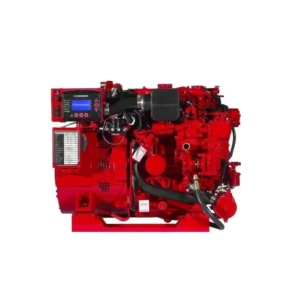
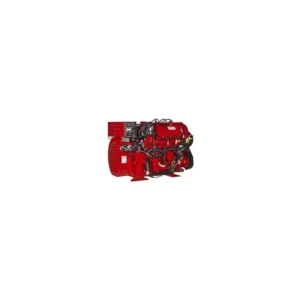
9.5 MCGA – 9.5 kW, 60 Hz low-CO Gas Generator
€19.288,00
9.5 MCGA – 9.5 kW, 60 Hz low-CO Gas Generator
€19.288,00
- Description
- Reviews (0)
Description
Here is the complete publishable product description for the Westerbeke 9.5 MCGA 9.5 Low-CO Marine Generator.
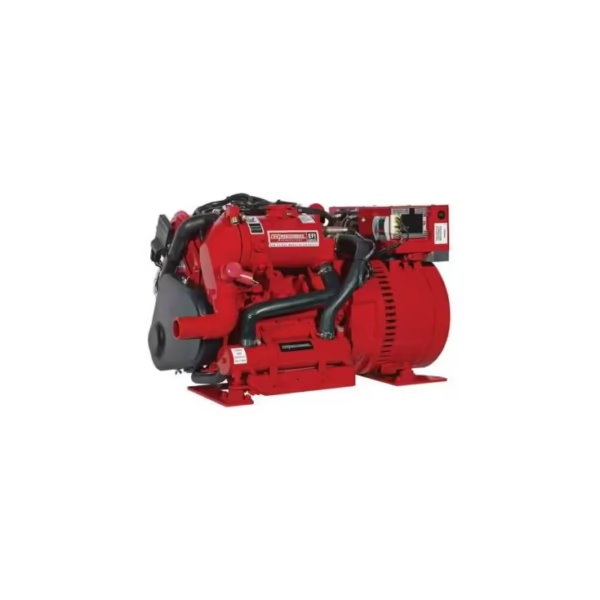
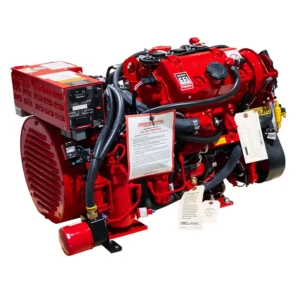
Westerbeke 9.5 MCGA 9.5 kW 60 Hz Low-CO Marine Gasoline Generator
Compact, Low-Speed Multiport EFI Power for Marine Applications
The Westerbeke 9.5 MCGA 9.5 kW 60 Hz Low-CO Marine Gasoline Generator is a compact, electronically controlled generator developed to provide dependable onboard electricity for gasoline-powered motor yachts, sport cruisers, houseboats, passenger vessels, and other compatible marine applications.
Delivering 9.5 kW at 120/240V, 60 Hz and 1800 RPM, the Westerbeke 9.5 MCGA combines a smooth four-cylinder industrial engine with sequential multiport electronic fuel injection, electronic governing, a water-cooled returnless fuel system, freshwater cooling, a brushless four-pole alternator, remote starting, automatic safety shutdowns, and Low-CO exhaust technology.
The standard 9.5 MCGA 9.5-614 configuration provides approximately 79.1 amps at 120V or 39.5 amps at 240V. Its low-profile dimensions make it suitable for installations where available machinery-space height and width are limited but dependable auxiliary output is still required.
Its electrical capacity may support compatible onboard systems such as:
- Marine air-conditioning systems
- Refrigerators and freezers
- Battery chargers and inverter-chargers
- Freshwater and seawater pumps
- Water makers
- Navigation and communication electronics
- Cabin and deck lighting
- Entertainment systems
- Electrical outlets
- Galley appliances
- Other compatible hotel and auxiliary loads
Actual suitability depends on the vessel’s continuous electrical demand, compressor and electric-motor starting current, simultaneous appliance use, distribution voltage, and required operating reserve.
Important Fuel-Type Clarification
The Westerbeke 9.5 MCGA 9.5 is a gasoline or petrol marine generator, not a diesel generator.
It uses sequential multiport electronic fuel injection and must be installed aboard a vessel with a properly engineered marine gasoline fuel system, approved fuel hoses, ignition-protected electrical components, adequate machinery-space ventilation, carbon-monoxide detectors, and a compliant wet-exhaust arrangement. 9.5 MCGA 9.5
Correctly identifying the generator’s fuel type is essential when planning:
- Fuel-tank compatibility
- Fuel-hose selection
- Fuel filtration
- Machinery-space ventilation
- Ignition-protected electrical systems
- Fire and explosion protection
- Exhaust routing
- Carbon-monoxide detection
- Applicable marine installation standards
The generator cannot be operated using diesel fuel. Installation and servicing should be completed by qualified marine technicians familiar with marine gasoline systems and Westerbeke EFI generators. 9.5 MCGA 9.5
Production and Availability Status
The Westerbeke 9.5 MCGA 9.5 is no longer in production. Westerbeke’s current model record continues to provide official advanced specifications, operator and parts manuals, wiring diagrams, installation drawings, service bulletins, diagnostic-software information, and common maintenance-part references.
Available generators may therefore consist of:
- Unused old-stock units
- Dealer or distributor surplus
- Previously installed low-hour generators
- Professionally reconditioned units
- Used generators removed during vessel repower or refit projects
Before purchasing an available Westerbeke 9.5 MCGA 9.5, confirm:
- Generator serial number
- Production date
- New, surplus, used, or reconditioned condition
- Total operating hours
- EFI and electronic-control condition
- Catalyst and exhaust-system condition
- Included control panel and wiring harness
- Included optional enclosure
- Maintenance history
- Warranty terms
- Replacement-parts availability
Any advertised Westerbeke 9.5 MCGA 9.5 price should be considered together with the unit’s condition, operating hours, included accessories, service records, catalyst history, and installation compatibility.
Low-CO, Low-Profile and Low-Speed Design
Westerbeke developed the 9.5 MCGA 9.5 as a compact, low-speed gasoline generator capable of delivering substantial electrical output without using the 3600 RPM speed common to many smaller marine gasoline generators.
The generator operates at an electronically controlled 1800 RPM. Its lower operating speed, heavy-duty industrial base engine, low-profile construction, and marine-specific systems were designed to deliver smooth, quiet, and reliable performance in restricted machinery spaces. 9.5 MCGA 9.5
Principal design features include:
- Four-cylinder industrial gasoline engine
- Sequential multiport electronic fuel injection
- Water-cooled returnless fuel system
- Electronic engine governing
- Low-CO exhaust technology
- Freshwater cooling with heat exchanger
- Freshwater-cooled exhaust manifold
- Water-injected exhaust elbow
- Belt-driven raw-water pump
- Brushless four-pole alternator
- One-touch start-and-stop control
- Remote-control capability
- Automatic warnings and shutdowns
- AC output circuit breaker
- Vibration isolators
- Remote lubricating-oil filter
- Optional ventilated enclosure
These features make the generator suitable for compatible original installations and marine generator replacement projects.
Smooth Four-Cylinder Gasoline Engine
The Westerbeke 9.5 MCGA 9.5 uses a naturally aspirated, four-cylinder, four-stroke gasoline engine with 64.1 cubic inches or approximately 1.051 litres of displacement.
The engine develops approximately 16.8 horsepower at 1800 RPM. Its construction includes an aluminium cylinder head, cast-iron cylinder block, forged crankshaft supported by four main bearings, overhead rotating valves, and a semi-spherical combustion chamber.
| Engine specification | Published value |
|---|---|
| Number of cylinders | 4 |
| Cylinder arrangement | Vertical inline |
| Engine cycle | Four stroke |
| Fuel type | Gasoline/petrol |
| Aspiration | Naturally aspirated |
| Displacement | 64.1 cu. in. / 1.051 L |
| Bore × stroke | 2.58 × 3.07 in. |
| Compression ratio | 9.0:1 |
| Rated output | Approximately 16.8 hp |
| Rated operating speed | 1800 RPM |
| Combustion system | Semi-spherical |
| Fuel system | Sequential Multiport EFI |
| Governor | Electronic |
| Electrical system | 12V DC, negative ground |
The four-cylinder configuration provides smoother power delivery than many compact twin- or three-cylinder generator platforms. Combined with low-speed operation and electronic governing, it helps reduce noticeable vibration and changes in engine speed as electrical demand increases.
9.5 kW Electrical Output at 60 Hz
The Westerbeke 9.5 MCGA 9.5-614 produces 9.5 kW of single-phase electrical power at 60 Hz.
| Electrical specification | Published rating |
|---|---|
| Generator model | 9.5 MCGA-614 |
| Rated electrical output | 9.5 kW |
| Voltage | 120/240V |
| Rated current | 79.1/39.5 amps |
| Frequency | 60 Hz |
| Phase | Single phase |
| Number of wires | Four |
| Power factor | 1.0 |
| Operating speed | 1800 RPM |
| Starting arrangement | Remote |
The 120/240V configuration is suitable for compatible North American and other 60 Hz marine electrical systems. The vessel’s neutral arrangement, grounding, circuit protection, shore-power transfer system, and connected appliances must be checked before installation.
Marine Electrical Load Planning
A professional marine electrical load calculation should be completed before selecting the Westerbeke 9.5 MCGA 9.5.
The calculation should account for:
- Continuous electrical demand
- Air-conditioning compressor startup
- Refrigerator and freezer compressor startup
- Freshwater-pump starting current
- Seawater-pump starting current
- Battery-charger demand
- Water-maker consumption
- Galley-appliance loads
- Lighting and entertainment systems
- Simultaneous equipment operation
- Planned electrical additions
- Desired generator reserve
Electric motors and compressors may temporarily require considerably more current during startup than during normal operation.
A generator may therefore appear correctly sized when only running wattage is considered but still experience difficulty when several high-demand systems start simultaneously.
Possible signs of generator overloading include:
- Voltage reduction
- Frequency instability
- Difficulty starting compressors
- Engine bogging
- Unstable lighting
- Excessive heat
- Circuit-breaker operation
- Automatic shutdowns
Electronic governing improves transient-load performance but cannot compensate for continuous overloading or incorrect generator sizing.
Field-Convertible 50 and 60 Hz Platform
The Westerbeke 9.5 MCGA shares its platform with the corresponding 7.6 MCGA 50 Hz generator.
| Configuration | Output | Voltage | Frequency | Speed |
|---|---|---|---|---|
| 9.5 MCGA-614 | 9.5 kW | 120/240V | 60 Hz | 1800 RPM |
| 7.6 MCGA-514 | 7.6 kW | 230V | 50 Hz | 1500 RPM |
Westerbeke originally described the generator as field-convertible between 50 and 60 Hz. Conversion affects engine speed, rated output, voltage connections, control settings, circuit protection, frequency, and compatibility with the vessel’s appliances.
Any conversion should be performed by a qualified Westerbeke technician using approved technical procedures.
Sequential Multiport Electronic Fuel Injection
The 9.5 MCGA 9.5 uses sequential multiport electronic fuel injection, commonly referred to as Multiport EFI or MPI.
Unlike a conventional carburettor, the EFI system electronically controls fuel delivery to the engine’s intake ports. Westerbeke identifies the principal benefits as efficient fuel delivery, easier starting, improved reliability, reduced normal emissions, and advanced diagnostic capability.
Potential benefits include:
- Easier cold and warm starting
- Precise fuel metering
- Consistent air-to-fuel control
- Improved response to changing electrical loads
- Reduced fuel-related hesitation
- Improved high-temperature operation
- Electronic fault diagnosis
- Reduced normal exhaust emissions
The EFI system works with electronic speed control to help prevent the engine from bogging down when substantial electrical loads are connected.
EC-11 Electronic Diagnostic Support
Westerbeke provides EC-11 diagnostic software for qualified technicians working on compatible EFI generators, including the 9.5 MCGA family.
The software provides detailed operating information that may assist with diagnosing:
- EFI sensor faults
- Fuel-delivery problems
- Electronic-governor issues
- Difficult starting
- Unstable engine speed
- Ignition-system faults
- Unexpected shutdowns
- Abnormal load response
Westerbeke recommends that its proprietary diagnostic software be used by qualified technicians.
Electronic diagnostics do not replace mechanical inspection, fuel-pressure testing, cooling-system checks, exhaust inspection, or routine maintenance.
Water-Cooled Returnless Fuel System
Gasoline may vaporise when exposed to high machinery-space temperatures. This can result in vapor lock, difficult starting, unstable operation, or interrupted fuel delivery.
The Westerbeke 9.5 MCGA 9.5 uses a water-cooled returnless fuel system designed to help regulate fuel temperature and improve operation in high ambient conditions.
A correctly installed marine gasoline fuel system should include:
- Approved gasoline-resistant marine hose
- Correctly sized fuel-supply piping
- An accessible fuel shutoff valve
- Suitable gasoline filtration
- Secure and leak-free fittings
- Correct grounding and bonding
- Ignition-protected electrical components
- Adequate machinery-space ventilation
- Routine fuel-leak inspections
The published fuel-supply connection is approximately ¼-inch internal diameter or 6.35 mm.
Westerbeke Low-CO Technology
The 9.5 MCGA 9.5 is a Low-CO marine gasoline generator.
Its electronically controlled fuel system helps maintain the correct air-to-fuel ratio, while exhaust after-treatment reduces normal carbon-monoxide emissions. Westerbeke describes its Low-CO generators as producing dramatically lower CO emissions than conventional marine gasoline generator designs.
Low-CO does not mean zero carbon monoxide.
Carbon monoxide remains:
- Colourless
- Odourless
- Tasteless
- Poisonous
- Potentially fatal
Every gasoline-generator installation should include:
- Functioning marine carbon-monoxide detectors
- Correct detector placement
- Adequate machinery-space ventilation
- A properly installed and leak-free exhaust system
- Correct exhaust-outlet positioning
- Routine catalyst and exhaust inspection
- Proper fuel- and ignition-system maintenance
- Professional CO testing where required
Low-CO technology reduces emissions but does not make gasoline exhaust safe to breathe.
Catalyst and Exhaust-System Inspection
The exhaust after-treatment system is important to the generator’s Low-CO performance.
Its effectiveness may be affected by:
- Seawater intrusion
- Incorrect fuel mixture
- Ignition-system faults
- Electronic-control faults
- Contaminated intake air
- Exhaust overheating
- Catalyst deterioration
- Exhaust leaks
The generator should not be operated with:
- A damaged catalyst
- A leaking exhaust connection
- A corroded water-injection elbow
- A faulty EFI component
- An inoperative carbon-monoxide detector
- Evidence of seawater entering the engine or exhaust system
The catalyst, exhaust elbow, muffler, exhaust hose, clamps, siphon break, and discharge outlet should be inspected according to the applicable Westerbeke service documentation.
Electronic Governing for Stable Frequency
The Westerbeke 9.5 MCGA 9.5 uses an electronic engine governor to help maintain the correct 1800 RPM speed as connected electrical demand changes.
When an air-conditioning compressor, pump, battery charger, or other substantial load starts, the engine experiences an immediate increase in mechanical demand. The electronic governor adjusts engine operation to minimise speed reduction and maintain stable 60 Hz power.
Westerbeke publishes frequency regulation of approximately 0.5 Hz, or 1%, from no load to full load.
Stable frequency supports compatible:
- Air-conditioning systems
- Refrigeration compressors
- Battery chargers
- Electric pumps
- Navigation electronics
- Communication systems
- Lighting circuits
- Entertainment equipment
- Monitoring systems
Brushless Four-Pole Alternator
The Westerbeke 9.5 MCGA 9.5 uses a brushless, four-pole revolving-field alternator.
Published alternator characteristics include:
- Brushless construction
- Four-pole electrical design
- Revolving electrical field
- Class H winding insulation
- Direct-connected centrifugal cooling blower
- Approximately ±5% voltage regulation
- Approximately 0.5 Hz frequency regulation
- Temperature rise within the applicable NEMA definition
The four-pole design allows the generator to produce 60 Hz electricity at 1800 RPM. Brushless construction reduces routine servicing associated with carbon brushes, while Class H insulation provides thermal protection for the windings.
Reliable onboard electrical performance still depends on correct:
- AC cable sizing
- Circuit protection
- Grounding and bonding
- Neutral configuration
- Shore-power transfer switching
- Cable separation
- Ventilation
- Load management
Freshwater Cooling with Marine Heat Exchanger
The Westerbeke 9.5 MCGA 9.5 uses a freshwater cooling system with a marine heat exchanger.
Internal coolant circulates through the cylinder block, aluminium cylinder head, and freshwater-cooled exhaust manifold. Raw water drawn through the vessel’s seawater intake removes heat through the heat exchanger before being discharged through the water-injected exhaust system.
The cooling arrangement includes:
- Closed freshwater coolant circuit
- Marine heat exchanger
- Coolant-recovery tank
- Freshwater-cooled exhaust manifold
- Belt-driven raw-water pump
- Water-injected exhaust elbow
- ¾-inch raw-water connection
The published cooling-system capacity is approximately 4.75 US quarts or 4.5 litres.
Routine cooling-system maintenance should include inspection of:
- Coolant level and condition
- Raw-water seacock
- Seawater strainer
- Raw-water pump and impeller
- Pump drive belt
- Heat-exchanger passages
- Cooling hoses and clamps
- Exhaust-injection elbow
- Siphon break
- Wet-exhaust hose
- Waterlift muffler
Restricted raw-water flow may cause high exhaust or coolant temperature and activate a protective shutdown.
Water-Injected Marine Exhaust
The 9.5 MCGA 9.5 uses a water-injected marine exhaust system with a published two-inch exhaust-elbow connection.
The exhaust system must be designed to:
- Carry exhaust safely outside the vessel
- Control exhaust temperature
- Prevent excessive back pressure
- Prevent seawater from entering the engine
- Reduce carbon-monoxide accumulation
- Prevent vessel flooding
An approved anti-siphon valve may be required where the exhaust water-injection point is near or below the vessel’s loaded waterline.
Incorrect exhaust design can cause:
- Seawater intrusion
- Catalyst damage
- Internal engine corrosion
- Exhaust leakage
- Carbon-monoxide exposure
- Engine failure
- Vessel flooding
The final arrangement should be designed by a qualified marine installer using the approved Westerbeke installation drawing.
Approximate Fuel Consumption
Westerbeke publishes the following approximate fuel-consumption figures for the 9.5 MCGA 9.5 operating at 1800 RPM:
| Generator load | Approximate gasoline consumption |
|---|---|
| 100% load | 1.24 US gal/hr / 4.68 L/hr |
| 75% load | 1.02 US gal/hr / 3.85 L/hr |
| 50% load | 0.79 US gal/hr / 3.00 L/hr |
| 25% load | 0.59 US gal/hr / 2.25 L/hr |
Actual fuel consumption will vary with connected load, engine condition, gasoline quality, ambient temperature, ventilation, installation, EFI-system condition, and maintenance.
One-Touch Control and Remote Starting
The Westerbeke 9.5 MCGA 9.5 was supplied with a straightforward one-touch start-and-stop control panel incorporating a running-hour meter and annunciation-light strip.
The original control and protection package included:
- Start-and-stop control
- Running-hour meter
- Warning-annunciation lights
- Electronic engine control
- AC output circuit breaker
- Automatic safety shutdowns
- Remote-control capability
An optional remote start-and-stop panel could be installed at the helm, saloon, electrical panel, or another suitable position aboard the vessel.
Automatic Safety Warnings and Shutdowns
The generator monitors potentially damaging operating conditions and can shut down automatically when a serious fault is detected.
Published protection includes:
- Engine overspeed
- Engine underspeed
- Low lubricating-oil pressure
- High exhaust temperature
- High engine-coolant temperature
- Additional monitored operating faults
These systems help protect the engine and generator but do not replace routine inspection of oil, coolant, raw-water flow, fuel connections, exhaust components, ventilation, and electrical wiring.
Starting System and Battery Charging
The 9.5 MCGA 9.5 uses a 12V, 1.4 kW electric starting motor and an integral battery charger.
| Starting-system specification | Published value |
|---|---|
| Electrical system | 12V DC, negative ground |
| Starting motor | 12V, 1.4 kW |
| Minimum cranking requirement | Approximately 120 amps at 70°F |
| Integral battery charger | 12 amps |
| Starting arrangement | Remote |
The generator’s starting battery should be correctly sized, properly secured, connected with marine-grade cables, and protected by suitable battery switching and circuit protection.
Smooth and Quiet 1800 RPM Operation
The Westerbeke 9.5 MCGA 9.5 combines several features intended to reduce operating noise and vibration:
- Low-speed 1800 RPM operation
- Smooth four-cylinder engine
- Electronic governing
- Flexible vibration isolators
- Freshwater-cooled exhaust manifold
- Water-injected exhaust system
- Heavy-duty industrial construction
Westerbeke described the four-cylinder 1800 RPM generator as extremely smooth and quiet compared with higher-speed 3600 RPM gasoline generator designs.
Final onboard sound levels also depend on:
- Generator foundation
- Machinery-space insulation
- Ventilation openings
- Muffler selection
- Exhaust-hose routing
- Flexible connections
- Hose and cable support
- Structural vibration transmission
- Optional enclosure selection
Optional Westerbeke Ventilated Enclosure
The Westerbeke 9.5 MCGA 9.5 was available with an optional ventilated enclosure, commonly known as a Venclosure.
| Enclosure measurement | Published specification |
|---|---|
| Length | 34.0 in. / 863 mm |
| Width | 22.6 in. / 573 mm |
| Height | 19.5 in. / 494 mm |
| Approximate weight | 30 lb. / 14 kg |
Westerbeke specified that the enclosure was not sold separately and therefore normally needed to be ordered with the generator.
The enclosure provides a finished protective installation while maintaining airflow around the generator. It does not replace correctly engineered machinery-space ventilation or ignition-protected blower arrangements.
Because the MCGA is discontinued, availability of a new enclosure or individual enclosure components should be confirmed before purchase.
Dimensions, Weight and Installation Planning
The Westerbeke 9.5 MCGA 9.5 has the following published base-generator dimensions:
| Measurement | Published specification |
|---|---|
| Length | 31.50 in. / approximately 800 mm |
| Width | 18.50 in. / approximately 470 mm |
| Height | 18.10 in. / approximately 460 mm |
| Dry weight | 445 lb. / 201.9 kg |
| Raw-water connection | ¾ in. / 19.1 mm |
| Exhaust connection | 2 in. / 50.8 mm |
| Fuel-supply connection | ¼ in. ID / 6.35 mm |
| Lubricating-oil capacity | 4.1 US qt / 3.9 L |
| Cooling-system capacity | 4.75 US qt / 4.5 L |
| Maximum operating angle | 25° in all directions |
The manufacturer states that general drawings are for reference and should not be used as final installation drawings. The approved model-specific drawing should be used when fabricating foundations and positioning fuel, seawater, exhaust, electrical, and control connections.
Before installation, confirm:
- Machinery-space dimensions
- Mounting-hole positions
- Lifting and removal route
- Routine service access
- Fuel-system compatibility
- Ignition-protected ventilation
- Raw-water intake arrangement
- Anti-siphon requirements
- Wet-exhaust routing
- Starting-battery cable size
- AC output cable size
- Grounding and bonding
- Shore-power transfer switching
- Carbon-monoxide detector placement
- Optional enclosure clearance
Applications of the Westerbeke 9.5 MCGA 9.5
Gasoline-Powered Motor Yachts
The generator is suitable for compatible vessels whose propulsion engines and onboard fuel-storage systems already use gasoline.
Sport Cruisers
Its compact height and 1800 RPM operation make it suitable for cruisers requiring power for air conditioning, refrigeration, charging, pumps, lighting, electronics, and comfort systems.
Houseboats and Liveaboard Vessels
The 9.5 MCGA 9.5 may support compatible refrigerators, freshwater systems, battery banks, lighting, outlets, entertainment systems, air conditioning, and galley appliances.
Passenger and Hospitality Craft
The generator may provide auxiliary electricity for lighting, refrigeration, communication systems, pumps, galley services, and passenger-comfort loads.
Marine Generator Replacement
The 9.5 MCGA 9.5 may replace an older gasoline generator when its fuel type, voltage, frequency, output, dimensions, weight, ventilation, cooling, exhaust, controls, and vessel wiring are compatible.
Complete Technical Specifications
| Specification | Details |
|---|---|
| Manufacturer | Westerbeke |
| Model | 9.5 MCGA-614 Low-CO |
| Generator type | Multiport EFI Marine Gasoline Generator |
| Rated output | 9.5 kW |
| Voltage | 120/240V |
| Frequency | 60 Hz |
| Phase | Single phase |
| Rated current | 79.1/39.5 amps |
| Number of wires | Four |
| Power factor | 1.0 |
| Operating speed | 1800 RPM |
| Engine cylinders | Four |
| Engine configuration | Vertical inline |
| Engine cycle | Four stroke |
| Aspiration | Naturally aspirated |
| Displacement | 64.1 cu. in. / 1.051 L |
| Bore × stroke | 2.58 × 3.07 in. |
| Compression ratio | 9.0:1 |
| Engine output | Approximately 16.8 hp |
| Fuel system | Sequential Multiport EFI |
| Fuel cooling | Water-cooled returnless system |
| Low-CO system | Electronic fuel control with exhaust after-treatment |
| Governor | Electronic |
| Alternator | Brushless, four pole |
| Voltage regulation | Approximately ±5% |
| Frequency regulation | Approximately 0.5 Hz |
| Winding insulation | Class H |
| Cooling system | Freshwater with heat exchanger |
| Exhaust manifold | Freshwater cooled |
| Raw-water pump | Belt driven |
| Starting system | 12V, 1.4 kW electric |
| Battery charger | 12 amps |
| Raw-water connection | ¾ inch |
| Exhaust connection | 2 inches |
| Lubricating-oil capacity | 4.1 qt / 3.9 L |
| Cooling capacity | 4.75 qt / 4.5 L |
| Approximate dimensions | 31.5 × 18.5 × 18.1 in. |
| Approximate dry weight | 445 lb. / 201.9 kg |
| Maximum operating angle | 25° in all directions |
| Diagnostic system | Westerbeke EC-11 compatible |
| Optional enclosure | Westerbeke Venclosure |
| Production status | Discontinued |
The technical figures above are based on Westerbeke’s official advanced specification sheet and current legacy model record. Final compatibility should be checked against the exact serial number and approved installation documentation.
Standard Equipment
Original standard equipment included:
- Four-cylinder gasoline engine
- Sequential Multiport EFI
- Water-cooled returnless fuel system
- Low-CO exhaust technology
- Electronic engine governor
- One-touch start-and-stop panel
- Running-hour meter
- Annunciation-light strip
- Automatic safety shutdowns
- Freshwater cooling
- Coolant-recovery tank
- AC output circuit breaker
- 12-amp battery charger
- Water-injected exhaust elbow
- Belt-driven raw-water pump
- Flexible vibration isolators
- Remote lubricating-oil filter
- Lubricating-oil drain hose
- Belt guard
- Operator’s manual
- Parts documentation
Original literature stated compliance with applicable US Coast Guard, CARB, US EPA, and CE requirements and advertised a five-year limited warranty. Warranty coverage for any generator currently offered for sale must be confirmed according to its serial number, condition, original registration, commissioning history, and seller’s terms.
Optional Equipment
Original optional accessories included:
- Remote start-and-stop controls
- Ventilated enclosure
- Rear-exhaust arrangement
- Hydro-Hush muffler and fittings
- Anti-siphon valve with stainless-steel loop
- Ship-to-shore transfer switch
- Auxiliary DC power adapter
- Onboard spare-parts kit
- Extended-cruising spare-parts kit
Availability of legacy accessories should be confirmed before finalising an order.
Frequently Asked Questions
Is the Westerbeke 9.5 MCGA 9.5 a diesel generator?
No. It is a gasoline or petrol marine generator with sequential multiport electronic fuel injection.
How much electrical power does it produce?
The generator produces 9.5 kW at 120/240V, 60 Hz and 1800 RPM, with a rated current of approximately 79.1/39.5 amps.
Is the Westerbeke 9.5 MCGA 9.5 still manufactured?
No. Westerbeke currently identifies the 9.5 MCGA 9.5 as a model that is no longer in production. Technical documents, parts information, diagnostic software, and common maintenance-part references remain available.
How many cylinders does the engine have?
The generator uses a naturally aspirated four-cylinder gasoline engine with approximately 1.051 litres of displacement.
Does it use electronic fuel injection?
Yes. It uses sequential Multiport EFI for precise fuel delivery, easier starting, improved load response, reduced normal emissions, and electronic diagnostics.
What does Low-CO mean?
Low-CO means the generator uses electronic fuel control and exhaust after-treatment to reduce normal carbon-monoxide emissions. It does not eliminate carbon monoxide or make the exhaust safe to breathe.
Is the generator electronically governed?
Yes. Electronic governing helps maintain 1800 RPM and stable 60 Hz output as electrical demand changes.
Is the engine freshwater cooled?
Yes. It uses freshwater cooling with a marine heat exchanger and a freshwater-cooled exhaust manifold.
Is a ventilated enclosure available?
The generator was originally offered with an optional Westerbeke Venclosure. Because the MCGA is discontinued, current enclosure availability should be confirmed.
How much fuel does the generator consume?
Westerbeke published approximate gasoline consumption of 1.24 US gallons per hour at full load and 0.79 US gallons per hour at 50% load. Actual consumption depends on generator condition, connected load, installation, and maintenance.
Can the 9.5 MCGA 9.5 replace another marine generator?
Potentially. Compatibility must be confirmed for fuel type, voltage, frequency, rated output, dimensions, weight, ventilation, exhaust, cooling, controls, and vessel wiring.
Request Pricing and Availability
The Westerbeke 9.5 MCGA 9.5 kW 60 Hz Low-CO Marine Gasoline Generator combines compact dimensions, low-speed 1800 RPM operation, smooth four-cylinder performance, sequential Multiport EFI, electronic governing, a water-cooled returnless fuel system, freshwater cooling, a brushless four-pole alternator, remote operation, and Low-CO marine technology.
Because this model is discontinued, customers should request confirmation of the generator’s condition, serial number, operating hours, EFI-control status, catalyst condition, included accessories, maintenance history, warranty coverage, and replacement-parts availability before purchasing.
Contact our marine generator specialists to check the latest Westerbeke 9.5 MCGA 9.5 price, available inventory, shipping arrangements, and compatibility with your vessel.
Reviews
There are no reviews yet.