
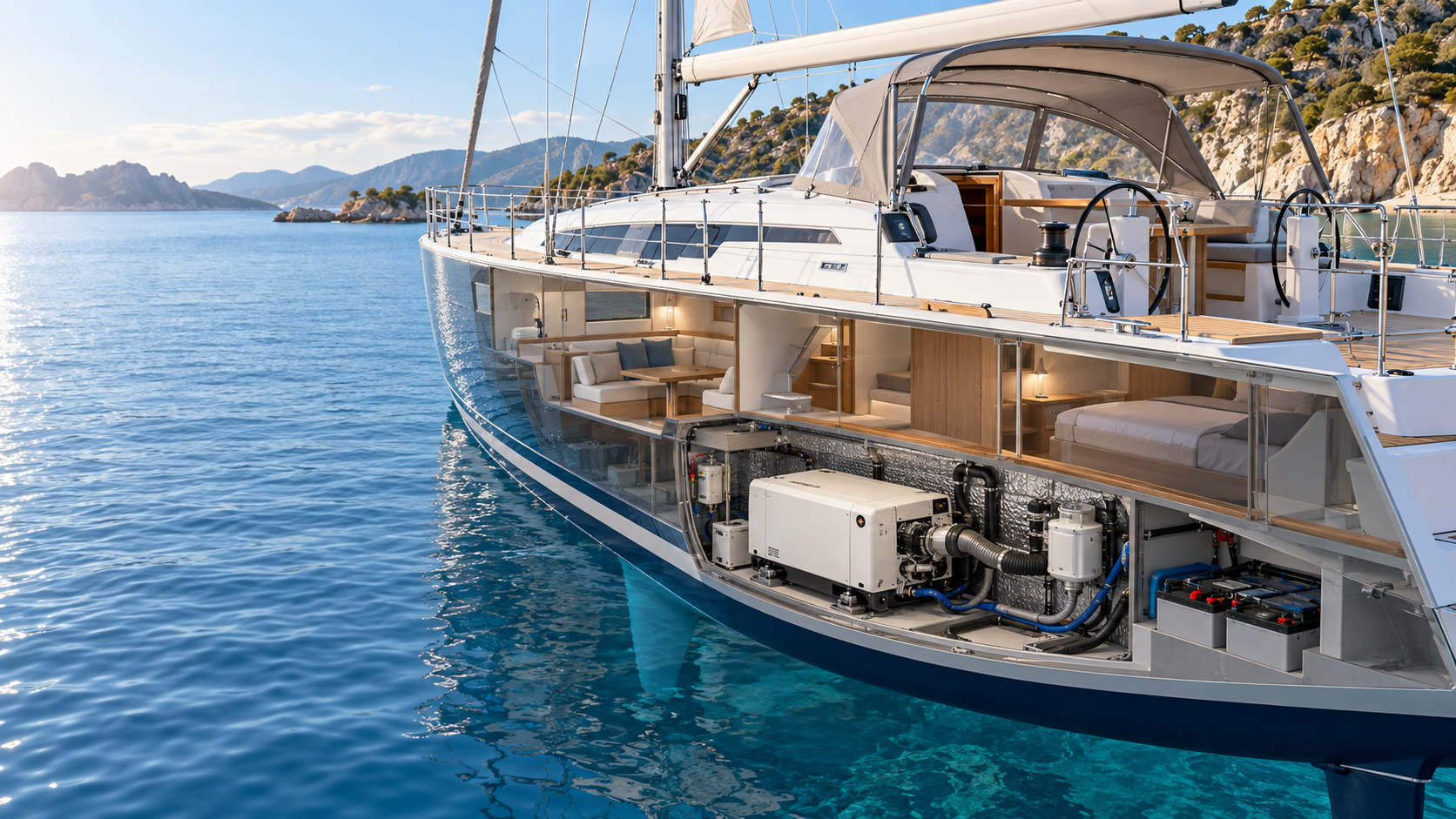
If you are searching for the quietest marine generator, you probably do not want silence for its own sake. You want to run air conditioning, refrigeration, battery chargers, watermakers and other onboard systems without turning the cabin into an engine room.
A practical example makes the problem clear. Imagine a yacht anchored in a quiet bay. The generator is powerful enough to run every major appliance, but guests still notice a low-frequency hum through the cabin floor. The owner checks the brochure and discovers that the generator was advertised as “quiet.” The issue is not necessarily the generator itself. It may be the mounting, exhaust, ventilation, sound shield or the way vibration is being transferred through the hull.
That is why choosing a quiet marine generator requires more than comparing one number on a product page.
The quietest marine generator is not always the model with the lowest published dB rating. It is the generator whose engine, enclosure, mounts, exhaust, ventilation and installation work together to control noise onboard.
This guide explains what to compare before buying a quiet marine generator for a boat, yacht, sailboat, catamaran or liveaboard vessel. Westerbeke 7.6 EGTD.
What Is the Quietest Marine Generator?
The direct answer
There is no single quietest marine generator for every vessel.
The correct choice depends on:
- The generator’s dB(A) rating
- Measurement distance
- Operating load during testing
- Sound-shield configuration
- Engine speed
- Vibration-isolation system
- Exhaust and muffler arrangement
- Ventilation design
- Machinery-space location
- Quality of installation
- Service and maintenance condition
A generator that produces a very low sound reading in an open-field test may be louder inside a yacht if it is mounted incorrectly or connected to the hull with rigid components.
The fairest way to compare a quiet yacht generator is to examine the complete noise-control system rather than relying on the word “silent.”
Why the lowest dB number may not be the quietest onboard
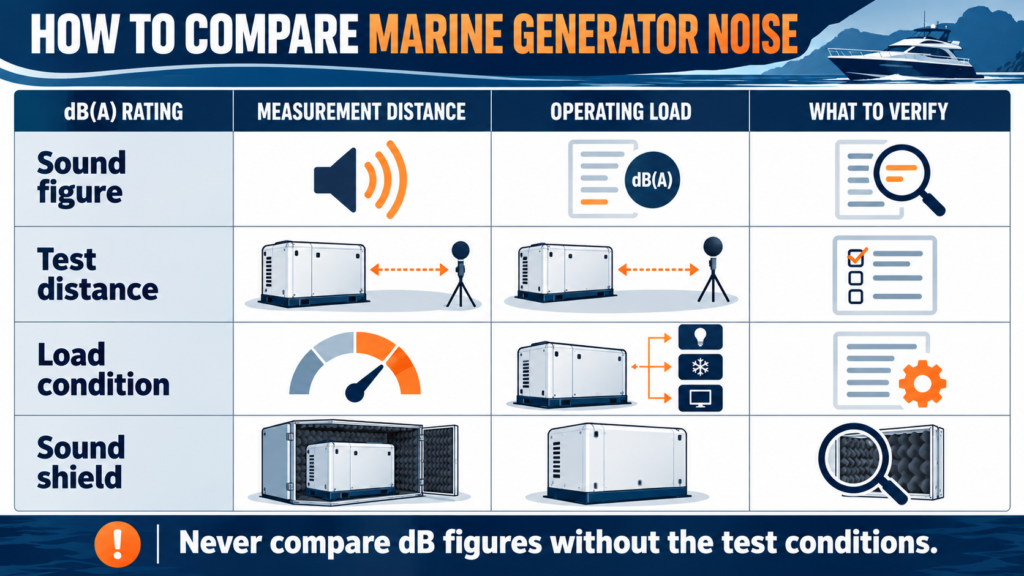
Manufacturers do not always test sound in identical conditions. One company may measure at 1 metre, another at 7 metres or 23 feet. One may test at half load, while another publishes a figure with no electrical load. Some figures include an acoustic enclosure; others describe the generator without one.
That means a sound figure is not meaningful by itself.
Before comparing two generators, ask:
- At what distance was the sound measured?
- What was the generator load?
- Was the sound shield installed?
- Was the test performed indoors or outdoors?
- Was the reading taken beside the generator or in an accommodation area?
- Was the result measured in dB(A)?
- Was vibration included, or was only airborne noise measured?
Current marine-generator comparison guidance emphasizes these exact factors: dB(A) rating, measurement distance, operating conditions, enclosure, vibration control, exhaust design and service support.
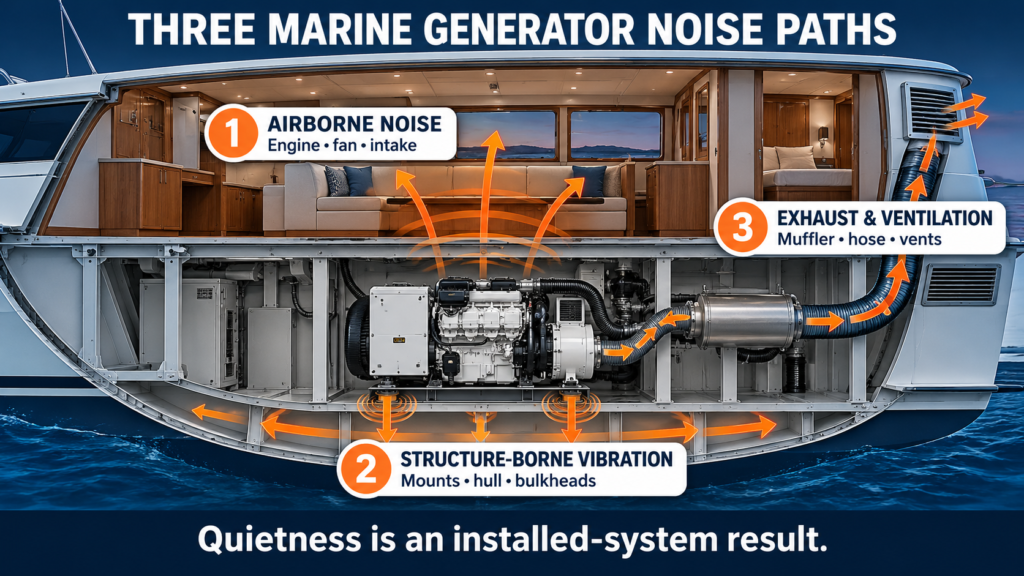
Quietness is an installed-system result
A marine generator is part of a larger mechanical and electrical system. The final noise level depends on how that system is installed.
For example, noise may increase when:
- A rigid exhaust pipe transfers vibration into a bulkhead
- Engine mounts are worn or incorrectly torqued
- A ventilation opening points toward a cabin
- The sound shield restricts cooling airflow
- The generator is installed directly below a sleeping area
- Flexible fuel and electrical connections are not properly designed
- The exhaust muffler is too small
- The machinery space amplifies low-frequency sound
This is why an experienced supplier should evaluate both the generator and the proposed installation.
What Makes a Marine Generator Quiet?
Engine and alternator noise
The engine is one of the obvious noise sources, but it is not the only one.
Noise can come from:
- Combustion pulses
- Engine speed
- Alternator rotation
- Cooling fans
- Fuel-injection events
- Belts and pulleys
- Pumps
- Mechanical resonance
- Loose panels or brackets
A low-speed generator may reduce some mechanical noise, but lower RPM does not automatically make every generator quieter. Alternator design, enclosure quality, mounting and exhaust routing remain important.
A high-quality low-noise marine diesel generator should be assessed as a complete assembly. The engine, alternator and control system must work together without creating excessive vibration or unstable operation.
Airborne noise
Airborne noise travels through the air from the generator into surrounding spaces.
Typical paths include:
- Engine-room ventilation openings
- Access hatches
- Machinery-space doors
- Bulkhead gaps
- Cooling-air ducts
- Exhaust outlets
- Unsealed sound-shield panels
A marine generator sound shield can reduce airborne mechanical noise by enclosing the engine and alternator. However, it must still allow enough air to enter and leave the enclosure for cooling.
If the enclosure is poorly ventilated, the generator may overheat or the cooling fans may run harder. That can create additional noise and reduce reliability.
A sound shield should therefore be evaluated for both acoustic performance and:
- Cooling-airflow capacity
- Corrosion resistance
- Service access
- Panel removal
- Fire-safety considerations
- Compatibility with the manufacturer’s installation instructions
Structure-borne vibration
Structure-borne vibration is one of the main reasons a generator can sound louder inside a cabin than beside the machine.
Vibration can travel through:
- Engine mounts
- Mounting rails
- Hull structure
- Bulkheads
- Exhaust pipes
- Fuel lines
- Electrical conduits
- Rigid brackets
The result is often a low-frequency hum or rumble. It may be felt through a cabin floor or berth even when the generator’s airborne sound seems acceptable.
Correct installation usually requires:
- Properly selected flexible mounts
- Correct mount compression
- Accurate alignment
- Flexible exhaust connections
- Flexible fuel and electrical connections
- Adequate structural support
- Isolation from accommodation bulkheads
For a quiet generator for liveaboard use, structure-borne noise deserves special attention because the generator may operate for several hours every day. Westerbeke Sound Guard.
Exhaust and ventilation noise
The exhaust system affects both sound and safety.
A typical marine exhaust system may include:
- Wet-exhaust hose
- Muffler
- Waterlock
- Siphon break
- Exhaust outlet
- Flexible connections
- Backpressure controls
The muffler and waterlock help absorb exhaust pulses and reduce sound leaving the vessel. However, an incorrectly sized exhaust system can create excessive backpressure, poor engine performance or increased noise.
Ventilation also matters. The engine needs sufficient air for combustion and heat removal, but ventilation openings can become direct sound paths. The intake and discharge should be located and treated so that they do not point directly toward sleeping cabins, cockpit seating or neighbouring boats.
Why marine generators differ from portable generators
A permanently installed marine generator is designed for a much more demanding environment than a portable camping or construction generator.
A marine-rated system must account for:
- Saltwater exposure
- Corrosion
- Wet exhaust
- Engine-room ventilation
- Remote starting
- Electrical integration
- Vibration control
- Fuel-system safety
- Cooling-water flow
- Long operating periods
A portable inverter generator may appear quiet when tested outdoors, but that does not automatically make it suitable for permanent onboard installation. Fuel storage, carbon-monoxide risk, exhaust routing, grounding, transfer switching and ventilation must be professionally assessed.
This is particularly important when searching for a silent boat generator. “Silent” is often a marketing term, not a guarantee of safe or quiet performance in a yacht’s machinery space.
How to Read a Marine Generator dB(A) Rating
What dB(A) means
Decibels measure sound pressure on a logarithmic scale. The “A” weighting in dB(A) adjusts the measurement to reflect how human hearing responds to different frequencies.
A dB(A) figure can help compare generators, but only when the testing conditions are comparable.
For example, a rating may be affected by:
- Engine speed
- Electrical load
- Distance
- Sound-shield status
- Test-room acoustics
- Background noise
- Frequency weighting
- Generator operating temperature
A lower number is useful only when you know what the number represents.
Measurement distance changes the result
Sound decreases as distance increases. A generator measured close to the enclosure will produce a different result from one measured several metres away.
Always identify whether the manufacturer measured at:
- 1 metre
- 2 metres
- 7 metres
- 23 feet
- A cabin location
- An open-field location
- A controlled laboratory
Do not compare a 60 dB(A) figure measured at 7 metres with a 63 dB(A) figure measured at 1 metre and assume the first generator is automatically quieter. Fischer Panda: Quietest Generator for a Boat.
Load condition changes the sound level
A generator often sounds different depending on the electrical load.
Compare test conditions at:
- No load
- Light load
- Half load
- Heavy load
- Full load
- Motor-starting events
Air-conditioning compressors, watermakers, refrigeration systems and pumps may create a temporary increase in mechanical noise and vibration when they start.
For this reason, a boat owner should ask for sound information under realistic operating conditions—not only at idle or no load.
Use a comparison table before buying
| Sound specification | Why it matters |
|---|---|
| dB(A) value | Shows measured sound pressure |
| Measurement distance | Makes competing results comparable |
| Operating load | Noise changes as demand changes |
| Sound-shield status | Enclosures can significantly affect results |
| Test environment | Open-field results may not represent cabin noise |
| Operating speed | RPM influences engine and alternator noise |
| Measurement location | Engine-room and cabin readings can differ |
Fischer Panda provides an example of why exact conditions matter: its official marine information publishes low-noise figures for selected models together with a stated measurement distance. Those figures should be treated as model-specific test data, not a universal rating for every Fischer Panda generator.
At Generator Plus, a professional recommendation should include the exact model, sound-shield configuration, measurement basis, electrical rating and installation requirements. That gives the buyer something verifiable instead of a vague promise that the generator is “quiet.”
The next section will introduce the BERTH Test for comparing quiet marine generators, then evaluate generator technologies, brands, installation factors and buying costs.
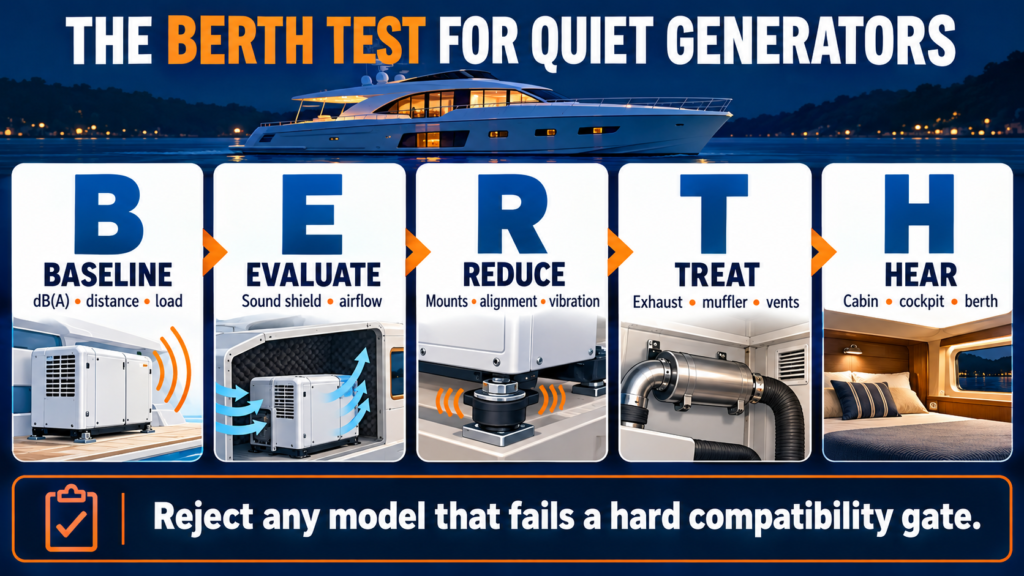
The BERTH Test for Comparing Quiet Marine Generators
A good quiet marine generator comparison needs a repeatable method. Otherwise, buyers end up choosing whichever product page uses the strongest word: silent, whisper-quiet or ultra-quiet.
At Generator Plus, a useful way to evaluate a generator is the BERTH Test:
- B — Baseline the sound measurement
- E — Evaluate the enclosure
- R — Reduce vibration
- T — Treat exhaust and airflow
- H — Hear the result onboard
This is not a manufacturer standard. It is a practical buying framework for comparing the complete installation rather than one isolated specification.
B — Baseline the sound measurement
Start with the published marine generator dB rating, but do not stop there.
Ask:
- What is the dB(A) figure?
- At what distance was it recorded?
- Was the generator under load?
- Was the sound shield installed?
- Was the test performed indoors or outdoors?
- Was background noise controlled?
- Was the result measured next to the generator or at an accommodation point?
A rating is useful only when the comparison conditions are similar. A generator measured at 1 metre cannot be fairly compared with another measured at 7 metres without accounting for the difference.
Also ask for sound information at a realistic operating load. A generator may be relatively quiet at no load but produce more engine, fan and exhaust noise when operating air-conditioning compressors, pumps or a watermaker.
E — Evaluate the enclosure
A marine generator sound shield can reduce airborne engine and alternator noise, but its design matters.
Check whether the enclosure:
- Is included in the quoted price
- Is designed for marine corrosion conditions
- Has sufficient cooling airflow
- Provides access to service points
- Can be removed without dismantling the installation
- Has treated intake and discharge openings
- Is approved for the exact generator model
The sound shield must reduce noise without restricting airflow. If the generator runs hotter because the enclosure is poorly ventilated, cooling fans may work harder and create additional noise.
An enclosure should also allow technicians to inspect filters, belts, impellers, coolant connections, electrical terminals and exhaust components. A box that is difficult to open may reduce noise temporarily but increase maintenance problems later.
R — Reduce vibration
Many owners describe generator noise as a hum or rumble rather than a sharp engine sound. That usually points toward structure-borne vibration.
Check:
- Flexible engine mounts
- Mount compression
- Mounting-foot positions
- Hull reinforcement
- Alignment
- Flexible exhaust connections
- Flexible fuel connections
- Flexible electrical conduits
- Isolation from accommodation bulkheads
A generator that is quiet beside the machinery space can still be disruptive in a cabin if vibration travels through the hull.
This is particularly important for a quiet generator for liveaboard vessels, where owners may run the generator for long periods while sleeping, working or entertaining guests onboard.
T — Treat exhaust and airflow
The exhaust system can influence both noise and engine performance.
Review:
- Wet-exhaust hose diameter
- Muffler or waterlock capacity
- Exhaust backpressure
- Siphon-break location
- Exhaust outlet location
- Flexible connections
- Distance from sleeping areas
- Air-intake and discharge routing
The ventilation system also requires careful planning. The generator needs sufficient combustion and cooling air, but large openings can transmit noise directly into the accommodation.
The goal is not to seal the engine room completely. The goal is to provide safe airflow while preventing the intake, fan and exhaust paths from becoming acoustic shortcuts into the cabin.
H — Hear the result onboard
The final test is practical: what does the generator sound like where people actually live?
Ask:
- Can someone sleep in the nearest cabin?
- Can guests hold a normal conversation?
- Is the low-frequency vibration noticeable through the floor?
- Is the cockpit comfortable while the generator runs?
- Can neighbouring boats hear the exhaust or cooling fan?
- Does the sound change dramatically when air conditioning starts?
Quiet Marine Generator Technologies to Compare
Low-speed marine generators
Low-speed generator sets may reduce certain types of mechanical noise and vibration. They can be attractive for yachts where acoustic comfort is important.
However, low speed may also affect:
- Generator dimensions
- Weight
- Installation footprint
- Cooling requirements
- Output characteristics
- Service access
- Purchase price
Do not assume that every 1,500 RPM marine generator is automatically quieter than every higher-speed unit. Compare the complete sound-control package and the actual test data.
Sound-shielded marine generators
Sound shields are among the most visible noise-control features on a marine genset. They can help contain:
- Engine combustion noise
- Alternator noise
- Fan noise
- Mechanical resonance
- Airborne sound leaving the machinery space
But a sound shield does not automatically solve:
- Hull vibration
- Poor engine mounts
- Rigid exhaust pipes
- Incorrect ventilation
- Worn engine components
- Loose panels
- Exhaust leaks
Westerbeke’s Sound Guard products provide an example of manufacturer-supported acoustic enclosures for marine diesel-generator ranges. The enclosure must still be matched to the exact generator and installed according to the manufacturer’s requirements.
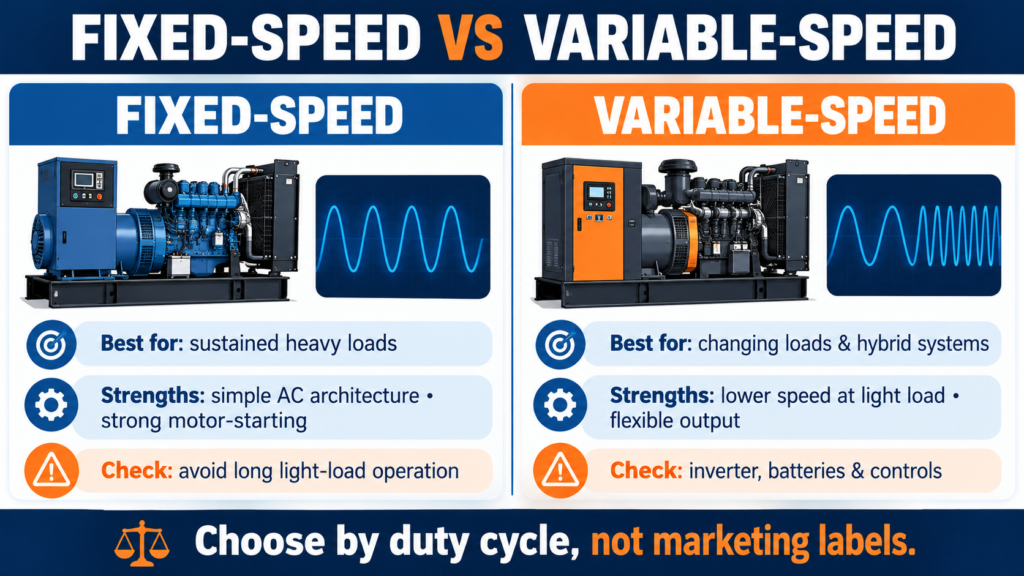
Variable-speed and inverter generators
A variable-speed marine generator can reduce engine speed during lighter electrical demand. This may lower noise and fuel consumption in certain operating conditions.
Variable-speed systems can be useful for:
- Hybrid battery systems
- Changing onboard loads
- Quiet anchorage operation
- Smaller or moderate electrical loads
- Vessels that do not run heavy equipment continuously
However, they may require more complicated integration between:
- Generator
- Inverter
- Battery bank
- Charger
- AC distribution system
- Monitoring controls
A variable-speed system is not automatically the right choice for a yacht with heavy air-conditioning loads, frequent motor starts or a conventional AC architecture.
Fixed-speed marine generators
A fixed-speed marine generator may be more suitable when the yacht has sustained electrical demand or requires strong motor-starting performance.
Potential advantages include:
- Familiar AC architecture
- Straightforward service procedures
- Stable operating frequency
- Strong compatibility with conventional switchboards
- Good suitability for regular heavy loads
The main risk is incorrect sizing. A fixed-speed generator that is substantially oversized may spend too much time at light load, while an undersized unit may operate loudly and inefficiently near maximum capacity.
Water-cooled and freshwater-cooled systems
Water cooling helps manage heat in a confined engine room. Freshwater cooling can also reduce the exposure of internal engine components to raw seawater.
When comparing a water-cooled marine generator, verify:
- Raw-water intake
- Seawater strainer
- Heat exchanger
- Freshwater circuit
- Coolant expansion tank
- Exhaust-water injection
- Cooling-air requirements
- Service access
A cooling system that is quiet but difficult to maintain is not a strong long-term solution.
Quiet Marine Generator Brands to Compare
Cummins Onan Quiet Diesel
A Cummins Onan marine generator may appeal to buyers who want:
- A widely recognized marine brand
- Multiple output classes
- 50 Hz and 60 Hz options
- Digital controls
- Strong motor-starting capability
- Established dealer and service support
Do not compare “Onan” as if it were one single product. Exact models differ in:
- Output
- Dimensions
- Frequency
- Phase
- Sound-shield configuration
- Control system
- Service access
- Installation requirements
Fischer Panda
A Fischer Panda marine generator is often considered for compact, sound-insulated, and space-sensitive installations.
Potential strengths include:
- Compact capsule design
- Freshwater cooling
- Low-noise packaging
- Variable-speed options
- Hybrid and battery-system compatibility
Fischer Panda publishes quiet-operation information for selected models, including figures measured at a stated distance. Those figures must be connected to the exact model and test conditions rather than applied to the entire brand.
Kohler and Rehlko
Kohler/Rehlko marine generators may be suitable for owners comparing:
- Sound-shield accessories
- Digital controllers
- Diesel marine configurations
- Mid-size cruising applications
- Replacement installations
- Regional dealer support
Verify whether the sound shield, remote controls, wiring harness and transfer equipment are included in the quotation or priced separately.
Westerbeke Sound Guard
Westerbeke should be evaluated by:
- Diesel or gasoline configuration
- Sound Guard enclosure
- Operating speed
- Fuel-system requirements
- Output
- Voltage and frequency
- Service access
Gasoline generator installations require additional attention to ignition protection, ventilation, fuel vapour management and carbon-monoxide safety.
Northern Lights, Paguro, MASE and Nanni
These brands may suit specific vessel types, regional markets and replacement projects.
Compare each exact model for:
- Operating speed
- Noise rating
- Enclosure design
- Vibration mounts
- Dimensions
- Output
- Voltage
- Frequency
- Phase
- Parts availability
- Technician support
- Warranty
Generator Plus presents multiple marine-generator brands and supports customers with selection, installation guidance, parts and technical support.
The right question is not “Which brand is always quietest?” It is:
Which exact model provides the best combination of measured noise performance, electrical compatibility, installation fit and support for this vessel?
Installation Factors That Determine Real-World Quietness
Machinery-space location
The generator’s location can matter as much as the generator itself.
Before installation, consider:
- Distance from sleeping cabins
- Shared bulkheads
- Cabin floors above the machinery space
- Engine-room doors and hatches
- Hull construction
- Access-route limitations
- Location of ventilation openings
A generator installed directly below a cabin may require more acoustic treatment than the same model installed farther aft or behind a dedicated machinery-space bulkhead.
Mounts and alignment
Correct mounting helps prevent vibration from entering the hull.
The installer should verify:
- Mount type
- Mount compression
- Mounting-foot alignment
- Structural support
- Engine and alternator alignment
- Flexible exhaust connection
- Flexible fuel and electrical connections
Rigidly attaching hoses, pipes or brackets to the hull can create a vibration bridge around the generator’s isolation mounts.
Exhaust-system design
A well-designed wet-exhaust system should account for:
- Hose diameter
- Muffler size
- Waterlock location
- Backpressure
- Siphon-break position
- Exhaust outlet location
- Flexible connection points
An exhaust that is too small, too rigid or poorly supported can create noise and damage even if the generator engine itself is quiet.
Ventilation and cooling airflow
The generator needs enough air for combustion and cooling. But ventilation fans, grilles and ductwork can transmit noise if they are positioned badly.
Evaluate:
- Air-intake location
- Hot-air discharge
- Fan noise
- Acoustic lining
- Distance from accommodation
- Heat buildup
- Service access
The installation must reduce noise without compromising safe operating temperature.
Quiet Marine Generator Cost and Total Ownership
A quiet marine generator is an investment in comfort, reliability and onboard usability. The cheapest generator at checkout is not always the least expensive system over five or ten years.
Equipment price versus installed cost
When comparing marine generator price, confirm whether the quotation includes only the generator or the complete installation package.
The total project may include:
- Generator set
- Sound shield
- Remote control panel
- Flexible engine mounts
- Exhaust hose
- Muffler or waterlock
- Siphon break
- Raw-water strainer
- Cooling components
- Fuel filters and hoses
- Starter battery and cables
- Electrical breakers
- Automatic transfer switch
- Removal of the old generator
- Switchboard modifications
- Ventilation changes
- Installation labour
- Commissioning
- Freight, customs and taxes
A generator-only price should never be compared directly with an installed price.
Two generators may appear similar online, but the final cost can change significantly depending on:
- Whether a sound shield is included
- How far the exhaust must be routed
- Whether the old generator must be removed
- Whether the electrical panel needs modification
- How difficult the machinery-space access is
- Whether additional acoustic treatment is required
- Whether shipping is domestic or international
Long-term ownership cost
The lifecycle cost of a quiet marine diesel generator includes more than fuel.
Evaluate:
- Fuel consumption
- Oil and filter costs
- Impeller and belt replacement
- Coolant service
- Sound-shield maintenance
- Parts availability
- Technician coverage
- Warranty response
- Expected operating hours
- Cost of downtime
- Future replacement compatibility
A generator that is slightly more expensive but easier to service may provide better value than a cheaper unit with poor access and limited parts availability.
What a professional quotation should include
A reliable supplier quotation should identify:
- Exact manufacturer and model
- Rated kW and kVA
- Voltage
- Frequency
- Phase
- Fuel type
- Sound-shield status
- Remote-control options
- Installation accessories
- Delivery lead time
- Warranty coverage
- Shipping terms
- Taxes and duties
- Installation scope
- Exclusions
- Commissioning responsibility
At Generator Plus, customers should be encouraged to request model-specific documentation rather than relying on general brand descriptions. Generator Plus presents itself as a supplier of marine generators, parts, installation support and technical assistance for recreational and commercial vessels. Cummins Onan Marine Generators.
Quiet Marine Generator Buying Checklist
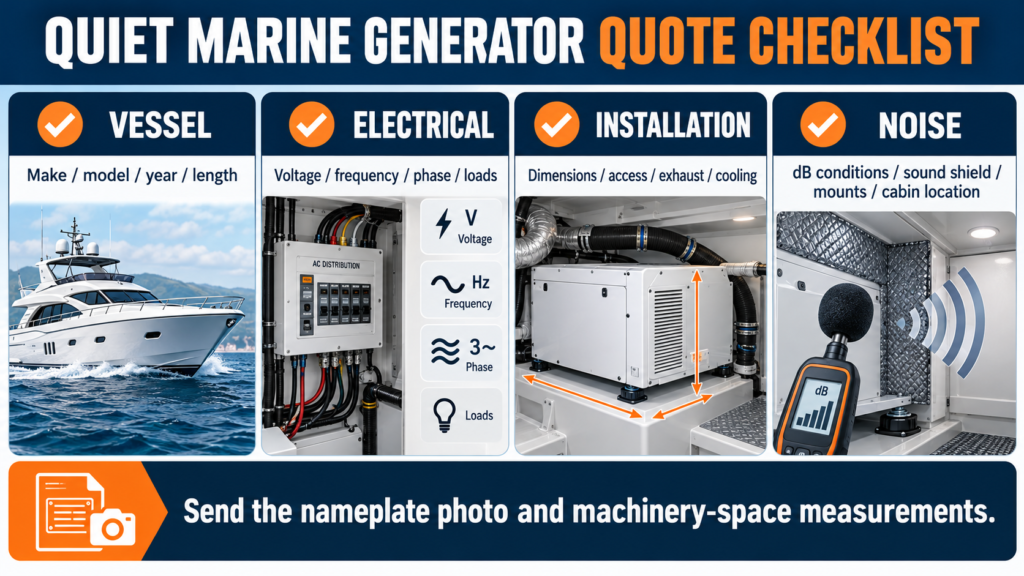
Information to collect before requesting a quote
The more complete the information, the more accurate the recommendation will be.
Provide:
- Boat or yacht make
- Vessel model and year
- Vessel length and type
- Cruising region
- Existing generator make and model
- Generator nameplate photograph
- Voltage
- Frequency
- Phase
- Main electrical loads
- Air-conditioning details
- Watermaker details
- Battery-bank and inverter information
- Machinery-space dimensions
- Access-hatch dimensions
- Removal route
- Existing exhaust arrangement
- Cooling-system details
- Delivery location
- Required purchase or installation date
A photograph of the existing nameplate is particularly valuable. It may reveal the generator’s output, voltage, frequency, phase, engine speed and model number in a few seconds.
Questions to ask the supplier
Before ordering a quiet marine generator, ask:
- At what distance was the dB(A) rating measured?
- What electrical load was applied during testing?
- Was the sound shield installed?
- Is the quoted sound shield included?
- What service clearance is required?
- Will the existing mounts work?
- Can the current exhaust system be reused?
- What raw-water flow is required?
- What is the maximum allowable exhaust backpressure?
- Can the generator start the largest onboard motor?
- Are remote controls included?
- What parts are normally stocked?
- What is the warranty?
- What is the delivery lead time?
- Who is responsible for commissioning?
Red flags before buying
Be cautious when a product page:
- Uses “silent” without a measured dB(A) figure
- Gives a dB rating without measurement distance
- Does not state the operating load
- Does not clarify whether the sound shield is included
- Provides no installation drawing
- Does not show service-clearance requirements
- Makes no mention of exhaust or ventilation
- Gives no warranty or parts information
- Treats a portable generator as a permanent marine solution
A professional supplier should be comfortable discussing these details. If the seller avoids technical questions, the risk usually shifts to the boat owner and installer.
Frequently Asked Questions About Quiet Marine Generators
What is the quietest marine generator?
There is no single model that is quietest for every boat or yacht.
The correct choice depends on the generator’s measured dB(A) rating, test distance, operating load, sound shield, mounting system, exhaust arrangement, ventilation and machinery-space location.
What is a good dB rating for a marine generator?
There is no universal dB number that guarantees a quiet cabin.
A dB rating must be considered with:
- Measurement distance
- Operating load
- Test environment
- Sound-shield configuration
- Measurement location
- Background-noise conditions
A lower figure is useful only when the test conditions are comparable.
Does a marine generator sound shield make the generator quiet?
A sound shield can reduce airborne noise from the engine, alternator and cooling system.
However, it cannot correct:
- Poor engine mounts
- Rigid exhaust connections
- Hull vibration
- Incorrect ventilation
- Worn engine parts
- Loose brackets
- Exhaust leaks
A sound shield is one part of the noise-control system, not the entire solution.
Are variable-speed marine generators quieter?
A variable-speed generator may be quieter during light-load operation because the engine can operate at a lower speed.
However, the result depends on:
- Electrical load
- Battery and inverter system
- Control strategy
- Generator installation
- Sound-shield design
- Exhaust and ventilation
Variable-speed technology is not automatically better for every yacht.
Is a 1,500 RPM generator quieter than a higher-speed model?
Lower-speed operation can reduce some mechanical noise and vibration, but RPM alone does not determine the complete sound result.
Alternator design, mounts, enclosure, exhaust, ventilation and machinery-space construction all matter.
Can I make my existing marine generator quieter?
In many cases, noise can be reduced by correcting installation or maintenance problems.
Potential improvements include:
- Replacing worn engine mounts
- Repairing exhaust leaks
- Adding flexible exhaust connections
- Servicing belts and pulleys
- Tightening loose panels
- Improving acoustic treatment
- Replacing damaged insulation
- Installing an approved sound shield
- Redirecting ventilation openings
Do not enclose a generator or restrict ventilation without following the manufacturer’s requirements. Excessive heat can damage the engine and create a safety risk.
Is a quiet marine generator suitable for air conditioning?
Yes, provided the generator has sufficient continuous output and motor-starting capacity for the air-conditioning compressors.
The load calculation should include:
- Running current
- Compressor starting current
- Multiple air-conditioning zones
- Battery chargers
- Refrigeration
- Pumps
- Watermakers
- Other equipment operating at the same time
Is a quiet generator suitable for a sailboat?
A quiet generator for sailboat use must fit a compact machinery space, tolerate vessel movement and provide stable power for the boat’s electrical system.
Important considerations include:
- Physical dimensions
- Weight
- Mounting
- Exhaust routing
- Ventilation
- Sound transmission through the hull
- Battery charging
- Air-conditioning loads
- Access for service
Is a quiet marine generator suitable for liveaboard use?
A quiet generator for liveaboard use should be evaluated for long operating periods, sleeping comfort and easy maintenance.
Prioritize:
- Low cabin noise
- Low vibration
- Reliable remote starting
- Efficient partial-load operation
- Accessible service points
- Parts availability
- Strong technical support
Are portable inverter generators suitable for yachts?
Not automatically.
A portable unit may be quiet in an outdoor test, but permanent onboard use requires careful consideration of:
- Fuel storage
- Carbon-monoxide risk
- Exhaust routing
- Grounding
- Transfer switching
- Ventilation
- Water exposure
- Weather protection
- Marine electrical regulations
A purpose-built marine generator is designed for the conditions of onboard installation.
What information does Generator Plus need to recommend a quiet generator?
Send:
- Vessel make, model and year
- Vessel length and type
- Existing generator nameplate photograph
- Voltage, frequency and phase
- Main electrical loads
- Machinery-space measurements
- Access-route dimensions
- Existing exhaust and cooling details
- Delivery location
- Intended purchase date
This information allows Generator Plus to compare suitable models, package contents, installation requirements and lead times.
Conclusion: Choose Quietness You Can Verify
Choosing the best quiet marine generator is not about finding the most impressive marketing claim.
It is about verifying the complete system.
Before buying, compare:
- dB(A) rating
- Measurement distance
- Operating load
- Sound-shield configuration
- Engine speed
- Flexible mounts
- Exhaust and muffler design
- Ventilation
- Machinery-space location
- Electrical compatibility
- Service access
- Parts availability
- Warranty
- Total installed cost
The BERTH Test provides a practical way to evaluate each candidate:
- Baseline the noise measurement
- Evaluate the enclosure
- Reduce vibration
- Treat exhaust and airflow
- Hear the result onboard
The generator with the lowest published sound figure may not provide the quietest experience after installation. The best solution is the one that combines verified noise performance with correct sizing, safe installation, reliable operation and support throughout the generator’s service life.
Looking for a quiet marine generator for your boat, yacht, sailboat, catamaran or liveaboard vessel?
Send Generator Plus:
- Your current generator nameplate photograph
- Vessel make, model and year
- Voltage, frequency and phase
- Main electrical loads
- Machinery-space measurements
- Access-route dimensions
- Delivery location
- Required purchase or installation date
Generator Plus can help you compare suitable marine-generator options, confirm technical compatibility and prepare a quotation that clearly separates equipment, accessories, installation requirements, delivery and warranty coverage.
Request a quiet marine generator recommendation from Generator Plus before ordering, and verify the complete noise-control and installation package—not just the headline dB rating.
