
Choosing a yacht generator looks simple until you are standing in an engine room with three competing priorities: enough power for the equipment you actually use, low enough noise for comfortable cruising, and a package that can physically fit through the boat’s access route.
I often use this illustrative refit scenario when explaining the decision. A 48-foot cruising yacht needed air conditioning, refrigeration, battery charging and a watermaker while sitting at anchor. The owner initially focused on the generator with the lowest advertised sound figure. But after checking the electrical system, starting loads, machinery-space dimensions and exhaust route, the “quietest” option on paper was not automatically the best fit. The better choice was the model that met the whole vessel’s requirements.
That is the central lesson of this guide:
The best yacht generator is the one that matches the vessel’s real electrical load, starting demand, installation space, noise priorities and long-term support requirements.
There is no universal winner for every yacht generator 35 ft, yacht generator 50 ft, yacht generator 60 ft or yacht generator 70 ft application. Yacht length helps describe the vessel, but it does not determine generator capacity by itself.
What Is the Best Yacht Generator for a 35–70 ft Yacht?
The best marine generator for yacht use depends on how the yacht is operated and what must run at the same time.
A compact cruising yacht may need power for refrigeration, battery charging, navigation equipment and one air-conditioning unit. A larger liveaboard yacht may operate several air-conditioning zones, a watermaker, electric cooking equipment, laundry appliances, pumps and entertainment systems simultaneously.
A practical comparison looks like this:
| Yacht-owner priority | What to prioritize |
|---|---|
| Quiet anchorage operation | Sound enclosure, vibration isolation, controlled exhaust and correct installation |
| Compact machinery space | Small footprint, low height and accessible service points |
| Multiple air-conditioning zones | Strong motor-starting capacity and sufficient continuous output |
| Liveaboard use | Efficient operation, dependable controls and easy maintenance |
| Offshore cruising | Cooling reliability, parts availability and technical support |
| Generator replacement | Dimensional, electrical, exhaust and mounting compatibility |
| Luxury yacht comfort | Low cabin noise, remote monitoring and smooth operation |
A yacht diesel generator should therefore be selected as part of the yacht’s complete power system—not as an isolated engine-room purchase.
Why yacht length is not a sizing formula
Two yachts of the same length can have completely different electrical demands.
One 50-foot yacht may use efficient appliances, solar charging and a large battery bank. Another may operate several air-conditioning units, a watermaker, an electric galley and laundry equipment every day. Their generator requirements could be very different.
The correct question is not:
“What size generator is normally used on a 50-foot yacht?”
The better question is:
“What equipment must run together, what starting demand does it create, and how many hours will the generator operate under that load?”
Manufacturer sizing guidance also emphasizes actual onboard equipment and starting requirements rather than choosing a generator from vessel length alone.
How Much Generator Capacity Does a Yacht Need?
Start with a real onboard load schedule
Before comparing a best yacht generator, list every important AC load on the vessel.
Include:
- Air-conditioning compressors
- Refrigerators and freezers
- Battery chargers
- Watermakers
- Water heaters
- Electric cooking equipment
- Washing machines and dryers
- Freshwater and seawater pumps
- Navigation and communication equipment
- Workshop tools
- Entertainment systems
- Dive compressors or specialist equipment
Record the running load for each item from the manufacturer’s nameplate or technical documentation. Then identify whether the equipment has a significant starting surge.
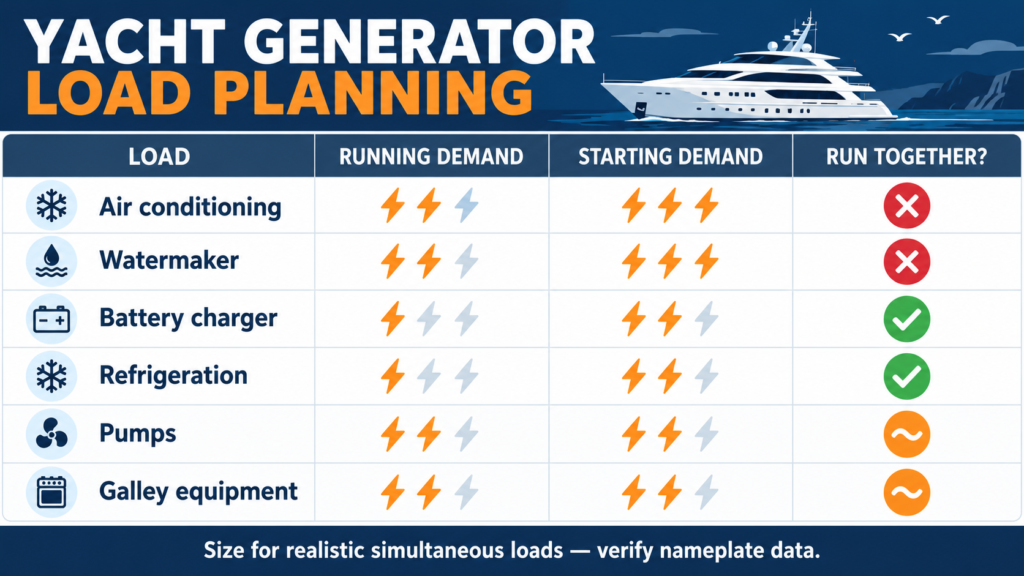
A simple planning table can help:
| Equipment | Running demand | Starting demand | Runs simultaneously? |
|---|---|---|---|
| Air-conditioning compressor | Verify nameplate | High | Often |
| Watermaker | Verify manufacturer data | Moderate to high | Sometimes |
| Battery charger | Verify actual draw | Usually lower | Usually |
| Electric galley equipment | Varies by appliance | Variable | Depends on use |
| Pumps | Verify motor rating | Moderate | Often |
This load schedule is more valuable than a generic “generator size by yacht length” chart because it reflects the way the vessel is actually operated.
Running load is not the same as starting load
A generator may have enough capacity to operate a pump or compressor after it has started, but still struggle when that motor first switches on.
Air-conditioning compressors, watermakers, refrigeration systems and hydraulic pumps can briefly demand far more power during startup than during normal operation. If several motors start together, the generator may experience:
- Voltage dips
- Frequency instability
- Control-system alarms
- Failed motor starts
- Automatic shutdown
- Excessive mechanical stress
This is why a yacht generator must be checked for motor-starting capability—not only its headline kW rating.
Do not simply add a random percentage to the running load. Identify the equipment with the highest starting demand and ask the supplier or marine electrician how the proposed generator handles those loads.
Understand kW and kVA
Marine-generator specifications may show both kW and kVA.
- kW describes real usable power.
- kVA describes apparent power.
- Power factor affects the relationship between them.
They are related, but they are not automatically interchangeable. When comparing a quiet marine generator for yacht applications, confirm that each model is being compared at the same voltage, frequency, phase and power-factor basis.
A generator advertised as 12 kVA should not be compared casually with a 12 kW generator without checking the manufacturer’s rating conditions.
Illustrative yacht-use profiles
The following profiles are planning examples, not fixed recommendations.
35–40 ft yachts
Typical requirements may include:
- Refrigeration
- Battery charging
- Navigation electronics
- Lighting
- One modest air-conditioning system
- Small pumps
The main challenge is often machinery-space size and noise rather than maximum output.
45–50 ft yachts
These yachts may require:
- One or more air-conditioning zones
- Watermaker operation
- Battery charging
- Electric galley loads
- Refrigeration
- Pumps and entertainment systems
Starting demand becomes increasingly important if several comfort systems operate together.
55–60 ft yachts
A larger yacht may operate:
- Multiple air-conditioning zones
- Larger watermakers
- Electric cooking equipment
- Laundry equipment
- Larger battery chargers
- More pumps and hotel loads
The generator must be sized for realistic simultaneous use rather than a theoretical maximum where every appliance runs continuously.
65–70 ft yachts
Larger yachts may require:
- Multiple generators
- Redundancy
- Larger hotel loads
- Multiple electrical panels
- Three-phase equipment
- More extensive monitoring and automation
At this level, the electrical design, generator synchronisation and distribution system may be as important as the generator itself.
Avoid undersizing and oversizing
An undersized generator can create unstable operation, nuisance shutdowns and poor comfort.
An oversized generator may also create problems. If it runs for long periods at very light load, the engine may operate inefficiently and fail to reach its intended operating temperature. You may also pay more for:
- The generator itself
- Installation labour
- Exhaust and cooling components
- Space and structural modifications
- Maintenance and fuel
The goal is not to buy the largest generator that fits. The goal is to match capacity to the yacht’s real duty cycle.
What Makes a Yacht Generator Quiet?
Many buyers search for the quietest marine generator or a quiet yacht generator, but “quiet” is not a single specification.
Read the dB rating carefully
A marine-generator sound rating is meaningful only when you know:
- The measurement distance
- The generator load during testing
- Whether the test was indoors or outdoors
- Whether a sound shield was installed
- Whether the figure is measured in dB(A)
- Whether the result represents airborne noise only
Two manufacturers may publish different sound figures using different test conditions. That means a lower number is not automatically a fair comparison.
The correct approach is to compare ratings measured under similar conditions, then evaluate the complete installation package.
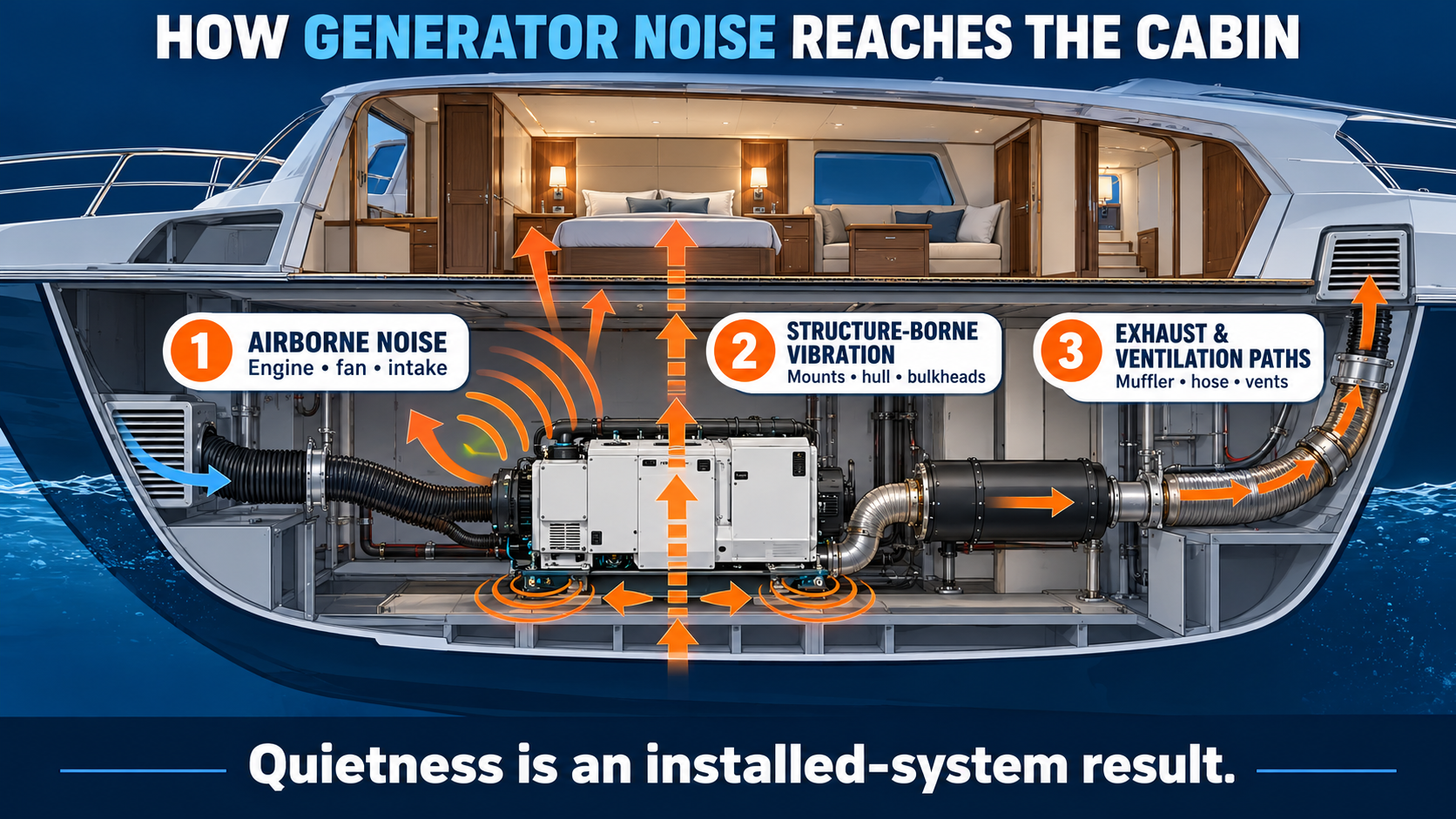
The three main yacht-generator noise paths
Noise reaches the yacht through three primary routes.
Airborne noise
This includes sound from:
- The engine
- Alternator
- Cooling fan
- Air intake
- Exhaust outlet
A sound shield and properly treated ventilation openings can reduce airborne noise.
Structure-borne vibration
Vibration can travel through:
- Engine mounts
- Mounting rails
- Exhaust connections
- Fuel lines
- Hull structure
- Bulkheads
This is why a technically quiet generator can still create an irritating hum in a cabin if it is mounted incorrectly.
Exhaust and cooling noise
Poorly designed exhaust routing can transmit sound through the hull and machinery space. Cooling-air openings can also become direct sound paths into accommodation areas.
A quiet installation must consider the generator, the mounts, the exhaust, the ventilation and the surrounding structure together.
What should a quiet-generator package include?
A properly planned marine generator sound shield may be combined with:
- Flexible engine mounts
- Correctly sized exhaust hose
- A suitable muffler or waterlock
- Wet exhaust routing
- Acoustic machinery-space treatment
- Proper ventilation design
- Flexible connections
- Correct alignment
- Remote controls to reduce unnecessary cabin access
Fischer Panda’s marine-generator guidance, for example, highlights compact packaging, freshwater cooling and low-noise designs for boat and yacht applications.
The key insight is simple:
Quietness is an installed-system result, not merely a number printed on a product page.
A generator with a strong published dB rating can still be noisy if the exhaust is rigidly connected, the mounts are unsuitable or the machinery space transfers vibration into the accommodation.
Before selecting a quiet marine generator for yacht use, ask for the full noise-control package and confirm how the proposed installation will be executed.
Best Yacht Generator Brands and Model Families to Compare
Once you understand the yacht’s electrical load and noise requirements, the next step is comparing brands and model families using the same criteria.
Do not compare brands only by advertised kW, price or a single sound figure. A proper comparison should consider:
- Continuous output
- Starting capacity
- 50 Hz or 60 Hz availability
- Single-phase or three-phase configuration
- Sound-shield options
- Variable-speed or inverter technology
- Dimensions and service access
- Controls and monitoring
- Parts availability
- Local technical support
- Warranty and lifecycle cost
Generator Plus currently supplies a broad range of marine generator brands, including Cummins Onan, Kohler/Rehlko, Fischer Panda, Westerbeke, MASE, Nanni, Northern Lights, Paguro, and Vetus. The right brand depends on the yacht, the operating region and the installer’s ability to support the system after delivery.
Cummins Onan marine generators
A Cummins Onan marine generator is often shortlisted by yacht owners who want an established manufacturer, broad output range and strong service-network potential.
Cummins lists Onan marine-generator options across smaller recreational applications and larger yacht systems, with models covering both 50 Hz and 60 Hz configurations. Its marine range includes compact units for smaller yachts as well as larger sets for demanding recreational and commercial vessels.
Cummins Onan may be worth considering when you prioritize:
- A widely recognized marine-generator brand
- Multiple output classes
- 50 Hz and 60 Hz availability
- Strong motor-starting capability
- Digital controls and monitoring
- Established dealer or service support
- Replacement compatibility with an existing Onan installation
However, “Cummins Onan” is not one single specification. Two Onan models can differ substantially in dimensions, frequency, controls, output, fuel system and service requirements. Always compare the exact model number and configuration.
For a yacht replacement, confirm:
- Whether the new model fits the original footprint
- Whether the existing exhaust and cooling systems can be reused
- Whether the control harness is compatible
- Whether the generator is rated for the vessel’s electrical frequency
- Whether the quoted package includes the required sound shield and remote panel
Kohler and Rehlko marine generators
A Kohler marine generator, now associated with the Rehlko brand in many current product references, can be a strong option for yacht owners who value established marine controls, compact installations and available sound-control accessories.
For example, the Rehlko 7EFKOZD is listed as a 7 kW, 50 Hz diesel marine generator with a four-pole alternator and optional accessories including a sound shield, remote wiring harness and digital gauge.
When comparing a Kohler or Rehlko unit, verify:
- Whether the model is 50 Hz or 60 Hz
- Whether the output is single-phase or three-phase
- Which controller is included
- Whether the sound shield is standard or optional
- How much service clearance is required
- Whether local technicians support that exact model
The brand may suit mid-size cruising yachts, refit projects and vessels that already use Kohler/Rehlko controls or electrical equipment. But a sound shield listed as an accessory should not be assumed to be included in the base generator price.
Fischer Panda yacht generators
A Fischer Panda yacht generator is commonly considered when compact size, low weight and quiet operation are major priorities.
Fischer Panda’s marine range emphasizes compact packaging, freshwater cooling and low-noise operation. Its official sizing guidance also stresses that generator selection should be based on actual equipment and starting requirements rather than a simple yacht-length formula.
Fischer Panda may be particularly relevant for:
- Space-constrained machinery rooms
- Smaller cruising yachts
- Sailing yachts and catamarans
- Hybrid or battery-supported electrical systems
- Owners who place a high value on acoustic comfort
- Installations where a compact sound-insulated capsule is useful
One important detail is output type. Some Fischer Panda systems are designed primarily for AC generation, while others may be intended for DC battery charging or hybrid integration. Do not compare a DC charging system directly with an AC yacht generator without checking the complete electrical architecture.
Before choosing a Fischer Panda model, confirm:
- AC or DC output
- Nominal and continuous output
- Voltage and frequency
- Battery-bank compatibility
- Service access inside the capsule
- Cooling-air and exhaust requirements
- Availability of replacement parts in the cruising region
Westerbeke marine generators
A Westerbeke marine generator may be attractive for yacht refits because some models are designed around compact footprints, low-profile installations and practical service access.
When assessing Westerbeke, compare:
- Diesel versus gasoline configuration
- Low-profile dimensions
- 50 Hz or 60 Hz output
- Fuel-system requirements
- Sound-shield availability
- Remote-control options
- Existing mounting and exhaust compatibility
Westerbeke also offers marine gasoline-generator products for compatible gasoline-powered vessels. Gasoline installations require careful attention to ignition protection, ventilation, fuel-system design and applicable marine safety requirements.
MASE, Paguro, Nanni, Northern Lights and Vetus
Other brands can be suitable depending on the vessel, region and application.
A Paguro marine generator may appeal to owners seeking a compact European package. A Nanni marine generator may be considered where the buyer values marine diesel integration and regional service access. Northern Lights marine generators are often evaluated for durable commercial-style construction and serviceability. MASE and Vetus may also be relevant for specific replacement, compact-installation or regional-support requirements.
Rather than declaring one of these brands the best in every case, compare each candidate according to:
- Exact output
- Operating speed
- Noise-control package
- Dimensions and weight
- Cooling system
- Exhaust arrangement
- Control integration
- Parts availability
- Dealer support
- Warranty terms
- Total installed cost
The strongest brand on paper may not be the best choice if its nearest service technician is difficult to reach or if essential parts have long lead times.
Fixed-Speed Versus Variable-Speed Yacht Generators
One of the most important decisions is whether to choose a traditional fixed-speed unit or a variable-speed marine generator.
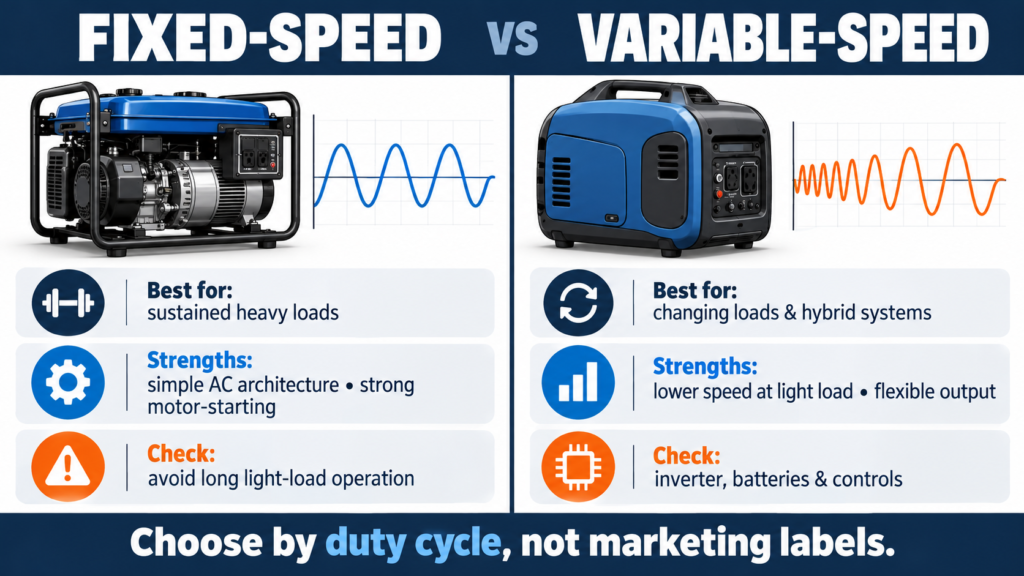
When a fixed-speed marine generator makes sense
A fixed-speed marine generator may be appropriate when the yacht has:
- Consistent and relatively heavy electrical loads
- Several air-conditioning zones
- Frequent watermaker operation
- A traditional AC distribution system
- A strong need for motor-starting capacity
- A service team familiar with conventional generator systems
Fixed-speed systems are often straightforward to understand and service. They can be a practical choice for yachts that regularly operate at a moderate-to-high load for extended periods.
The important issue is correct sizing. A fixed-speed generator that is substantially oversized may spend too much time operating at a light load. A generator that is too small may struggle whenever multiple compressors or pumps start together.
When a variable-speed or inverter generator makes sense
A variable-speed marine generator can be useful when the yacht’s electrical demand changes frequently.
Potential advantages include:
- Lower engine speed during lighter loads
- Reduced noise in some operating conditions
- Better matching of fuel use to demand
- Compact packaging
- Compatibility with hybrid battery systems
- Improved comfort during quiet anchorage operation
Variable-speed technology may be particularly attractive for a marine generator for liveaboard use, where loads vary throughout the day and the owner may spend long periods at anchor.
However, the system must be evaluated as a complete package. Confirm how the generator, inverter, battery bank, charger and AC distribution system interact.
Contrarian insight: variable-speed is not automatically better
It is easy to assume that a variable-speed or inverter generator is always the superior yacht solution because it is marketed as quieter and more efficient.
That is not necessarily true.
A conventional fixed-speed generator may be a better fit when the yacht has sustained heavy loads, demanding motor starts, an established AC system or a service network experienced with that technology. A variable-speed unit may be the better choice when loads change frequently and low-noise operation is a major priority.
The best choice depends on:
- Daily operating profile
- Peak starting demand
- Battery and inverter architecture
- Electrical frequency
- Installation space
- Service support
- Total lifecycle cost
Electrical Compatibility Checklist Before Buying
A generator can be mechanically suitable and still be electrically incompatible with the yacht.
Confirm voltage and frequency
The most common compatibility questions involve:
- 120 V versus 230 V
- 50 Hz versus 60 Hz
- Single-phase versus three-phase systems
- Shore-power configuration
- Appliance and charger requirements
A 50 Hz yacht generator may not suit a vessel designed around 60 Hz equipment, and vice versa. Frequency affects motors, pumps, clocks, chargers, air-conditioning equipment and other onboard systems.
Before ordering, photograph the existing generator nameplate and electrical panel. Record:
- Voltage
- Frequency
- Phase
- Rated kW
- Rated kVA
- Breaker size
- Control-panel type
- Shore-power arrangement
Confirm kW, kVA and power factor
Do not compare the quoted generator output without checking the rating basis.
Ask whether the specification refers to:
- Prime output
- Continuous output
- Standby output
- kW or kVA
- A specific power factor
- A specific ambient temperature
- A specific altitude or installation condition
The number must be compared on the same technical basis as the yacht’s existing system.
Check controls and transfer equipment
The generator may need to integrate with:
- Remote start and stop controls
- Automatic transfer switches
- Shore-power interlocks
- Digital monitoring systems
- Vessel-management systems
- Alarm and shutdown circuits
- Synchronisation or paralleling controls
If the yacht uses two generators, confirm whether the proposed model can operate in parallel and whether the existing switchboard supports the control architecture.
Consider batteries and inverters
Many modern yachts use batteries and inverters to reduce generator runtime. That can be an excellent solution, but it changes the sizing calculation.
You must understand:
- How much energy the battery bank stores
- How quickly the batteries must recharge
- Which loads are supplied directly by the inverter
- Which loads require generator power
- Whether the charger creates a large starting or charging demand
- Whether the generator can operate efficiently during charging
A generator that works well with direct AC loads may not be the best match for a complex hybrid power system without additional controls or configuration
Installation Fit Matters More Than Brochure Size
A generator can have the correct output and still be the wrong choice if it cannot be installed, serviced or removed safely.
Before ordering a yacht generator for sale, verify the complete installation path—not only the space where the unit will sit.
Measure the machinery space
Record:
- Overall length, width and height
- Weight of the complete wet unit
- Mounting-foot positions
- Service clearance
- Access-hatch dimensions
- Engine-room door dimensions
- Removal route for the existing generator
- Available lifting points
- Clearance above filters, belts and service panels
A generator that fits inside the engine room may still be impossible to move through the companionway, hatch or corridor.
This is especially important during a replacement project. The original generator may have been installed before the deck, furniture or bulkheads were completed. Removing it may require a different route from installing a new-build unit. Replacement Marine Generator Guide – Replacing an Old or Discontinued Genset
Plan cooling and raw-water flow
A marine generator typically requires a correctly designed cooling arrangement, including:
- Raw-water intake
- Seawater strainer
- Raw-water pump
- Heat exchanger
- Freshwater cooling circuit
- Coolant expansion tank
- Ventilation and heat-rejection path
Restricted raw-water flow can cause overheating, shutdowns and premature component failure. The installation must also allow the strainer, impeller and heat exchanger to be inspected and serviced.
Freshwater-cooled marine generators can help protect internal engine components from the corrosive marine environment, but they still require correct seawater flow and regular maintenance. Fischer Panda’s marine guidance, for example, highlights freshwater cooling as part of its marine-generator system design.
Plan fuel and exhaust systems
The fuel system must be checked for:
- Fuel-line size
- Primary and secondary filtration
- Fuel shutoff arrangement
- Return-line requirements
- Tank connection
- Air-bleeding access
- Fire-safety requirements
The exhaust system requires equal attention. Confirm:
- Wet-exhaust routing
- Muffler or waterlock capacity
- Exhaust hose diameter
- Exhaust backpressure
- Siphon-break position
- Outlet location
- Clearance from accommodation spaces
- Carbon-monoxide protection
A poorly routed exhaust can create noise, heat, corrosion and safety problems even when the generator itself is well engineered.
Preserve service access
Do not install a generator so tightly that routine maintenance becomes a major repair project.
Technicians should be able to reach:
- Oil and fuel filters
- Raw-water impeller
- Belts
- Coolant cap
- Control panel
- Battery connections
- Circuit breakers
- Exhaust components
- Mounting hardware
A compact quiet marine generator for yacht use is only a good installation if it remains serviceable after the sound shield, hoses and electrical connections are fitted.
Include commissioning and documentation
Commissioning should verify:
- Output voltage
- Frequency stability
- Phase balance
- Load response
- Motor starting
- Cooling-water flow
- Exhaust-water discharge
- Alarm functions
- Remote controls
- Automatic transfer operation
- Shutdown protection
Request updated wiring diagrams, manuals, service intervals and warranty-registration documents. These records improve future troubleshooting and help the next technician understand exactly how the system was installed.
Yacht Generator Cost and Total Ownership
Separate equipment price from installed cost
The advertised yacht generator price may cover only the basic generator package. The final project cost may also include:
- Sound shield
- Remote control panel
- Automatic transfer switch
- Exhaust components
- Waterlock and siphon break
- Raw-water strainer
- Fuel filters and hoses
- Battery and starter cables
- Wiring and breakers
- Engine mounts
- Removal of the old generator
- Modifications to the electrical panel
- Ventilation changes
- Labour
- Commissioning
- Freight, customs and taxes
That is why two apparently similar quotes can differ substantially.
A professional quotation should clearly separate:
- Generator equipment
- Optional accessories
- Installation materials
- Labour
- Removal and disposal
- Testing and commissioning
- Freight and taxes
- Exclusions
Never compare a generator-only price with a fully installed price.
Lifecycle value matters more than purchase price
The cheapest generator can become expensive if it has poor parts availability, difficult service access or limited technical support in the yacht’s cruising area.
Assess:
- Fuel consumption
- Maintenance intervals
- Filter and belt availability
- Technician coverage
- Warranty response
- Expected annual operating hours
- Cost of downtime
- Ease of future replacement
- Resale impact
- Compatibility with the existing electrical system
Generator Plus positions its support around generator selection, installation guidance, spare parts and technical assistance for yacht owners, shipyards and marine professionals.
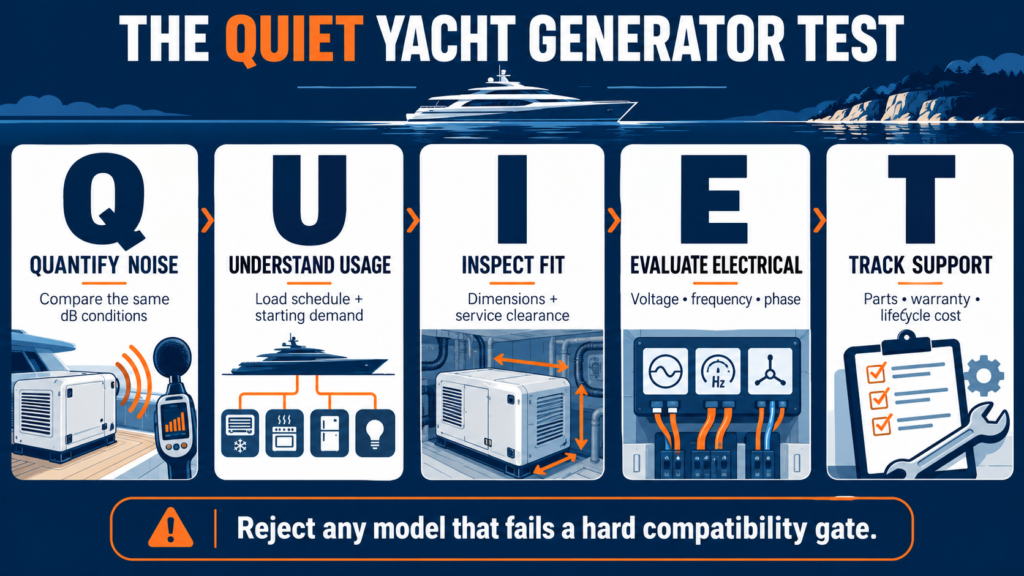
The QUIET Yacht Generator Selection Framework
Use this framework to compare shortlisted generators before requesting a quotation.
| Letter | Decision question | Evidence to collect |
|---|---|---|
| Q — Quantify noise | How quiet must the yacht be? | Comparable dB ratings, test distance, load condition, mounts and exhaust design |
| U — Understand usage | What will operate, and for how long? | Load schedule, daily energy use and starting demand |
| I — Inspect fit | Can the unit be installed and serviced? | Dimensions, weight, access route and service clearance |
| E — Evaluate electrical compatibility | Will it integrate with the yacht? | Voltage, frequency, phase, controls and transfer equipment |
| T — Track support and lifetime cost | Can it be supported where the yacht cruises? | Parts, warranty, service coverage, lead time and installed cost |
Apply hard gates before scoring brands
Some problems cannot be solved by a lower price or better sound rating.
Reject a candidate before detailed scoring if it:
- Cannot supply the required electrical load
- Does not match the yacht’s frequency
- Has the wrong voltage or phase
- Cannot fit through the installation route
- Lacks service clearance
- Cannot connect to the existing control system
- Requires unavailable parts or unsupported technology
A generator that fails one of these gates is not a bargain. It is a future installation problem.
Build a practical comparison worksheet
For each candidate, record:
- Brand and exact model
- Rated kW
- Rated kVA
- Voltage
- Frequency
- Phase
- Fuel type
- Dimensions
- Wet weight
- Sound rating and measurement conditions
- Sound-shield availability
- Starting capability
- Cooling arrangement
- Exhaust requirements
- Control system
- Warranty
- Parts availability
- Price
- Lead time
- Installation exclusions
This makes it easier to compare a Cummins Onan marine generator, Kohler marine generator, Fischer Panda yacht generator or Westerbeke marine generator on the same basis.
Yacht Generator Buying Checklist
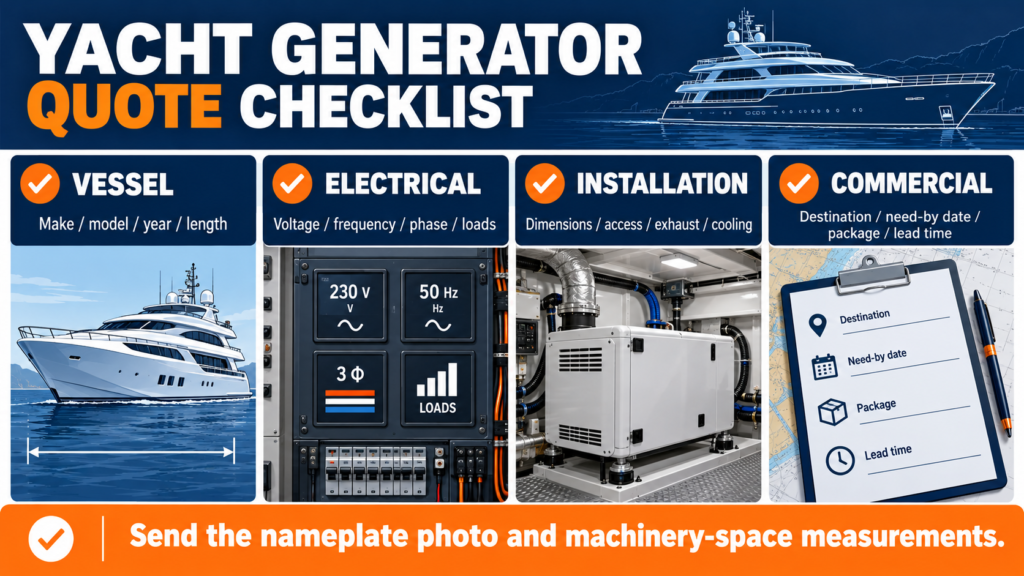
Information to send Generator Plus
To receive a more accurate recommendation, provide:
- Yacht make, model and year
- Overall vessel length
- Motor yacht, sailing yacht, catamaran or commercial yacht
- Cruising region
- Existing generator make and model
- Generator nameplate photograph
- Voltage, frequency and phase
- Main electrical loads
- Air-conditioning capacity
- Watermaker details
- Battery-bank and inverter information
- Machinery-space dimensions
- Access-hatch measurements
- Photos of the existing installation
- Delivery location
- Intended purchase or installation date
The purchase date matters because stock may need to be allocated or reserved, especially for refit projects with a defined yard schedule.
Questions to ask before ordering
Ask the supplier:
- Is this model suitable for my vessel’s electrical system?
- Is the quoted output continuous or standby?
- Does the price include the sound shield?
- What is the tested dB rating and measurement distance?
- Are remote controls included?
- What installation accessories are required?
- Can the existing exhaust and cooling systems be reused?
- What changes will be needed to the switchboard?
- Are parts available in my cruising region?
- What is the expected delivery lead time?
- What does the warranty include?
- Who is responsible for commissioning?
- What information is excluded from the quotation?
Frequently Asked Questions About Yacht Generators
What is the best yacht generator for a 35–70 ft yacht?
The best yacht generator is the model that matches the vessel’s simultaneous loads, motor-starting demand, voltage, frequency, installation space, noise requirements and service network. Yacht length alone cannot determine the correct size.
What size generator do I need for a 40 ft, 50 ft or 60 ft yacht?
There is no reliable size recommendation based only on length. Create a load schedule, identify starting demand and confirm the vessel’s electrical configuration before choosing a generator.
What is the quietest yacht generator?
There is no universally quietest model under every installation condition. Compare dB ratings using the same measurement distance and load, then assess the sound shield, mounts, exhaust, ventilation and machinery-space construction.
Is a variable-speed yacht generator better?
A variable-speed generator may be beneficial when loads change frequently, quiet anchorage operation is important and the vessel uses batteries or inverter technology. A fixed-speed generator may be more suitable for sustained heavy loads, demanding motor starts or a conventional AC system.
Is kVA the same as kW?
No. kW measures real usable power, while kVA measures apparent power. The relationship depends on power factor, so both figures should be checked when comparing marine generators.
Do I need a 50 Hz or 60 Hz yacht generator?
The generator frequency must match the yacht’s appliances, motors, chargers, switchboard and shore-power system. A 50 Hz yacht generator should not be selected for a 60 Hz vessel without confirming compatibility with every connected load.
Can batteries and an inverter replace a yacht generator?
Sometimes. The decision depends on battery capacity, energy consumption, charging time, peak loads, solar or alternator input and the required operating duration. High-demand air conditioning, watermaking and electric galley loads may still require a generator.
How much does a yacht generator cost?
The final cost includes the generator, accessories, installation, electrical modifications, exhaust, cooling, removal of the old unit, commissioning, freight and taxes. Request a complete itemized quotation rather than relying on the equipment-only price.
Can I replace my old generator with a different brand?
Yes, in many cases, but compatibility must be verified. Check dimensions, mounting points, electrical output, voltage, frequency, phase, controls, cooling, exhaust and service access before changing brands.
How often should a yacht generator be serviced?
Follow the exact manufacturer’s maintenance schedule. Routine checks commonly include oil, coolant, belts, filters, raw-water flow, exhaust discharge and battery connections. Maintenance intervals vary by model, operating hours and duty cycle.
Conclusion: Choose the Generator That Fits the Whole Yacht
The best yacht generator is not necessarily the largest, cheapest or quietest model listed online.
It is the generator that:
- Supplies the yacht’s real simultaneous loads
- Starts compressors and pumps reliably
- Operates quietly after installation
- Fits the machinery space and removal route
- Matches voltage, frequency and phase
- Integrates with the switchboard and controls
- Can be serviced where the yacht cruises
- Has dependable parts, warranty and technical support
For a professional recommendation, send Generator Plus your yacht details, current generator nameplate photograph, electrical requirements, machinery-space measurements and delivery location.
Generator Plus can help you compare suitable marine-generator options from Cummins Onan, Kohler/Rehlko, Fischer Panda, Westerbeke, MASE, Nanni, Northern Lights, Paguro and other established manufacturers.
Request a yacht-generator quotation from Generator Plus and confirm the correct model, package contents, installation requirements, delivery lead time and support options before placing your order.
