
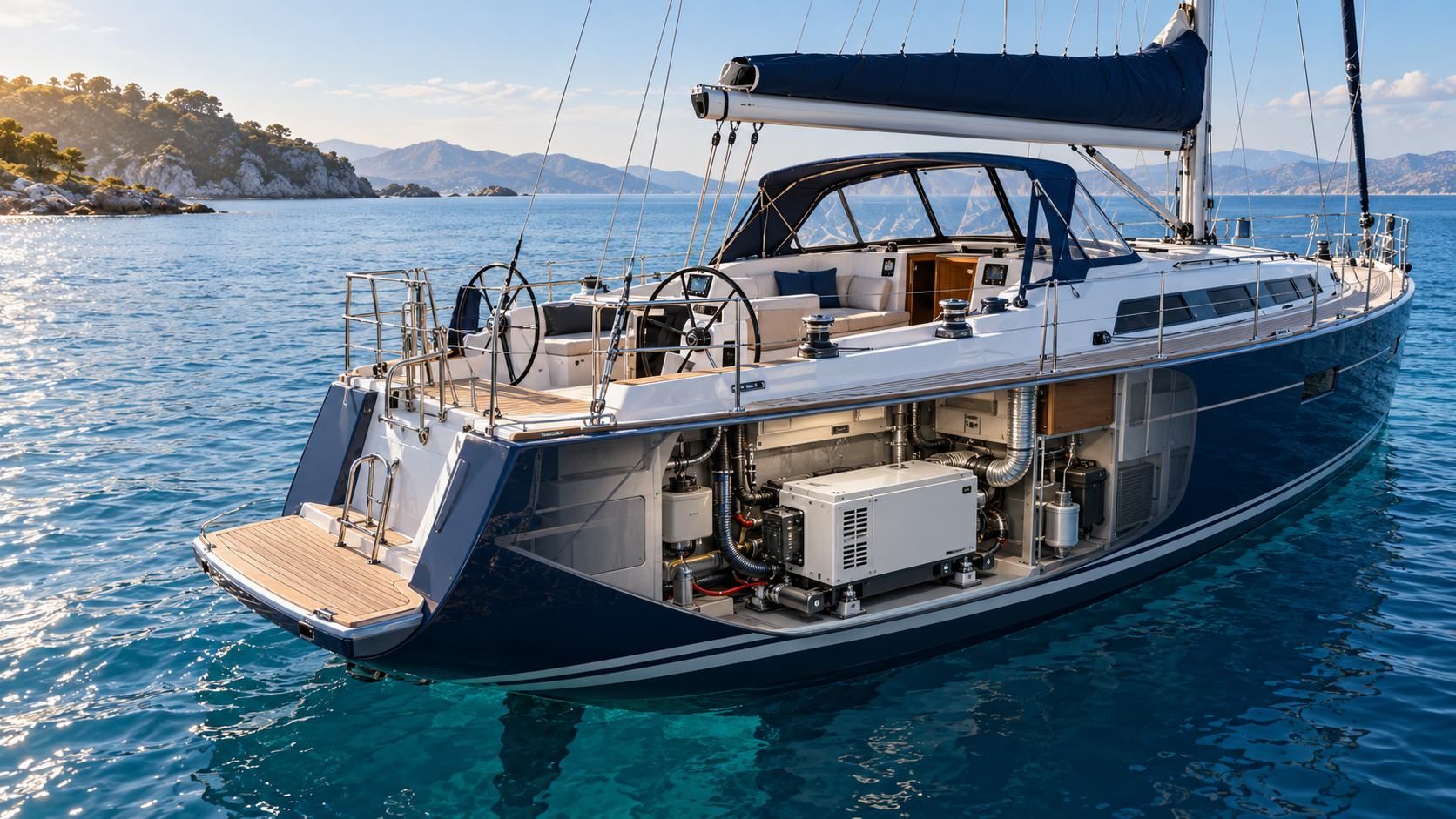
Choosing the best marine generators for sailboat use is rarely as simple as selecting the highest-rated unit or the most familiar brand.
A sailboat has different priorities from a large motor yacht. Space is tighter, access can be difficult, weight matters, and noise travels easily through the hull. At the same time, modern cruising sailboats may need to power air conditioning, refrigeration, watermakers, battery chargers, navigation electronics, induction cooking, and communications equipment.
The Right Generator Is the One That Fits the Boat
Consider this common refit scenario:
A 44-foot cruising sailboat owner wants to replace an ageing 5kW generator. The owner assumes the answer is a newer 8kW model because the boat now has a watermaker and larger battery bank. However, the new generator is taller, the exhaust outlet is in a different position, and the machinery-space hatch is too narrow for easy removal.
The owner may have solved the power problem but created a much larger installation problem.
This is a composite scenario for illustration, not a specific Generator Plus customer case. It reflects the type of compatibility issue that should be considered before selecting any sailboat generator.
The best unit is not automatically the smallest, quietest, cheapest, or most powerful generator. It is the generator that can:
- Handle the vessel’s actual simultaneous electrical loads
- Start compressors and motors without unacceptable voltage drops
- Fit inside the available machinery space
- Remain accessible for servicing
- Match the boat’s voltage, frequency, and phase
- Operate safely with the existing cooling, exhaust, fuel, and control systems
- Offer practical parts and service support
Quick answer: What size generator is best for a sailboat?
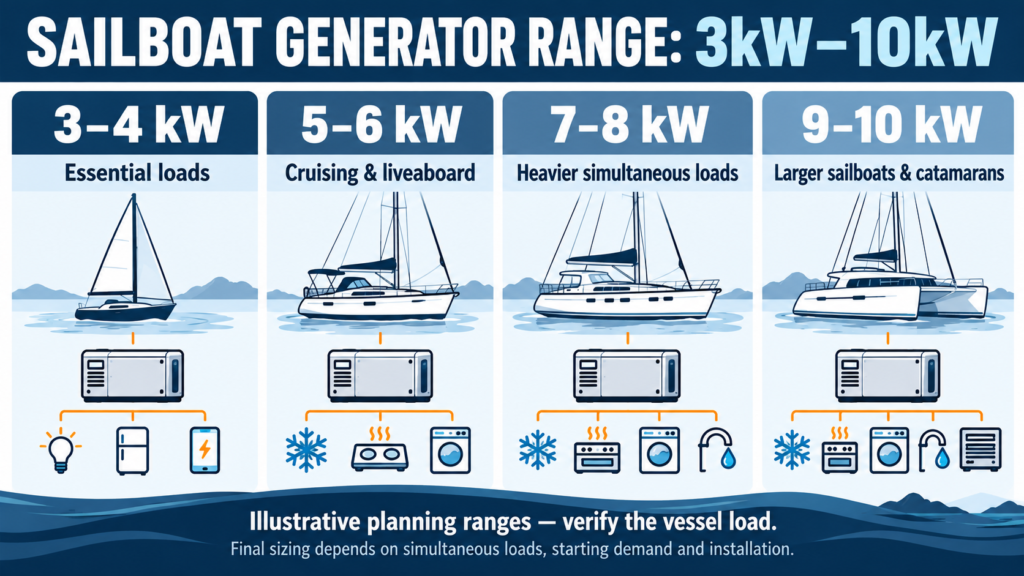
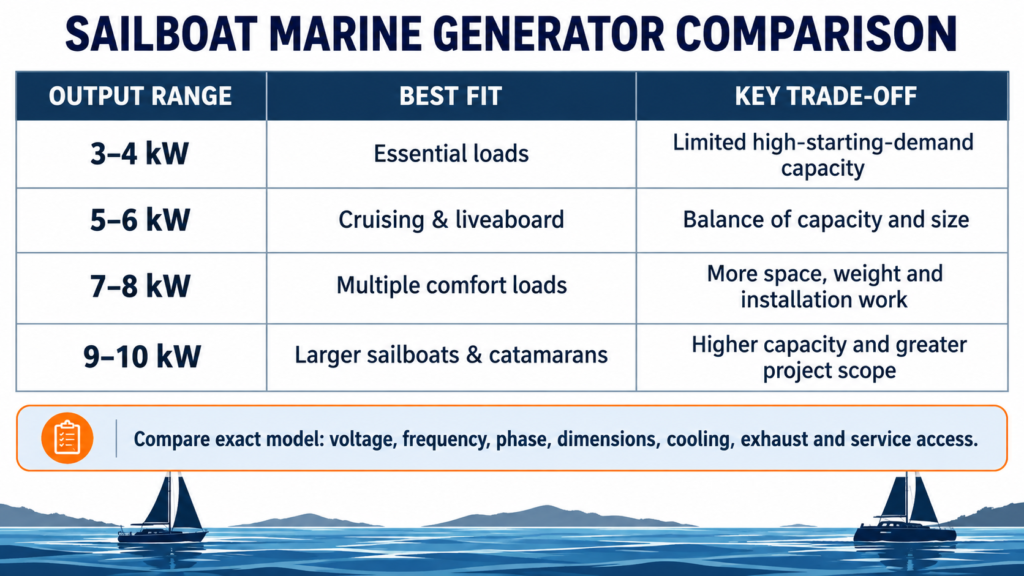
A 3kW–4kW generator may suit essential loads such as battery charging, refrigeration, lighting, navigation electronics, and small pumps. A 5kW–6kW generator may be more suitable for a cruising or liveaboard sailboat using one air-conditioning unit, a watermaker, refrigeration, chargers, and galley equipment. Larger 7kW–10kW generators may be appropriate for boats with multiple air-conditioning systems, electric cooking, large watermakers, or heavier simultaneous loads.
These are planning ranges, not universal rules. Final sizing should be based on a load calculation, motor-starting requirements, electrical configuration, installation dimensions, and the boat’s intended use.
Manufacturer and marine-industry comparison pages commonly emphasize compact design, quiet operation, variable-speed technology, water cooling, and correct load matching when discussing generators for smaller yachts and sailboats.
What Makes a Marine Generator Suitable for a Sailboat?
A sailboat generator must be evaluated as part of the entire vessel. The engine-generator package, electrical system, machinery space, cooling circuit, exhaust, fuel supply, controls, and maintenance access all affect whether a model is genuinely suitable. Fischer Panda marine generators
Compact Dimensions and Realistic Service Access
A compact marine generator is valuable on a sailboat, but compactness should never be judged by the product’s external dimensions alone.
You also need to consider:
- The hatch or companionway used to bring the generator onboard
- The route used to remove the old unit
- Mounting-footprint dimensions
- Height above the mounting rails
- Space around filters and belts
- Access to the control panel
- Room to remove the heat exchanger
- Clearance around the exhaust elbow
- Access to battery cables and electrical terminals
- Space for future repairs
A generator can fit inside the engine room and still be unsuitable if technicians cannot remove a fuel filter, inspect the raw-water pump, replace a belt, or access the control module.
This is particularly important for a small marine generator installed beneath a cockpit, cabin sole, aft berth, or galley. The available space may appear adequate during a visual inspection but become impractical once service clearances are considered.
Installation access matters during removal
A replacement project includes two separate access questions:
- Can the old generator be removed?
- Can the new generator be brought into position?
The answers may not be the same. A new unit may be lighter than the old one but wider at its control-panel end. Another model may fit through the hatch only after the sound shield is removed.
Before ordering, measure both the generator compartment and the complete access route.
Low Noise and Vibration
For many owners, a quiet marine generator for sailboat use is not a luxury. It is a comfort, sleep, and communication issue.
Noise can travel through:
- The hull
- Engine-room bulkheads
- Exhaust piping
- Fuel and cooling hoses
- Rigid electrical conduits
- Structural mounting points
- Ventilation openings
A generator’s noise level depends on more than the engine itself. Important variables include:
- Engine operating speed
- Number of cylinders
- Generator load
- Sound-shield design
- Flexible engine mounts
- Exhaust silencing
- Alignment
- Machinery-space insulation
- Cooling-fan noise
- Installation quality
A sound shield may reduce airborne noise, but it does not automatically eliminate vibration transmitted through the mounting structure. Similarly, a quiet engine can become disruptive if the exhaust system is rigidly connected or the mounts are incorrectly adjusted.
How to compare noise ratings
When comparing a quiet marine generator, check whether the manufacturer’s sound rating identifies:
- Measurement distance
- Operating load
- Engine speed
- Sound-shield configuration
- Test environment
- Sound-pressure or sound-power measurement
Never compare two decibel figures without checking how they were measured.
Fischer Panda positions its compact marine range around low noise, compact packaging, freshwater cooling, and onboard integration. Its published marine range includes smaller AC generator options around 3.5kW, 5kW, 5.5kW, 8kW, and 9kW, although exact suitability still depends on the vessel and electrical configuration.
Cooling and Marine Protection
A sailboat generator operates in a confined space surrounded by saltwater, humidity, vibration, and heat. The cooling arrangement must therefore be reviewed before purchase.
Important considerations include:
- Raw-water intake size
- Seawater pump capacity
- Heat-exchanger design
- Freshwater-cooling circuit
- Siphon-break location
- Coolant expansion tank
- Hose-routing requirements
- Ventilation
- Engine-room heat rejection
- Exhaust-water injection
A freshwater-cooled marine generator uses a closed internal coolant circuit to protect the engine while raw water normally removes heat through a heat exchanger. This can help reduce direct saltwater exposure to internal engine components, but it does not eliminate the need for proper raw-water maintenance.
The proposed generator may require different hose sizes, a different siphon-break location, or a revised exhaust and cooling layout. These changes should be identified before the final order.
Electrical Compatibility
The best marine diesel generator for sailboat use must match the vessel’s complete electrical system.
Verify:
- Rated kW
- kVA rating
- Power factor
- Voltage
- Frequency
- Single-phase or three-phase output
- Main breaker rating
- Starting-battery voltage
- Transfer-switch compatibility
- Remote-control requirements
- Load-starting capability
A generator with the correct kW rating can still be unsuitable if it produces the wrong voltage or frequency.
For example, a 50 Hz marine generator should not be treated as interchangeable with a 60 Hz model simply because both are rated at 5kW. Frequency affects motors, pumps, refrigeration systems, air-conditioning compressors, chargers, transformers, and other onboard equipment.
Likewise, 230V and 120V systems require different electrical arrangements. A single-phase generator is not automatically interchangeable with a three-phase generator.
kW is not the whole sizing decision
The generator’s rated output is important, but it does not explain how the unit will behave when several loads start together.
High-starting-demand equipment may include:
- Air-conditioning compressors
- Watermakers
- Refrigeration compressors
- Hydraulic pumps
- Electric winches
- Battery chargers
- Electric cooking equipment
A generator can provide enough running power but still struggle when a large motor starts. That is why sizing should consider both operating loads and starting loads.
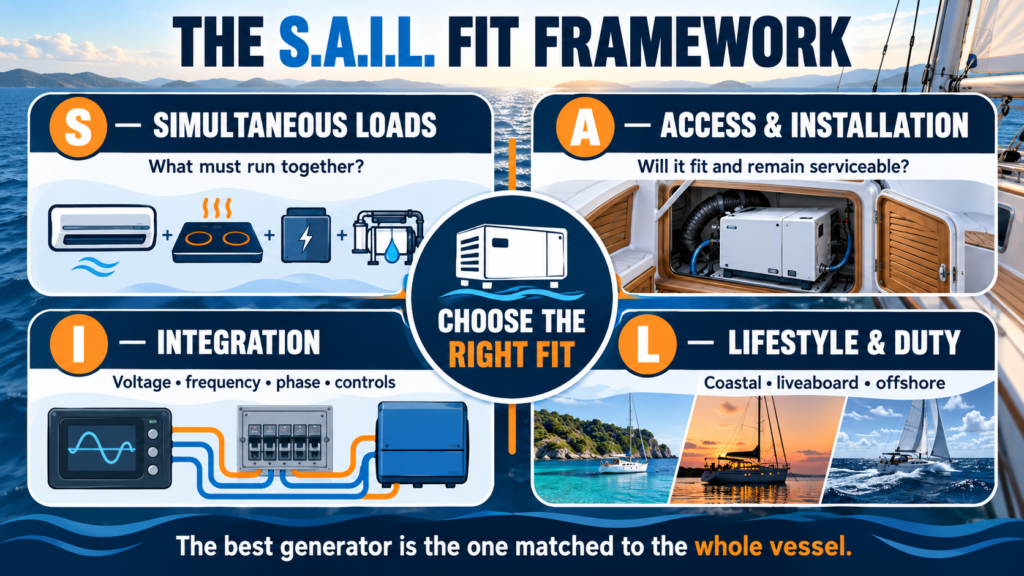
The S.A.I.L. Fit Framework
To make the buying decision easier, Generator Plus can position this article around an original framework: the S.A.I.L. Fit Framework.
It evaluates four questions before the buyer compares brands or models.
S — Simultaneous Loads
First, identify what the generator must power at the same time.
Ask:
- Will air conditioning run while the watermaker operates?
- Will the battery charger run with refrigeration and cooking equipment?
- Which pumps start automatically?
- Which appliances are used during overnight cruising?
- Which motors have high starting demand?
Do not add every appliance’s maximum rating together and assume that result is the correct generator size. Review the vessel’s real operating pattern.
A — Access and Installation
Next, confirm that the generator can physically enter, fit, and remain serviceable.
Check:
- Machinery-space dimensions
- Mounting-rail spacing
- Hatch and companionway dimensions
- Removal route
- Service clearances
- Exhaust access
- Filter access
- Control-panel location
- Sound-shield clearance
A generator that cannot be serviced properly is not a good long-term choice, even if its output is correct.
I — Integration
The generator must integrate with the boat’s existing systems.
Confirm:
- Voltage
- Frequency
- Phase
- Transfer switch
- Control panel
- AC wiring
- DC starting system
- Battery charger
- Cooling circuit
- Exhaust system
- Fuel supply
- Vessel-monitoring equipment
This is where many supposed “drop-in” replacements stop being drop-in projects.
L — Lifestyle and Duty Cycle
Finally, match the generator to how the boat is actually used.
A weekend coastal cruiser may have very different needs from:
- A liveaboard sailboat
- An offshore passagemaker
- A charter catamaran
- A tropical cruising yacht
- A boat with electric cooking
- A vessel relying heavily on battery charging
- A yacht that runs air conditioning overnight
A generator that is ideal for occasional weekend use may be poorly matched to a vessel operating continuously for days at a time.
The Contrarian Buying Insight
The most useful question is not:
“What is the biggest generator I can install?”
It is:
“What is the smallest generator that can reliably handle my real simultaneous loads, starting demand, installation limits, and duty cycle?”
That approach avoids two expensive mistakes:
- Undersizing, which causes overloads, voltage dips, and failed motor starts
- Oversizing, which adds cost, weight, space requirements, and potentially inefficient light-load operation
The best sailboat generator is therefore a system decision, not just a product decision.
3kW–4kW Marine Generators for Sailboats
A 3kW–4kW unit can be an excellent choice when the sailboat needs dependable auxiliary power but does not operate several high-demand appliances at the same time.
Who should consider a 3kW–4kW generator?
This range may suit a coastal-cruising sailboat that mainly needs power for:
- Battery charging
- Refrigeration
- Lighting
- Navigation equipment
- Communications equipment
- Small pumps
- Entertainment systems
- Basic galley appliances
A 3kW marine generator can also be useful as a compact replacement where the original generator was installed in a narrow machinery space.
The main advantage is that smaller units generally require less installation space and may be easier to remove or service. They can also be more practical for owners who use shore power frequently and only run the generator during passages, anchoring, or overnight stays.
What may exceed a 3kW–4kW generator?
This range may become restrictive when the boat needs to run several of the following simultaneously:
- Air-conditioning compressors
- Electric water heaters
- Large watermakers
- Induction cooking
- Multiple battery chargers
- Refrigeration compressors starting together
- Electric winches
- Hydraulic pumps
The key issue is not only the running load. Compressors and motors may require additional starting power, which can cause voltage or frequency dips if the generator is too small.
Best characteristics to look for
For this output range, prioritize:
- Compact physical dimensions
- Low vibration
- Easy filter and belt access
- Adequate motor-starting capability
- Correct 50 Hz or 60 Hz configuration
- Compatible voltage and phase
- Freshwater cooling
- Accessible replacement parts
- Optional sound enclosure
Potential brand families to investigate include Fischer Panda, Paguro, Phasor, MASE, and Westerbeke. Generator Plus lists several of these brands in its marine-generator catalogue, but the exact model must be matched to the vessel’s electrical and installation requirements.
5kW–6kW Marine Generators for Sailboats
The 5kW–6kW category is often attractive because it offers a practical balance between output, size, installation complexity, and operating cost.
Why 5kW–6kW is a popular middle range
A 5kW marine generator or 6kW marine generator may provide enough capacity for a cruising sailboat to operate several moderate loads together, without requiring the physical space of a much larger genset.
Depending on the load profile, this range may support:
- One air-conditioning system
- Refrigeration
- Battery charging
- A watermaker
- Lighting
- Navigation equipment
- Microwave or small galley appliances
- Pressure-water pumps
- Communications equipment
However, the owner still needs to determine which loads operate simultaneously. A generator that can power each appliance separately may not be able to start multiple compressors at the same time.
Why this range suits many liveaboard sailboats
A liveaboard may spend long periods away from shore power and need a more flexible power system. The generator may run while:
- Charging the battery bank
- Operating refrigeration
- Producing drinking water
- Running air conditioning
- Powering household electronics
- Supporting cooking or heating equipment
The generator should not be selected only by the boat’s length. Two sailboats of the same length may have completely different electrical demands depending on their batteries, air conditioning, galley equipment, watermaker, and cruising climate.
What to compare at 5kW–6kW
Compare:
- Rated output at the required frequency
- Starting performance
- Sound level under load
- Fuel consumption
- Engine speed
- Dimensions and weight
- Mounting-hole layout
- Exhaust outlet position
- Raw-water connection size
- Control-panel options
- Availability of a sound shield
- Warranty and service support
Fischer Panda’s published marine range includes compact AC models around 5kW and 5.5kW, while other brands offer different configurations in this output class. The figures should be treated as product-family examples, not proof that a particular model fits a specific sailboat. Cummins Marine Generator Sizing Tool.
7kW–8kW Marine Generators for Sailboats
A 7kW–8kW generator may be appropriate when a sailboat has heavier simultaneous demand or multiple comfort systems.
When 7kW–8kW becomes useful
This range may be considered for vessels with:
- More than one air-conditioning unit
- A larger watermaker
- High-capacity battery charging
- Electric cooking equipment
- Multiple refrigeration systems
- Large freezer systems
- Additional pumps
- Larger navigation and communications systems
- Hybrid or electric auxiliary systems
A 7kW marine generator may be sufficient for one vessel while an 8kW marine generator is necessary for another with a different starting-load profile.
The correct choice depends on the loads that operate together, not simply the number printed on the generator casing.
The installation trade-off
Moving from a 5kW or 6kW generator to an 8kW unit may increase:
- Generator weight
- Machinery-space requirements
- Exhaust size
- Cooling demand
- Ventilation requirements
- Fuel consumption
- Mounting loads
- Removal and installation difficulty
This is why the larger generator should be compared on a total installed basis. A unit with a lower purchase price may become more expensive if it requires new exhaust piping, mounting rails, cooling hoses, control wiring, or structural modifications.
Brand options to investigate
For this range, buyers may compare:
- Cummins Onan marine generators
- Fischer Panda marine generators
- Kohler/Rehlko marine generators
- Northern Lights marine generators
- Westerbeke marine generators
- Paguro or Phasor alternatives
YachtWorld’s marine-generator comparison also places Cummins Onan, Fischer Panda, Paguro, and other established manufacturers across different vessel sizes and output requirements.
The comparison should focus on the exact model, not just the brand reputation.
9kW–10kW Marine Generators for Sailboats
A 9kW–10kW generator may suit a larger sailboat, performance cruising yacht, or catamaran with several high-demand systems.
Who may need 9kW–10kW?
Possible applications include:
- Multiple air-conditioning units
- High-capacity watermakers
- Electric cooking
- Large battery banks
- Multiple refrigeration systems
- Electric heating
- Heavy onboard equipment
- Larger entertainment and communication systems
- Charter or liveaboard operation
A 10kW marine generator may provide useful reserve capacity, but reserve capacity should not be confused with automatically choosing the largest available machine.
The risk of oversizing
An oversized generator can add:
- Higher purchase cost
- More weight
- Greater installation complexity
- Larger cooling and exhaust requirements
- More machinery-space demand
- Higher service costs
- Inefficient light-load operation
A large unit may be justified when the load calculation supports it. It is not justified simply because the boat owner wants “extra power.”
The better approach is to identify the maximum realistic simultaneous load, account for motor-starting demand, and then select a generator with an appropriate operating margin.
Brand Comparison: Which Marine Generator Brands Suit Sailboats?
Generator Plus offers access to multiple marine-generator brands, including Cummins Onan, Fischer Panda, Rehlko/Kohler, Northern Lights, Paguro, Phasor, Nanni, MASE, Vetus, Westerbeke, and others.
The right brand depends on the vessel’s requirements, location, service network, and exact installation.
Cummins Onan Marine Generators
When comparing a Cummins Onan marine generator, review:
- Available output range
- Compact or enclosed configuration
- Electrical voltage and frequency
- Remote-control options
- Monitoring and shutdown systems
- Service support in the vessel’s region
- Installation dimensions
- Parts availability
Cummins also provides a marine generator sizing tool, reinforcing the importance of evaluating the vessel’s power needs rather than selecting a model by nameplate output alone.
Fischer Panda Marine Generators
Fischer Panda is strongly associated with compact and quiet marine generator systems.
Its published marine information highlights:
- Compact packaging
- Freshwater cooling
- Low-noise design
- Voltage-control systems
- Smaller AC generators
- Options for boats and yachts with restricted installation space
The manufacturer lists marine AC products around 3.5kW, 5kW, 5.5kW, 8kW, and 9kW, providing useful comparison points for this article’s 3kW–10kW range.
The buyer should still verify the exact frequency, voltage, dimensions, sound rating, and installation requirements.
Kohler/Rehlko Marine Generators
When comparing a Kohler marine generator or Rehlko marine generator, evaluate:
- 50 Hz or 60 Hz configuration
- Single-phase or three-phase output
- Controller type
- Sound-shield availability
- Transfer-switch options
- Remote display options
- Mounting and service access
- Parts support
Rehlko’s official 12EFKOZD listing demonstrates why model configuration matters: the product information identifies frequency, kW, fuel type, controller, alternator type, and available accessories.
Northern Lights Marine Generators
A Northern Lights marine generator may appeal to owners who prioritize robust marine construction, serviceability, and detailed installation documentation.
Compare:
- Generator dimensions
- Cooling system
- Mounting arrangement
- Exhaust requirements
- Service clearances
- Sound enclosure
- Available manuals
- Parts support
- Regional technicians
Northern Lights publishes technical information, specification sheets, operator manuals, parts manuals, installation drawings, and enclosure documentation across its marine generator range. www.northern-lights.com
Westerbeke, Paguro, Phasor, Nanni and MASE
These brands may also be relevant for sailboat applications, particularly when the buyer needs:
- A compact installation
- A specific frequency or voltage
- A low-profile design
- A certain cooling arrangement
- A replacement for an existing model
- Regional parts availability
- A particular budget or lead time
Do not assume that a model is suitable because it is listed as a “boat generator.” Confirm its rated output, electrical configuration, physical size, cooling, exhaust, controls, and intended duty cycle.
Sailboat Generator Size Examples
The following examples are for planning discussions only. They are not substitutes for a professional load calculation.
35–40-foot coastal-cruising sailboat
A vessel with basic refrigeration, lighting, navigation electronics, battery charging, and small pumps may investigate the 3kW–5kW range.
If the vessel also has air conditioning or a watermaker, starting loads must be reviewed carefully.
40–50-foot liveaboard sailboat
A liveaboard with one air-conditioning unit, a watermaker, refrigeration, battery charging, galley equipment, and regular off-grid operation may investigate 5kW–8kW options.
The final choice depends on which systems operate together.
Larger bluewater sailboat or catamaran
A larger vessel with multiple air-conditioning systems, electric cooking, a high-capacity watermaker, substantial refrigeration, and large battery charging requirements may need 8kW–10kW or more.
In this category, installation dimensions and service access become just as important as output.
Technical Specifications to Verify Before Buying
50 Hz versus 60 Hz
Confirm the frequency required by:
- Air-conditioning systems
- Refrigeration
- Pumps
- Motors
- Battery chargers
- Transformers
- Household appliances
A 50 Hz and 60 Hz generator should not be treated as interchangeable without confirming that the vessel’s equipment supports the proposed frequency.
Voltage and phase
Confirm whether the vessel requires:
- 120 V
- 230 V
- 120/240 V
- Single-phase
- Three-phase
A 230V marine generator may be suitable for one vessel but incompatible with another vessel’s switchboard and connected equipment.
kW, kVA and power factor
Check how the manufacturer presents the rating. kW and kVA are related but not identical, and power factor affects how much usable electrical load the generator can support.
Starting loads
Ask whether the generator can start the vessel’s largest motors and compressors without unacceptable voltage or frequency changes.
Dimensions and mounting
Verify:
- Length
- Width
- Height
- Weight
- Mounting-hole centres
- Mounting-foot height
- Service clearance
- Removal route
- Sound-shield dimensions
Cooling, exhaust and fuel
Confirm:
- Raw-water inlet and outlet sizes
- Heat-exchanger arrangement
- Siphon-break requirements
- Exhaust diameter
- Exhaust outlet position
- Maximum back pressure
- Fuel inlet and return connections
- Ventilation requirements
A true marine generator replacement must work with the vessel’s systems, not just fit inside the engine room.
Quietness, Vibration and Comfort on a Sailboat
For many cruising sailors, generator noise is one of the biggest ownership concerns. A generator may provide reliable electricity, but if it creates a loud vibration through the hull, it can affect sleep, conversation, navigation, and the overall experience onboard.
A quiet marine generator should therefore be evaluated as a complete installation rather than as an engine alone.
What makes a sailboat generator quiet?
Important factors include:
- Engine operating speed
- Number of cylinders
- Engine balance
- Flexible engine mounts
- Sound-shield design
- Exhaust silencer
- Intake silencing
- Vibration isolation
- Correct alignment
- Machinery-space insulation
- Cooling-fan noise
- Load level during operation
A slower-running multi-cylinder engine may produce a different sound profile from a smaller high-speed unit. However, engine speed is only one part of the result. Incorrect mounting or a poorly supported exhaust system can make even a well-designed generator unpleasantly loud.
Why installation matters as much as the generator
Noise can reach the accommodation spaces through several paths:
- Vibrations transmitted through the foundation
- Rigid exhaust connections
- Poorly adjusted mounts
- Metal-to-metal contact
- Uninsulated bulkheads
- Flexible hoses that are too short or incorrectly routed
- Sound shields with inadequate airflow or clearance
A professional marine generator installation should account for alignment, foundation strength, cooling airflow, exhaust routing, and service access. A sound shield must not be installed in a way that restricts ventilation or makes routine maintenance impossible.
How to compare manufacturer noise ratings
When comparing a quiet marine generator for sailboat use, check:
- The distance used for measurement
- Generator load during the test
- Engine speed
- Sound-shield configuration
- Test-room or open-air conditions
- Whether the figure represents sound pressure or sound power
Two manufacturers may use different test methods, so the numbers may not be directly comparable.
Diesel or Gasoline: Which Is Better for a Sailboat?
The right fuel type depends on the vessel’s existing systems, fuel storage, ventilation, safety requirements, cruising pattern, and available service support.
Marine diesel generators
A marine diesel generator for sailboat use may be suitable for owners who:
- Already carry diesel for the main engine
- Cruise offshore or for extended periods
- Need regular long-duration operation
- Prefer one primary fuel onboard
- Want a generator designed for continuous marine duty
- Need a broad marine parts and service network
Diesel systems can be heavier and more expensive than some gasoline alternatives, but they are common in cruising and liveaboard applications.
Gasoline marine generators
A gasoline generator may be considered when:
- The boat already uses gasoline propulsion
- The installation is specifically designed for gasoline equipment
- Ventilation and ignition-protection requirements are satisfied
- The output and duty cycle match the vessel’s needs
Gasoline installations require careful attention to vapour management, ventilation, fuel-system design, exhaust routing, and ignition protection. A portable household generator should not be treated as an automatic substitute for a properly installed marine genset.
The decision should be based on the complete vessel system, not only the purchase price.
The Final Sailboat Generator Buying Checklist
Before selecting a model, work through the following checklist.
Electrical requirements
Confirm:
- Required kW
- Required kVA
- Power factor
- Voltage
- Frequency
- Phase
- Main breaker rating
- Transfer-switch configuration
- Starting-battery voltage
- Remote-control requirements
- Motor-starting capability
A 50 Hz marine generator is not automatically interchangeable with a 60 Hz unit. Verify the frequency requirements of air conditioning, refrigeration, pumps, chargers, and other equipment before ordering.
Main onboard loads
List every item the generator may need to supply:
- Air conditioning
- Watermaker
- Refrigeration
- Freezer
- Battery charger
- Electric cooking equipment
- Water pumps
- Bilge pumps
- Lighting
- Navigation electronics
- Communications systems
- Entertainment equipment
- Workshop tools
- Heating equipment
Then identify which loads may operate at the same time.
Cummins provides a marine generator sizing tool because the correct model depends on the vessel’s estimated power needs and load profile, not simply the boat’s length or the old generator’s rating.
Physical installation
Measure:
- Generator length
- Generator width
- Generator height
- Weight
- Mounting-hole centres
- Mounting-rail dimensions
- Service clearances
- Hatch openings
- Companionway access
- Removal route
- Control-panel location
- Sound-shield dimensions
Do not measure only the empty space around the old generator. Measure the route used to remove the existing unit and bring in the new one.
Cooling and exhaust
Confirm:
- Raw-water inlet size
- Raw-water outlet size
- Heat-exchanger arrangement
- Siphon-break requirements
- Coolant capacity
- Ventilation openings
- Exhaust diameter
- Exhaust outlet location
- Muffler arrangement
- Maximum exhaust back pressure
- Water-injection location
Northern Lights publishes model-specific technical information and installation drawings because these details vary between generator configurations.
Service and ownership
Ask:
- Are genuine marine generator parts available?
- Is there regional technical support?
- What is the manufacturer warranty?
- Is a sound shield available?
- What maintenance intervals apply?
- Can filters and belts be reached easily?
- Is the control system supported?
- What is the expected delivery timeframe?
- Are installation accessories included?
The best generator is not necessarily the one with the lowest upfront price. A slightly more expensive unit may deliver better value if it is easier to service, supported in your region, and compatible with the existing installation.
What Information Should You Send Generator Plus?
To receive a useful quotation, send as much of the following information as possible:
- Vessel make and model
- Vessel length
- Vessel type
- Current operating location
- Existing generator manufacturer
- Exact model
- Serial number
- Generator nameplate photograph
- Rated kW or kVA
- Voltage
- Frequency
- Phase
- Starting-battery voltage
- Generator dimensions
- Mounting-footprint dimensions
- Installation-space photographs
- Hatch and access measurements
- Cooling arrangement
- Exhaust arrangement
- Fuel type
- Control-panel photographs
- Transfer-switch details
- Main electrical loads
- Air-conditioning capacity
- Watermaker capacity
- Desired delivery destination
- Required purchase date
- Target installation date
If a specification is unknown, state that clearly. A supplier can often verify some details from the nameplate photograph or model number. Northern Lights Technical Information.
Generator Plus presents a broad marine-generator catalogue alongside installation services, generator repair, parts support, and contact options, making the quotation process more useful when the technical information is supplied in advance.
Frequently Asked Questions
What size marine generator do I need for a sailboat?
The correct size depends on the vessel’s simultaneous running loads, motor-starting demand, voltage, frequency, phase, installation space, and intended duty cycle. A 3kW–4kW unit may suit essential loads, while 5kW–8kW may be more appropriate for many cruising or liveaboard applications. Larger sailboats and catamarans with several high-demand systems may require 8kW–10kW or more.
Is a 3kW marine generator enough for a sailboat?
It may be enough for battery charging, refrigeration, lighting, navigation electronics, communications equipment, and small pumps. It may not be sufficient for large air-conditioning compressors, electric cooking, high-capacity watermakers, or several motors starting together.
Can a 5kW marine generator run air conditioning?
Possibly. The answer depends on the air-conditioning system’s running demand, compressor-starting demand, and the other loads operating at the same time. A qualified technician should review the complete load profile before confirming suitability.
What is the best quiet marine generator for a sailboat?
The best quiet generator is the one that combines appropriate engine design, sound control, flexible mounting, proper exhaust silencing, and professional installation. Noise ratings should be compared using the same measurement conditions.
Should I choose diesel or gasoline?
Choose the fuel type that matches the vessel’s existing fuel system, ventilation design, operating pattern, safety requirements, and service support. Diesel is common for extended cruising, while gasoline may suit vessels already designed around gasoline propulsion.
Do I need a 50 Hz or 60 Hz generator?
Match the generator frequency to the vessel’s switchboard and connected equipment. Check air conditioning, refrigeration, pumps, chargers, motors, and appliances before selecting the model.
Can a marine generator run a watermaker and air conditioning at the same time?
It may, but the generator must be sized for both the normal running load and the starting demand of the watermaker and air-conditioning compressor. The generator’s rated output alone does not answer the question.
Can I install a sailboat generator myself?
A replacement involves electrical wiring, fuel, cooling, exhaust, ventilation, mounting, grounding, and safety systems. Manufacturer installation instructions and applicable regulations should be followed, and the work should be reviewed by a qualified marine professional.
Can I reuse the old sound shield, control panel, or exhaust system?
Only if compatibility is confirmed for the exact replacement model. Dimensions, airflow, wiring, control protocols, connection positions, and exhaust requirements may differ between brands and model generations.
What should I send when requesting a quotation?
Send the vessel details, generator nameplate photograph, model and serial number, electrical specifications, installation measurements, photographs, main onboard loads, delivery destination, and required purchase timeframe.
Conclusion: Choose the Generator That Fits Your Sailing Life
The best marine generator for sailboat use is not automatically the largest, cheapest, quietest, or most popular model.
The right choice is the generator that fits the vessel’s real operating pattern.
A 3kW–4kW unit may be practical for essential loads and smaller cruising boats. A 5kW–6kW generator may provide a useful balance for many liveaboard and coastal-cruising applications. A 7kW–8kW model may suit heavier simultaneous demand, while a 9kW–10kW unit may be appropriate for larger sailboats and catamarans with multiple high-load systems.
Before buying, verify:
- Simultaneous electrical loads
- Starting demand
- Voltage
- Frequency
- Phase
- Dimensions
- Mounting
- Cooling
- Exhaust
- Fuel
- Controls
- Service access
- Parts availability
- Installation cost
- Delivery requirements
Generator Plus can help you compare suitable small marine generators, compact diesel gensets, and higher-output options from established manufacturers. Send the current generator details, vessel information, installation photographs, electrical requirements, delivery destination, and desired purchase timeframe to begin a more accurate comparison.
The goal is simple: choose a generator that gives your sailboat dependable power without creating an avoidable installation, noise, or service problem.
