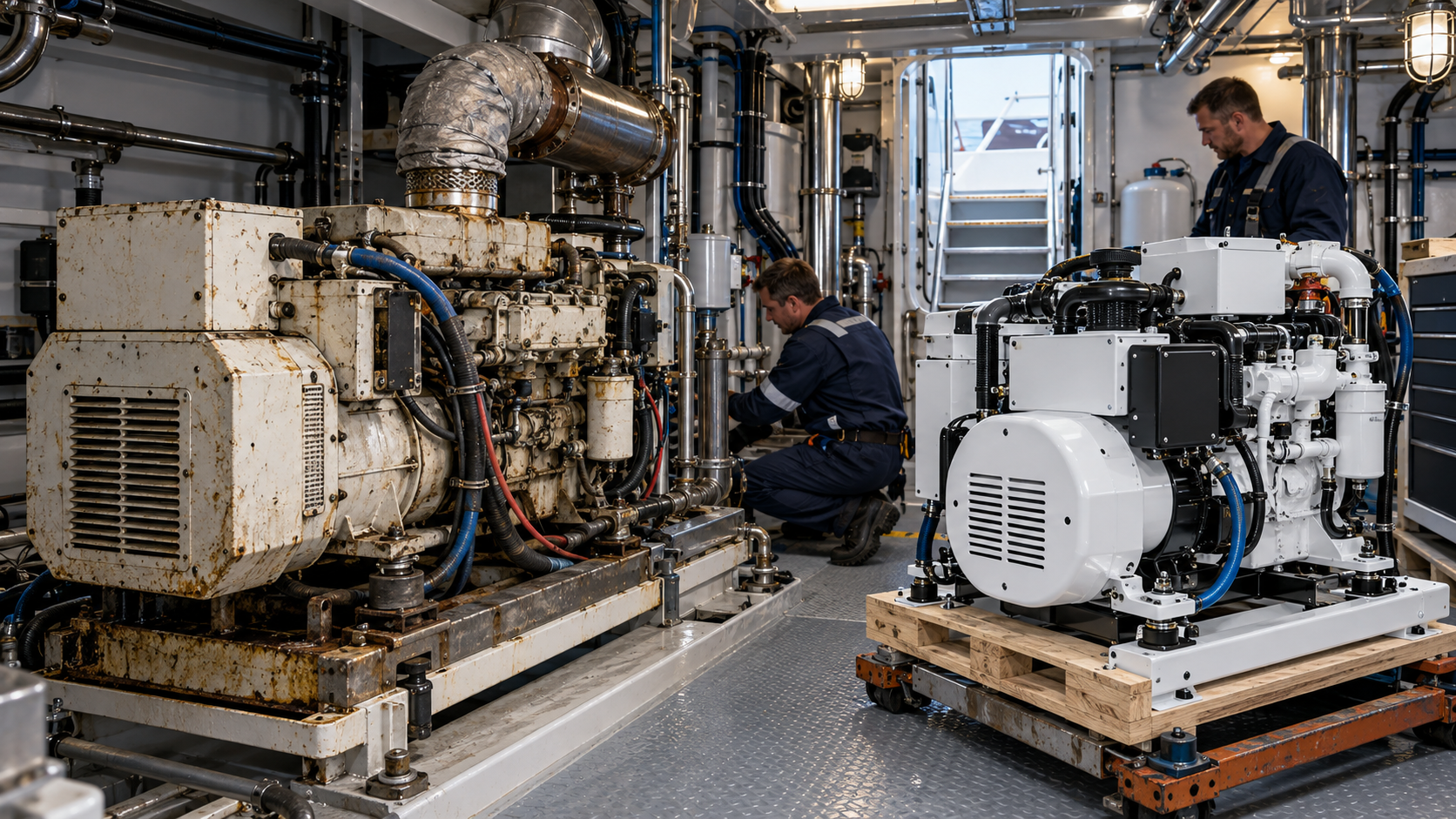
Picture this illustrative scenario: a skipper is preparing for a longer voyage when the boat’s generator begins shutting down under load. The unit can still start, but it struggles when the air conditioning, battery charger and watermaker operate together. The first instinct is usually simple: find another generator with the same kW rating and install it in the same place.
That approach can create a much larger problem.
The old generator may have been incorrectly sized from the beginning. The replacement model may have different dimensions, mounting points, cooling requirements, exhaust connections, control wiring or electrical specifications. Even if the new unit produces the same headline output, it may not be a direct replacement for the vessel.
The right replacement marine generator should match the boat’s actual electrical demand, available installation space, connected systems and future operating requirements. The existing generator’s nameplate is an important starting point, but it is not a complete replacement specification.
Generator Plus supports enquiries involving generator replacement, refit and new-build projects, including questions about sizing, cooling, electrical integration and available installation space.
This guide explains how to decide between repair and replacement, how to identify a suitable marine genset, what information to collect and how to request a quotation that reflects the complete project.
When Should You Replace a Marine Generator?
There is no single operating-hour figure or age at which every marine generator should be replaced. Some units remain serviceable for many years with proper maintenance. Others become uneconomical to operate much earlier because of corrosion, repeated faults, poor parts availability or changes to the vessel.
The decision should be based on evidence rather than age alone.
The generator has repeated or expensive failures
A single failed component does not necessarily mean you need a new boat generator replacement. A faulty impeller, starter motor, sensor, belt or control component may be repairable without replacing the complete genset.
Replacement becomes more reasonable when several major systems are deteriorating at the same time. Warning signs may include:
Repeated overheating
Low oil pressure shutdowns
Persistent starting problems
Alternator or voltage-regulator failure
Cooling-system corrosion
Exhaust-system damage
Fuel-system contamination or leakage
Repeated shutdowns under normal load
Increasingly difficult access to replacement parts
Long periods of unplanned downtime
The important question is not simply, “How much will this repair cost?” Ask instead:
If this repair is completed, how confident are we that the generator will meet the vessel’s requirements for the next several seasons?
A repair quotation should identify the failed parts, the cause of the failure and any other components that may require attention. Without that diagnosis, comparing repair with marine diesel generator replacement is guesswork. Cummins Marine Generator Sizing Tool
The original model has been discontinued
A discontinued marine generator is not automatically unusable. Manufacturers may continue supporting certain models with service parts, technical manuals or successor components. Specialist suppliers may also be able to source parts for older equipment.
However, a discontinued model deserves a more careful review.
You need to establish:
Whether the exact model is still supported
Whether critical service parts remain available
Whether the control system can still be repaired
Whether technical documentation is accessible
Whether the alternator and engine are both serviceable
Whether the generator is still suitable for the vessel’s current load
Whether repair downtime creates an operational problem
A discontinued marine generator replacement may be appropriate when a critical control board, alternator, engine component or cooling part is no longer reasonably available. It may also be sensible when the total repair involves several systems and the owner is likely to face another major failure soon afterward.
The key distinction is this:
Discontinued does not automatically mean beyond repair, and current does not automatically mean compatible.
A modern replacement can still require substantial modifications if the footprint, control system, exhaust arrangement or electrical configuration differs from the original unit.
The vessel’s electrical demand has changed
Many boats gradually acquire more electrical equipment. A vessel that originally needed power for refrigeration, lighting and battery charging may later add:
Air conditioning
A watermaker
Additional refrigeration
Induction cooking
Larger battery chargers
Seakeeper systems
Hydraulic pumps
Additional freezers
Entertainment systems
Workshop equipment
More navigation and communication equipment
That means the original generator may no longer be correctly sized, even if it operated well for many years.
The opposite can also happen. A generator may be much larger than the loads the vessel normally uses. Oversizing can increase purchase cost, physical size and operating inefficiency. Cummins’ sizing guidance emphasises the need to evaluate project parameters, load characteristics, motor starting demand, phase, frequency and voltage instead of choosing a genset from one rating alone.
A proper load review should identify:
Equipment that operates continuously
Equipment that cycles on and off
Motors and compressors
Starting demand
Loads likely to operate simultaneously
Equipment that may be added later
Air-conditioning compressors, watermakers and pumps deserve particular attention because their starting demand can be much higher than their normal running demand.
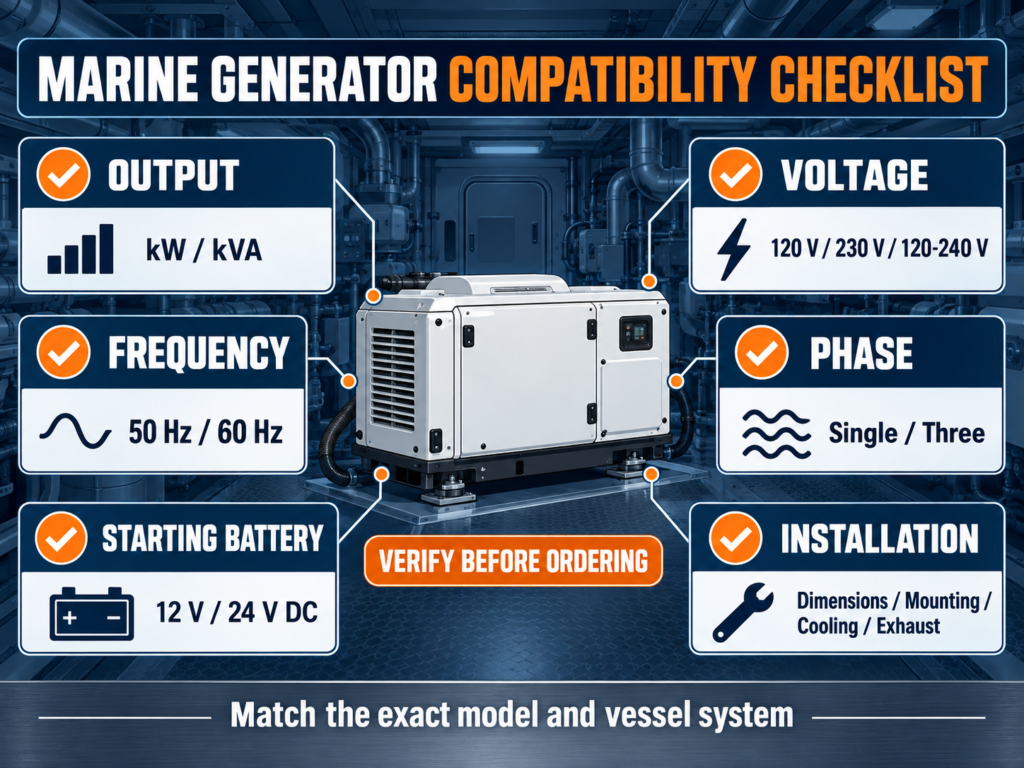
Marine generator compatibility checklist for kW voltage frequency and phase
The generator no longer suits the vessel’s operating pattern
A generator used for occasional weekend trips has different requirements from one used every day on a liveaboard yacht or commercial vessel.
Consider how the vessel operates:
Weekend cruising
Seasonal leisure use
Full-time liveaboard operation
Long-distance cruising
Charter service
Commercial fishing
Workboat operation
Passenger transport
Continuous or prime-power operation
The replacement should reflect the operating pattern. A compact unit may be entirely suitable for a small cruising boat but inappropriate for a commercial vessel that depends on long operating hours and immediate access to service parts.
Operating pattern also affects the importance of:
Fuel consumption
Noise
Service access
Parts availability
Redundancy
Remote monitoring
Automatic starting
Load management
Technical support
Repair, Replace or Repower?
Before ordering a new unit, compare three realistic paths:
Option
When it may be suitable
Main benefit
Main risk
Repair the existing generator
The fault is isolated and parts are available
Lower project disruption
Other ageing components may fail later
Replace with an equivalent model
The model or a documented successor remains suitable
Potentially simpler installation
The old design may no longer meet current needs
Replace with another brand or redesign the system
The vessel’s needs, space or support requirements have changed
Better long-term fit
More installation work may be required
When repairing the existing generator may be sensible
Repair deserves serious consideration when:
The fault has been correctly diagnosed
The engine and alternator are fundamentally sound
Critical parts are available
The repair scope is clearly defined
The unit still matches the vessel’s electrical demand
The expected repair life is reasonable
Downtime is acceptable
For example, replacing a worn seawater pump, belt, starter motor or sensor may restore reliable operation without a full marine genset replacement.
However, a low repair price can be misleading if it excludes the cause of the failure or ignores other deteriorating components. A repair should explain what will be replaced, what will be tested and what remains outside the scope.
When replacement may be the better decision
Replacement may be more appropriate when:
Several major systems are failing
The generator is repeatedly unavailable
Critical parts are difficult to source
The model is discontinued
The vessel’s electrical demand has increased
The existing installation is already being modified
The owner requires improved noise or service access
A major refit is already planned
The repair cost approaches the value of a reliable current unit
Do not rely on a universal rule such as “replace the generator when repairs exceed half its purchase price.” That calculation ignores downtime, installation work, future failures, parts availability and the vessel’s operating needs.
The R.E.P.L.A.C.E. Framework
Use this framework to move from a failing genset to a defensible replacement decision.
R — Record the existing generator
Start with the generator nameplate. Record:
Manufacturer
Model
Serial number
kW rating
kVA rating
Voltage
Frequency
Phase
Amperage
Engine speed
Starting-battery voltage
Control-panel model
Take a clear photograph of the complete nameplate. Do not rely only on a model number remembered from an old invoice.
E — Examine the repair and failure history
Collect:
Current fault symptoms
Previous repair invoices
Operating hours
Service history
Parts already replaced
Technician reports
Shutdown records
Periods of downtime
Evidence of corrosion or overheating
This separates a repairable failure from a generator that has become unreliable as a complete system.
P — Profile the vessel’s electrical load
List every item the generator may need to supply. Record running demand, starting demand and whether each load operates at the same time.
Include air conditioning, refrigeration, battery chargers, watermakers, pumps, cooking equipment and workshop tools.
The old generator’s output may help establish a baseline, but the current load profile should guide the new selection.
L — Lock down the physical installation
Measure:
Length
Width
Height
Weight
Mounting-foot positions
Service clearances
Hatch dimensions
Removal path
Access to filters and fluid connections
A manufacturer installation manual should be used with current dimensional drawings. Northern Lights specifically stresses planning, current drawings, service access, mounting, ventilation, cooling, exhaust, fuel and electrical systems during installation.
A — Audit the connected systems
Review the:
Cooling circuit
Raw-water intake
Exhaust system
Fuel supply
Ventilation
Battery cables
Control wiring
Transfer switch
Remote panel
Monitoring system
This is where many apparently simple replacements become larger retrofit projects.
C — Compare the complete installed cost
Compare more than the generator price. Include:
Generator set
Sound shield
Control panel
Removal
Delivery
Mounting
Electrical work
Cooling modifications
Exhaust work
Commissioning
Taxes
Shipping
Optional accessories
This is the difference between comparing a product and comparing a complete replacement project.
E — Establish supply and support
Before ordering, confirm:
Exact model and configuration
Availability
Lead time
Included accessories
Exclusions
Manufacturer documentation
Parts support
Warranty conditions
Delivery destination
Installation responsibility
Intended purchase date
The most useful quotation is one that makes the remaining decisions visible. It should tell you exactly what is being supplied, what must be modified and what the owner or installer must provide.
Confirming Compatibility Before You Buy
Once you decide that replacement is the right path, the next question is more important than “Which brand should I choose?”
The real question is:
Will this specific generator work with this vessel, this electrical system, and this installation?
A replacement marine generator is suitable only when its electrical output, physical dimensions, mounting, cooling, exhaust, fuel, controls, and service requirements match the vessel—or when the required modifications are clearly understood and budgeted.
A similar kW rating is not enough.
Identify the Existing Generator Correctly
Before comparing new models, document the generator already installed on the boat. This prevents one of the most common replacement mistakes: selecting a model based on a familiar brand name or approximate output while overlooking the exact configuration.
Record the following:
Manufacturer
Exact model number
Serial number
Rated kW or kVA
Voltage
Frequency
Single-phase or three-phase output
Operating RPM
Starting-battery voltage
Cooling arrangement
Overall dimensions
Mounting-footprint dimensions
Exhaust outlet position
Fuel inlet and return locations
Control-panel type
Sound-shield or enclosure configuration
A clear photograph of the generator nameplate is one of the most useful documents you can send to a supplier. The nameplate may reveal details that are not obvious from the model name, including voltage, phase, frequency, rated output, and serial-specific configuration.
For a discontinued marine generator replacement, the model and serial number are especially important. Some parts may have newer superseding numbers, while others may no longer be supported. A supplier should verify those details before recommending a replacement or repair kit. Northern Lights Technical Information.
Photograph the Entire Installation
The nameplate identifies the genset. Installation photographs show the project.
Take clear pictures of:
The generator from all accessible sides
Mounting feet and foundation rails
Exhaust elbow and muffler
Raw-water inlet and outlet hoses
Coolant expansion tank or heat exchanger
Fuel supply and return lines
Starting-battery cables
AC output cables
DC wiring
Remote control panel
Transfer switch
Ventilation openings
Service-access areas
The route used to remove the old unit
Photographs can reveal problems that measurements alone miss. For example, the new unit may fit inside the compartment but be impossible to lower through the hatch. A service panel may face a bulkhead. The exhaust outlet may point toward an existing structural member. Battery cables may be too short to reach the new starter location.
This is why marine generator replacement dimensions should include more than length, width, and height. You also need access dimensions, connection locations, lifting points, and maintenance clearances.
Measure the Available Space Properly
Measure the installation space in three ways:
The generator footprint — length, width, height, and mounting-hole positions.
The access route — hatch openings, companionways, doors, stairways, and lifting restrictions.
The service envelope — the room needed to remove filters, belts, heat exchangers, wiring covers, and control components.
A generator can physically fit but still be a poor replacement if routine servicing becomes difficult. The result may be higher maintenance costs and longer repair periods.
OEM documentation should always take priority over marketplace listings. Northern Lights, for example, publishes model-specific specification sheets, operator manuals, parts manuals, installation drawings, enclosure drawings, and sound-shield instructions across its generator range.
That level of detail matters because dimensions and connection layouts can change between variants that appear similar in a product catalogue.
Match the Electrical Specifications
Compare kW and kVA Correctly
The old generator’s output is a starting point—not a final answer.
A vessel may have originally used a 7.5 kW genset but now require more capacity because of additional air conditioning, battery chargers, a watermaker, induction cooking, refrigeration, or navigation equipment. Conversely, a larger generator may be unnecessary if the boat’s operating pattern has changed.
When comparing candidates, distinguish between:
Continuous or prime output
Standby output, if listed
kW rating
kVA rating
Power factor
Motor-starting capability
Load acceptance
Operating duty cycle
kW describes real power. kVA describes apparent power and is affected by power factor. The two ratings should not be treated as interchangeable without checking the manufacturer’s specifications.
Cummins provides a marine generator sizing tool because model selection depends on the vessel’s estimated power requirements, not only the old nameplate rating.
Confirm 50 Hz or 60 Hz
A 50 Hz marine generator replacement is not automatically interchangeable with a 60 Hz unit, and the reverse is also true.
Frequency affects equipment such as:
Air-conditioning compressors
Pumps
Motors
Battery chargers
Transformers
Refrigeration systems
Some electronic equipment
Clocks and frequency-sensitive appliances
European vessels commonly use 50 Hz systems, while many North American vessels use 60 Hz systems. However, vessel origin alone is not enough to confirm the requirement. Check the generator nameplate, main switchboard, connected equipment, and vessel documentation.
A product family may also be available in different frequency configurations. Rehlko’s 12EFKOZD, for example, is listed as a 12 kW, 50 Hz diesel generator with a Decision-Maker controller.
That does not mean every 12EFKOZD configuration is suitable for every vessel. The exact phase, voltage, controller, options, and installation arrangement still need to be verified.
Confirm Voltage and Phase
Voltage must match the vessel’s electrical system and connected equipment.
Common marine configurations include:
120 V
230 V
120/240 V
Single-phase
Three-phase
A 230V marine generator may be appropriate for a European vessel but unsuitable for a boat whose distribution system requires a different voltage or phase configuration.
Likewise, a single-phase generator cannot simply replace a three-phase unit because both have the same kW rating. The switchboard, loads, protection devices, cabling, and transfer equipment may all be different.
Check:
Generator output voltage
Line-to-line and line-to-neutral voltage, where applicable
Single- or three-phase configuration
Main breaker rating
Shore-power voltage
Transfer-switch configuration
Distribution-panel requirements
Required frequency
The replacement should be evaluated as part of the complete electrical system—not as an isolated engine-generator package.
Do Not Confuse Output Voltage With Starting-Battery Voltage
A generator may produce 230 V AC while using a 12 V DC starting system. Another model may use 24 V DC starting.
These are separate specifications.
Before ordering, confirm:
Starting-battery voltage
Starter-current requirements
Battery capacity
Battery-cable size
Battery isolator arrangement
Charging output
Grounding and bonding requirements
A mismatch in starting-battery voltage can prevent the unit from being commissioned even when the AC output appears correct.
Account for Starting Loads
Motors and compressors can require significantly more power during startup than while running. This commonly affects:
Air-conditioning compressors
Refrigeration compressors
Watermakers
Hydraulic pumps
Electric winches
Battery chargers
Bilge pumps
Large ventilation fans
A generator that handles the vessel’s running load may still experience voltage or frequency dips when a large motor starts.
Do not simply add every appliance’s maximum rating together and assume that is the correct generator size. Instead, identify which loads operate at the same time and which equipment has the highest starting demand. A qualified marine electrician can assess the vessel’s actual load profile and starting sequence.
Check Mechanical and Installation Compatibility
Electrical compatibility is only one part of a successful marine generator repower.
Mounting and Foundation
Compare:
Mounting-hole centres
Footprint
Base height
Mounting-bolt size
Vibration isolators
Generator weight
Centre of gravity
Foundation strength
Shaft or coupling alignment, where relevant
A different frame size may require new rails, adapter plates, foundation modifications, or vibration-isolator changes.
The installation should also account for service access. Northern Lights’ installation guidance emphasizes that generator projects involve mounting, ventilation, cooling, exhaust, fuel, electrical wiring, and bonding—not simply placing the genset on an existing platform.
Cooling System
Confirm whether the existing unit uses:
Heat-exchanger cooling
Keel cooling
Radiator cooling
Freshwater cooling
Raw-water cooling
A dedicated or shared seawater circuit
Then compare:
Raw-water inlet size
Outlet position
Hose routing
Pump capacity
Siphon-break requirement
Heat-exchanger arrangement
Coolant expansion-tank position
Required seawater flow
A new unit may need different hose diameters, a different siphon-break location, or a revised seawater intake arrangement.
Exhaust System
Check:
Exhaust outlet diameter
Elbow orientation
Wet or dry exhaust configuration
Muffler position
Water-injection point
Exhaust back pressure
Siphon-break arrangement
Exhaust hose routing
Insulation and heat protection
Never assume the old exhaust system can be reused simply because the replacement generator has the same output. The outlet may be in a different location or require a different diameter.
Fuel and Ventilation
Compare:
Fuel inlet size
Fuel-return requirement
Connection locations
Maximum fuel-line length
Lift-pump capability
Ventilation openings
Combustion-air requirements
Heat rejection
Compartment airflow
Gasoline and diesel generators have different fuel-system and ventilation considerations. A diesel unit should not be treated as a direct substitute for a gasoline generator without a complete system review.
Controls and Monitoring
Modern generators may use digital controllers, remote displays, network connections, automatic shutdowns, and electronic monitoring.
Check whether the proposed marine generator control panel is compatible with:
Existing remote wiring
Start/stop circuits
Alarm circuits
Automatic start systems
Engine-room monitoring
Vessel-management systems
Generator-hour meters
Emergency-stop circuits
A new control panel or harness may be required even when the generator itself fits the compartment.
Can You Replace a Marine Generator With a Different Brand?
Yes, but a cross-brand replacement should be treated as a compatibility project—not a simple product substitution.
A different brand may make sense when:
The original model is discontinued.
Critical parts are difficult to source.
The current manufacturer no longer offers a suitable configuration.
Another model provides better physical access.
Noise, vibration, or serviceability needs improvement.
The vessel’s voltage, frequency, or load requirements have changed.
A different supplier can provide better technical support or delivery.
Generator Plus supplies multiple marine generator brands, including Fischer Panda, Cummins Onan, Kohler/Rehlko, Westerbeke, MASE, Vetus, and others.
However, brand choice should come after the compatibility review.
A true direct replacement has closely matching:
Electrical configuration
Mounting arrangement
Dimensions
Connection locations
Controls
Cooling
Exhaust
Fuel system
Service requirements
A compatible alternative may perform the same function but require new mounts, pipework, wiring, controls, or commissioning work. Rehlko/Kohler 12EFKOZD Specifications.
What Can Be Reused?
Some existing components may be reusable. None should be assumed compatible without confirmation.
Existing component
May be reusable when…
Check before reuse
Sound shield
It is designed for the exact replacement model or approved by the manufacturer
Diameter, routing, back pressure, and outlet position are acceptable
Manufacturer limits and inspection
Fuel lines
Size, material, routing, and connection type are suitable
Inlet/return requirements and condition
Battery cables
Cable size, length, polarity, and termination are adequate
Starting current and voltage
Raw-water intake
Flow capacity and connection sizes match
Seawater pump demand and siphon protection
Mounting structure
Footprint and load capacity match
Bolt centres, vibration isolation, weight
Transfer switch
Voltage, phase, current rating, and control logic match
Shore/generator interlocking and protection
Sound shields deserve particular attention. Rehlko lists a sound-shield kit as an accessory for the 12EFKOZD, which demonstrates that enclosure compatibility is model-specific rather than universal.
The safest rule is simple:
Reuse a component only after the replacement manufacturer or responsible marine technician confirms that it is suitable for the exact model and installation.
Cost, Ordering, Installation and Final Replacement Checklist
Once the technical compatibility review is complete, you can compare the real project cost, request accurate quotations, and plan the marine generator installation.
This is where many replacement projects go wrong. An owner may compare two generator prices and assume the cheaper unit is the better option. In reality, the lower-priced genset may require new mounts, exhaust modifications, control-panel changes, additional wiring, or longer installation time.
The right comparison is not:
Which generator has the lowest purchase price?
It is:
Which replacement provides the lowest reliable installed cost for this vessel?
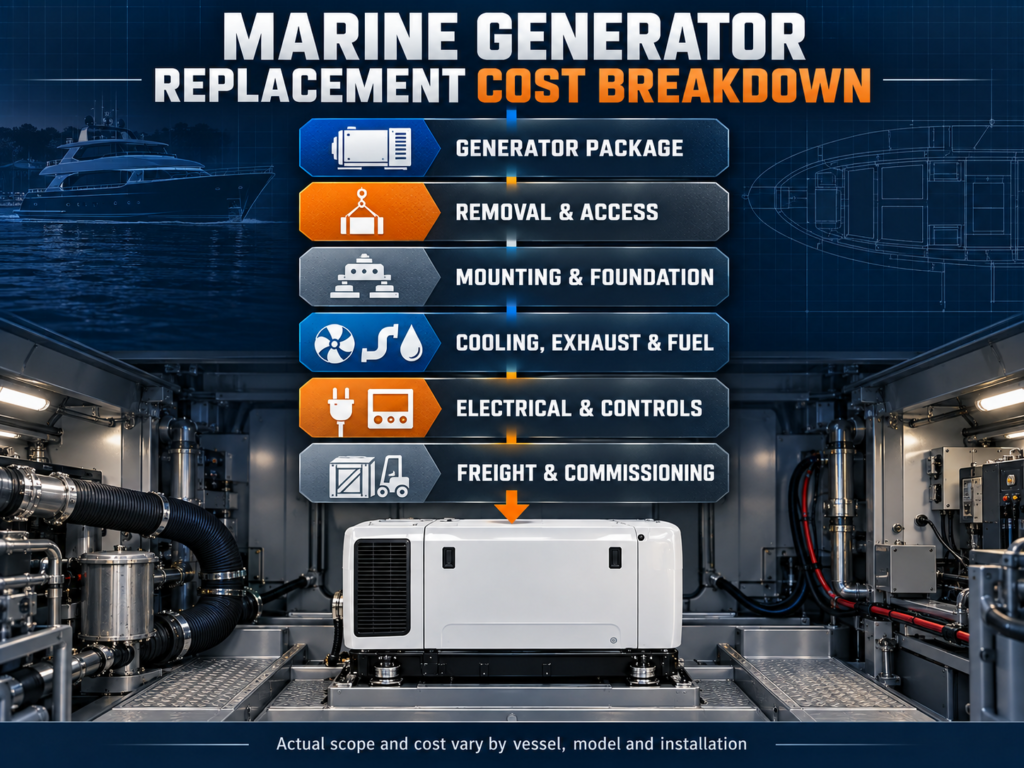
What Does Marine Generator Replacement Cost?
There is no universal price for a marine generator for sale replacement because every project has different equipment, access, electrical requirements, and installation conditions.
The total project may include:
New generator or genset package
Control panel and wiring harness
Sound shield or enclosure
Removal of the existing generator
Lifting equipment and access work
New mounting rails or foundation modifications
Exhaust modifications
Cooling-system modifications
Fuel-system changes
Battery cables and starting-system work
Electrical conversion
Transfer-switch changes
Freight and delivery
Installation labour
Testing and commissioning
Applicable taxes, customs charges, or import costs
A close replacement may reuse much of the existing installation. A cross-brand marine generator repower may require considerably more work.
The exact generator price is only one part of the total cost.
The Equipment Cost
The equipment price depends on:
Manufacturer
Rated kW or kVA
Diesel, gasoline, or other fuel type
50 Hz or 60 Hz configuration
Voltage
Single-phase or three-phase output
Open or enclosed configuration
Remote-control options
Sound-shield package
Automatic-start capability
Class or certification requirements
Available accessories
For example, Rehlko lists the 12EFKOZD as a 12 kW, 50 Hz diesel generator with a Decision-Maker controller and optional accessories such as a sound-shield kit, transfer switch, remote displays, and siphon break.
That illustrates why two generators with similar output ratings can have very different package prices.
Removal and Access Costs
Removing the old genset may involve:
Disconnecting AC and DC wiring
Draining coolant
Disconnecting fuel and exhaust systems
Removing sound shields
Lifting the generator out of the machinery space
Temporarily removing doors, panels, or furniture
Using a crane, chain hoist, or lifting frame
Transporting the old unit away
On some boats, access work can cost as much as the mechanical installation because the generator must pass through a narrow hatch or cabin area.
Installation-Modification Costs
A boat generator replacement may require modifications to:
Mounting rails
Vibration isolators
Exhaust hose and muffler
Raw-water hoses
Coolant lines
Fuel lines
Battery cables
AC output cabling
Remote control wiring
Ventilation openings
Transfer-switch wiring
Engine-room sound insulation
These costs should be clearly shown in a written quotation rather than hidden inside a vague “installation” allowance.
Commissioning and Testing
A professional marine generator commissioning process should confirm that:
The generator starts correctly.
Safety shutdowns operate correctly.
AC voltage is correct.
Frequency is correct.
Phase rotation is correct where applicable.
The generator accepts normal loads.
Large motors and compressors start correctly.
Cooling water flows correctly.
Exhaust connections are secure.
Fuel connections are leak-free.
Battery charging works correctly.
The remote panel communicates properly.
The transfer switch operates safely.
The installation does not create abnormal vibration or overheating.
Cummins states that generator installation and electrical connections must follow applicable instructions and codes and be carried out by trained and experienced personnel.
When requesting a marine generator quote, ask the supplier to separate the following items:
Quotation item
What should be confirmed
Generator model
Exact model, configuration, frequency, voltage and phase
Rated output
kW, kVA, power factor and duty rating
Included equipment
Control panel, harness, breakers, sound shield and accessories
Installation scope
Removal, mounting, wiring, cooling, exhaust and commissioning
Freight
Shipping method, destination and delivery conditions
Availability
Current stock status or expected lead time
Warranty
Applicable manufacturer warranty and registration requirements
Exclusions
Yard work, crane hire, electrical upgrades, taxes and customs
Payment terms
Deposit, balance, accepted payment method and validity
Documentation
Datasheet, installation drawing, manual and wiring diagram
A quote that lists only “10 kW marine generator” is not detailed enough for a replacement project.
The quotation should identify the exact configuration. For example, “12 kW diesel generator” does not tell you whether the unit is 50 Hz or 60 Hz, single-phase or three-phase, 230 V or 120/240 V, enclosed or open, or supplied with a remote panel.
New, Used, Rebuilt or Remanufactured?
A new unit is not the only replacement option, but each alternative carries a different level of risk.
New Replacement Generator
A new replacement marine generator may provide:
Current manufacturer support
New components
Current documentation
Applicable manufacturer warranty
Better emissions and fuel-efficiency technology
Improved control and monitoring systems
Easier access to future parts
The main disadvantages are the initial purchase price and the possibility that a new model will require installation modifications.
Used Marine Generator
A used marine generator may cost less initially, but price alone does not establish value.
Before buying used, request:
Exact model and serial number
Operating hours
Maintenance records
Previous application
Removal reason
Compression or diagnostic records, where available
Generator-end test results
Included control panel and accessories
Photographs of the nameplate and installation
Written warranty terms
A used generator that appears inexpensive may need injectors, pumps, control boards, hoses, mounts, or alternator work before installation.
Rebuilt or Remanufactured Unit
A rebuilt or remanufactured marine generator should be evaluated according to the actual work completed—not the label alone.
Ask:
Which engine components were replaced?
Was the generator end tested?
Were bearings, seals, injectors, pumps, and hoses replaced?
Was the control system tested?
Was the unit load-tested?
Who performed the work?
What warranty is provided?
Are replacement parts still available?
A rebuilt discontinued generator may still be difficult to support if the control board or alternator is obsolete.
The Marine Generator Replacement Process
A structured process reduces delays and prevents expensive compatibility mistakes.
Step 1: Diagnose the Existing Generator
Before removing anything, ask a qualified marine technician to identify the failure.
A hard-starting generator may have a battery, fuel, glow-plug, exhaust, cooling, or control problem. Repeated shutdowns may result from low oil pressure, overheating, poor raw-water flow, or a faulty sensor.
Do not replace the entire genset until the repair scope has been considered.
Step 2: Record the Existing Installation
Photograph the nameplate, connections, mounting system, control panel, exhaust, cooling lines, fuel lines, and access route.
Record measurements while the old generator is still installed. Once it is removed, important connection and mounting information may be difficult to reconstruct.
Step 3: Recalculate the Vessel’s Electrical Demand
List the equipment that must operate away from shore power.
Include:
Air conditioning
Refrigeration
Watermaker
Battery chargers
Pumps
Cooking equipment
Lighting
Navigation equipment
Communications equipment
Workshop or commercial equipment
Electric heating
Winches and other motors
Then identify which loads operate simultaneously and which have high starting demand.
Do not automatically select a larger generator simply because the vessel has added equipment. Oversizing can lead to low-load operation, inefficient running, increased maintenance, and unnecessary cost.
Step 4: Compare Current Models
Create a comparison sheet for each candidate, including:
Output
Voltage
Frequency
Phase
Dimensions
Weight
Mounting
Cooling
Exhaust
Fuel
Controls
Starting voltage
Sound shield
Service access
Parts availability
Warranty
Lead time
Installed cost
This makes it easier to compare a direct successor with a cross-brand alternative.
Step 5: Confirm the Installation Plan
Before ordering, have the responsible marine technician or electrician confirm:
The generator can enter and leave the vessel.
The foundation can support it.
The mounting system is suitable.
Cooling capacity is sufficient.
Exhaust back pressure is acceptable.
Fuel connections are suitable.
Electrical protection is correct.
Control and monitoring systems can be integrated.
Required clearances are available.
The transfer switch is compatible.
Northern Lights publishes installation drawings and technical manuals because generator installation involves more than selecting a rated output.
Step 6: Order Only After Configuration Is Confirmed
Do not order based on a product title alone.
Confirm the exact:
Model suffix
Frequency
Voltage
Phase
Controller
Sound-shield option
Cooling configuration
Accessories
Regional specification
Delivery scope
This is particularly important when buying a discontinued marine generator replacement, because a current successor may resemble the old model but use different controls, dimensions, or connections.
Step 7: Commission and Document the Work
After installation, keep:
Final wiring diagrams
Installation photographs
Commissioning results
Serial-number records
Warranty documents
Maintenance schedule
Replacement-parts information
Technician reports
Load-test results
This documentation helps with future troubleshooting, resale, warranty support, and the next replacement decision.
Marine Generator Replacement Checklist
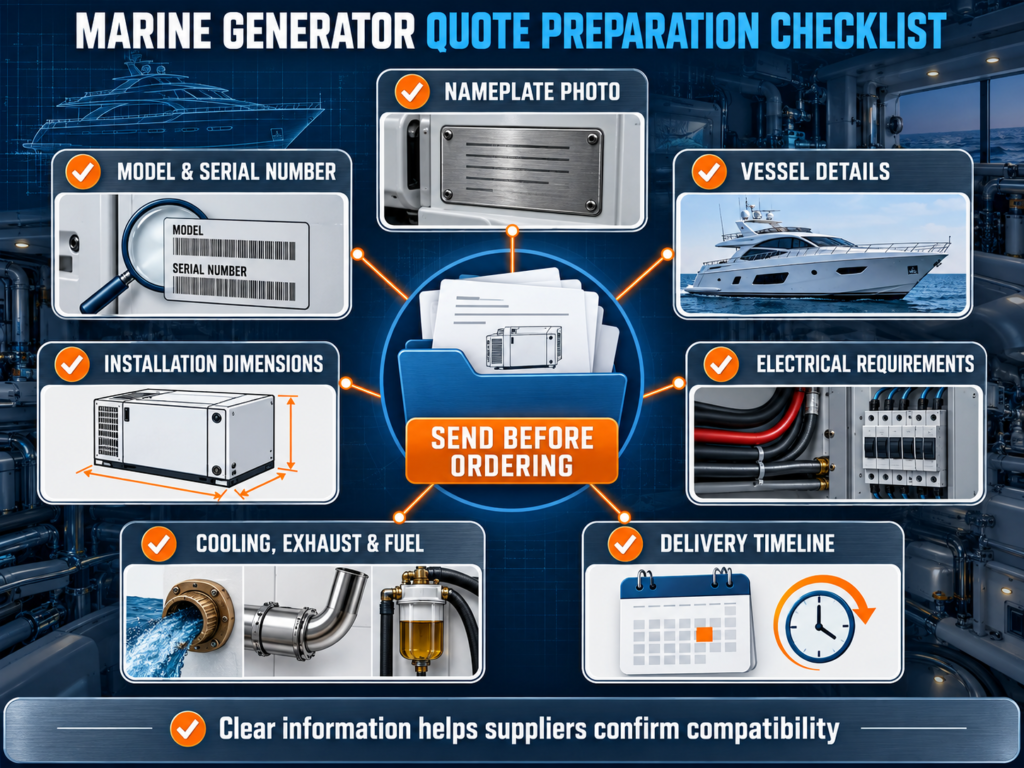
Before requesting a quotation from Generator Plus or another supplier, prepare the following:
Vessel make and model
Vessel length and type
Operating location
Existing generator brand
Exact model number
Serial number
Nameplate photograph
Rated kW or kVA
Voltage
Frequency
Phase
Starting-battery voltage
Generator dimensions
Mounting-footprint dimensions
Installation-space photographs
Access-route measurements
Cooling arrangement
Exhaust arrangement
Fuel arrangement
Control-panel photographs
Transfer-switch information
Main electrical loads
Required delivery location
Target purchase date
Required installation deadline
If you do not know a specification, say so. A clear statement such as “frequency unknown—please verify from the nameplate photograph” is better than an incorrect assumption.
Marine generator quote preparation checklist showing nameplate photo, model number, vessel details, dimensions and electrical requirements
Frequently Asked Questions
What is the best replacement marine generator?
The best option is the model that matches the vessel’s electrical requirements and installation conditions while offering dependable parts and service support. There is no universal best brand or kW rating for every boat.
Can I replace my old generator with a larger one?
Possibly, but larger is not automatically better. The vessel’s load profile, starting demand, physical space, ventilation, cooling, exhaust, and electrical protection must all be reviewed.
Can I replace a marine generator with a different brand?
Yes, when the alternative matches the required electrical and mechanical specifications or the necessary modifications are included in the project scope.
Does the replacement need the same kW rating?
Not necessarily. The old rating is useful reference information, but the current vessel load and operating pattern should determine the new generator size.
Can I reuse the old sound shield?
Only if the manufacturer or responsible technician confirms that it is compatible with the exact replacement model. Airflow, clearance, mounting, access, and noise-control design may differ.
How long does a marine generator replacement take?
The timeframe depends on equipment availability, shipping, access, removal, installation modifications, yard scheduling, and commissioning. A close replacement may be completed faster than a full repower.
Is a portable generator a suitable replacement?
A portable generator should not automatically be treated as a substitute for a properly installed marine generator. Fuel, ventilation, exhaust, grounding, electrical connection, carbon-monoxide, and onboard safety requirements must be considered.
What should I send for a replacement quotation?
Send the vessel details, generator nameplate photograph, model and serial number, electrical specifications, installation measurements, photographs, current load requirements, delivery destination, and required timeframe.
Conclusion: Choose the Generator That Fits the Vessel
Replacing an old or discontinued genset is not simply a matter of finding another generator with the same kW rating.
A successful marine genset replacement begins with accurate identification, a realistic electrical-load review, and a complete compatibility assessment. You must compare voltage, frequency, phase, dimensions, mounting, cooling, exhaust, fuel, controls, access, parts support, warranty, and total installed cost.
The strongest replacement decision is the one that is technically confirmed before the equipment is ordered.
If your generator is ageing, unreliable, discontinued, or no longer practical to repair, Generator Plus can help you compare suitable marine generator options. Send the existing generator’s nameplate photograph, model, serial number, electrical details, installation photographs, vessel information, and required delivery timeframe.
Generator Plus can then help review the available boat generator replacement and repower options for your vessel, including current models from established marine-generator manufacturers.